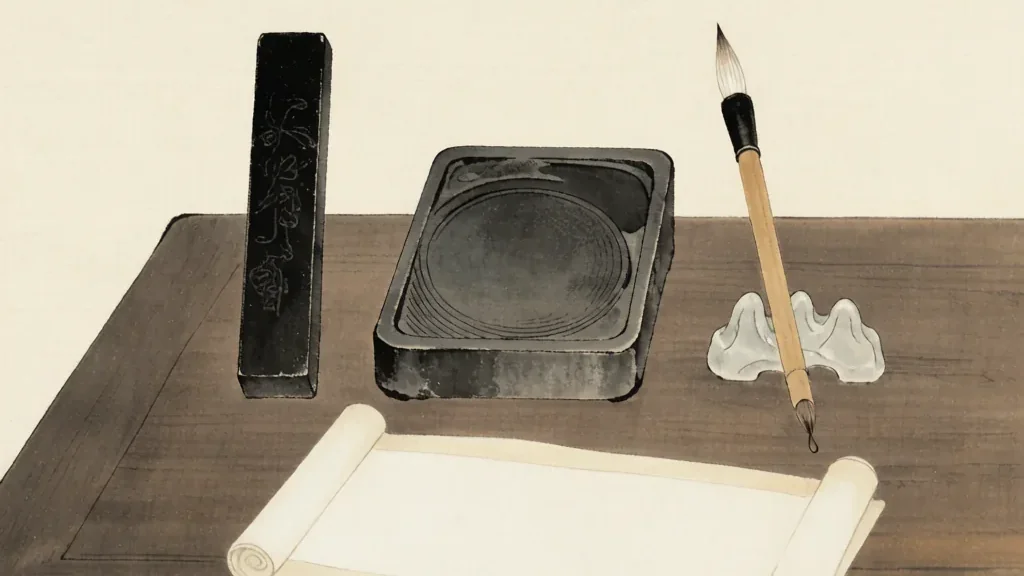
In every traditional Chinese scholar's study, four objects occupied places of honor on the desk. They were not merely tools but treasures — the wenfang sibao, or "Four Treasures of the Study." The brush, the ink stick, the paper, and the inkstone were the instruments through which Chinese civilization recorded its history, expressed its philosophy, and created its most sublime art. For over two thousand years, these four objects defined the practice of writing and painting in China, and the finest examples were prized as works of art in their own right, collected and treasured by emperors and scholars alike.
The Four Treasures are more than historical artifacts. They embody a philosophy of writing and art that is distinctly Chinese — a belief that the quality of the tools shapes the quality of the work, that the preparation of materials is itself a meditative practice, and that the act of writing is a holistic engagement of mind, body, and spirit. To understand the Four Treasures is to understand how the Chinese approached the most fundamental of civilized activities: putting thought into visible form.
The Brush: An Extension of the Self
The Chinese writing brush — bi — is unlike any other writing instrument in the world. Its soft, flexible tip, made of animal hair, can produce lines of extraordinary variation: from hair-thin strokes to broad, sweeping bands of ink, from delicate dots to bold, assertive characters. The brush does not merely record words; it expresses the movement, energy, and emotion of the writer. In the hands of a master, the brush becomes an extension of the body, translating the subtlest impulses of the wrist and fingers into visible form.
The history of the brush stretches back to the Neolithic period, when the earliest examples — simple arrangements of hair or feathers bound to sticks — were used to apply pigment to pottery. Legend credits the invention of the proper writing brush to Meng Tian, a general of the Qin Dynasty who unified China under the First Emperor. According to the story, Meng Tian observed rabbit hair clinging to a stick and realized it could be fashioned into a writing tool. While this legend is almost certainly apocryphal, archaeological discoveries have confirmed that brushes of sophisticated design were in use by the Warring States period, centuries before Meng Tian.
The finest brushes came to be associated with specific regions and traditions. The Hu brush, from Huzhou in Zhejiang Province, was celebrated for its quality and became the standard against which all other brushes were measured. Hu brushes were made from a carefully selected combination of hairs — goat hair for softness and ink-holding capacity, weasel hair for resilience and spring, and sometimes rabbit or deer hair for special effects. The making of a fine brush involved over seventy separate steps, each requiring skill and judgment passed down through generations of craftspeople.
The choice of brush was a deeply personal matter for Chinese calligraphers and painters. Different brushes produced different effects, and a master would own dozens of brushes, each suited to a particular purpose. The relationship between the artist and the brush was intimate — a good brush, properly cared for, could last for decades, becoming a trusted companion in the creative process. When a beloved brush finally wore out, it was sometimes given a ceremonial burial, honored for its years of service.
The Ink: Black Gold of the Scholar
The second treasure, ink — mo — was not a liquid but a solid stick, made from soot mixed with animal glue and compressed into molds. To produce ink, the scholar would grind the ink stick against the surface of the inkstone with a small amount of water, a process that could take many minutes and that served as a meditative preparation for the act of writing. The slow, rhythmic grinding of the ink was a time for the scholar to clear the mind, focus the intention, and enter the proper state of concentration.
The best Chinese ink was made from the soot of burned pine wood or, for the finest grades, from lampblack produced by burning tung oil or other vegetable oils. The soot was collected, mixed with glue made from animal hides, and kneaded into a paste that was then pressed into wooden molds and left to dry — a process that could take months or even years. The resulting ink stick was a solid block that could be stored indefinitely and that, when ground with water, produced a rich, black liquid of extraordinary depth and permanence.
Hui ink, from the Huizhou region of Anhui Province, was considered the finest in China. Its reputation was established during the Tang Dynasty and reached its zenith during the Ming and Qing. Hui ink sticks were often works of art in themselves, molded with intricate designs and sometimes gilded or painted. Collectors prized antique Hui ink sticks for their superior quality — properly aged ink was believed to produce smoother, more lustrous strokes than newly made ink.
The permanence of Chinese ink is legendary. Documents written with high-quality ink over a thousand years ago remain perfectly legible today. The carbon particles in the ink bond with the fibers of the paper, creating a mark that is resistant to water, light, and time. This permanence was not merely practical — it carried philosophical significance. The written word, like the virtuous deeds of a worthy person, was meant to endure. The ink that preserved the words of Confucius and the poems of Li Bai was a medium of immortality.
The Paper: A Canvas for the Mind
Paper — zhi — was invented in China during the Han Dynasty, traditionally credited to the court official Cai Lun in 105 CE. Before paper, Chinese writing was done on bamboo strips, wooden tablets, and silk — materials that were either cumbersome or expensive. The invention of paper revolutionized Chinese civilization, making writing more accessible and enabling the spread of literacy, literature, and bureaucratic administration.
The finest paper for calligraphy and painting was Xuan paper, named for its place of origin in Xuancheng, Anhui Province. Xuan paper was made from the bark of the blue sandalwood tree and rice straw, processed through a complex series of steps that could take up to two years from harvest to finished product. The resulting paper was extraordinarily absorbent, allowing ink to penetrate deeply into its fibers and creating the characteristic blurred edges and subtle tonal variations that are essential to Chinese calligraphy and ink painting.
Xuan paper was prized for its durability as well as its beauty. Properly made and stored, Xuan paper could last for over a thousand years without yellowing or becoming brittle — hence the Chinese saying that "paper has a life of a thousand years." The paper's longevity was crucial for the preservation of documents and artworks, and the finest Xuan paper was reserved for imperial archives and the most important works of art.
Different types of Xuan paper were suited to different purposes. Shengxuan, or "raw" Xuan paper, was highly absorbent and ideal for freehand calligraphy and expressive ink painting. Shuxuan, or "ripe" Xuan paper, was treated with alum to reduce absorbency, making it suitable for detailed brushwork and fine-line painting. The choice of paper was as important as the choice of brush or ink, and experienced calligraphers and painters developed preferences for specific types and brands of paper.
The Inkstone: The Scholar's Foundation
The fourth treasure, the inkstone — yan — was the platform on which the solid ink stick was ground into liquid ink. A good inkstone was essential for producing fine ink: the stone needed to be hard enough to grind the ink efficiently but smooth enough not to damage the ink stick, and it needed to have the right surface texture to produce ink of the proper consistency. The inkstone was the foundation of the scholar's practice, the stable ground on which the act of writing began.
The most celebrated inkstones came from Duanzhou in Guangdong Province — the Duan inkstone — and from Shezhou in Anhui Province — the She inkstone. Duan inkstones were made from a particular type of volcanic rock found in the Duanxi River, prized for its fine, dense texture and its ability to produce smooth, consistent ink. The best Duan stones had natural markings — "stone eyes" and other patterns — that were valued by connoisseurs and that made each inkstone unique.
Inkstones were not merely functional objects. They were works of art, often intricately carved with landscapes, calligraphy, and symbolic motifs. A fine inkstone could take a skilled carver months or even years to complete, and the best examples were treasured by collectors for generations. Emperors commissioned inkstones from the finest materials and the most skilled carvers, and a magnificent inkstone was considered an appropriate gift for the most honored occasions.
The inkstone also carried philosophical meaning. Its solidity and permanence represented the stability of the scholarly life. The slow grinding of ink on stone was a metaphor for the patient cultivation of knowledge and character. And the inkstone's role as the container for the water and ink — the fluid elements that would become the written word — made it a symbol of potential, the vessel from which culture and civilization flowed.
The Four Treasures as a Cultural System
The Four Treasures were not merely four separate tools. They were an integrated system in which each element depended on the others. The brush was useless without ink; the ink could not be prepared without the inkstone; the inkstone required water; and all three required paper to receive the marks they produced. The four treasures worked together in a harmony that mirrored the broader Chinese ideal of balance and mutual dependence.
The preparation and use of the Four Treasures was a ritual that structured the scholar's day. The grinding of the ink, the moistening of the brush, the careful placement of the paper — these actions created a transition from the ordinary world to the focused space of writing and art. In a culture that valued ritual as a means of cultivating character, the simple act of preparing to write was itself a form of self-cultivation.
The Four Treasures also represented the integration of natural materials and human craftsmanship. The brush came from animals, the ink from pine trees or oil, the paper from tree bark and rice straw, the inkstone from the earth itself. Each treasure was a collaboration between nature and human skill, a transformation of raw materials into instruments of culture. This integration of the natural and the cultural was a fundamental principle of Chinese aesthetics, reflected in everything from garden design to poetry.
The Four Treasures Today
In the age of keyboards and touchscreens, the Four Treasures might seem like relics of a bygone era. Yet they continue to hold a place of honor in Chinese culture. Calligraphy remains a respected art form, practiced by millions of people who find in the brush and ink a connection to tradition and a respite from the digital world. The finest brushes, ink sticks, papers, and inkstones are still produced by traditional methods, and a new generation of enthusiasts has discovered the pleasures of working with these ancient tools.
The Four Treasures have also found new meanings in the modern world. They appear in corporate logos and brand identities, symbolizing Chinese cultural heritage and the values of craftsmanship and refinement. They are given as gifts to mark important occasions, carrying wishes for wisdom, creativity, and success. And they continue to inspire artists who work in traditional media, keeping alive techniques and traditions that have been passed down through centuries.
In the end, the Four Treasures of the Study are more than tools for writing. They are symbols of a civilization's deepest values: the patient cultivation of skill, the integration of mind and body, the transformation of natural materials into expressions of human spirit, and the belief that the way we write shapes not only what we say but who we become.
Auxiliary Scholar's Tools
Around the Four Treasures sat a supporting cast of desk objects. The water dropper, or shui yu, released just enough water to grind ink without flooding the stone. The brush rest held a wet brush clear of the paper, and the paperweight, or zhen zhi, kept a scroll from curling as the hand moved. A seal and its red paste stamped the finished work, while a small incense holder scented the study. Each item was often itself a work of craft in porcelain, jade, bronze, or lacquer, so the scholar's desk became a miniature collection. These helpers show that writing was not a bare act but a settled environment in which every object had its place and its quiet etiquette.
The Four Treasures as Metaphor
Because the brush and ink were daily companions of the educated, they migrated into speech as metaphors for character and conduct. A person of steady principle was said to have a settled brush, while a hasty writer stood for a reckless mind, and the phrase a few strokes of the brush could mean the brief exercise of power. Poets described their pens as dragons and their ink as clouds, and paintings of a single brush in a vase became a symbol of the retired scholar's life. The tools thus stood for the learned life itself, so that to honor the Four Treasures was, indirectly, to honor cultivation, restraint, and the written word as the truest record of a person.
❓ Frequently Asked Questions
📝 Chinese Vocabulary
- 文房四宝 (wénfáng sìbǎo) — The Four Treasures of the Study: brush, ink, paper, and inkstone
- 笔 (bǐ) — Brush; the writing instrument made of animal hair
- 墨 (mò) — Ink; the solid ink stick ground on the inkstone
- 纸 (zhǐ) — Paper; invented in China during the Han Dynasty
- 砚 (yàn) — Inkstone; the stone platform for grinding ink
🎉 Fun Facts
- The finest Hu brushes can contain hairs from up to seven different animals, carefully blended to achieve the perfect balance of softness, spring, and ink-holding capacity.
- High-quality Chinese ink sticks were sometimes aged for decades before use — the longer the aging, the smoother and more lustrous the ink was believed to become.
- The most valuable Duan inkstones feature natural "stone eyes" — circular mineral formations that appear like eyes in the stone — and a single exceptional inkstone can sell for hundreds of thousands of dollars today.
- A worn-out favorite brush was sometimes given a small ceremonial burial by its owner, a sign of how personally a calligrapher could bond with a tool.
- The water dropper and brush rest were considered so essential that connoisseurs collected them as art, with imperial kilns producing porcelain versions.
- In the Qing court, complete scholar's desk sets in matched materials were presented as prestigious gifts to loyal officials.