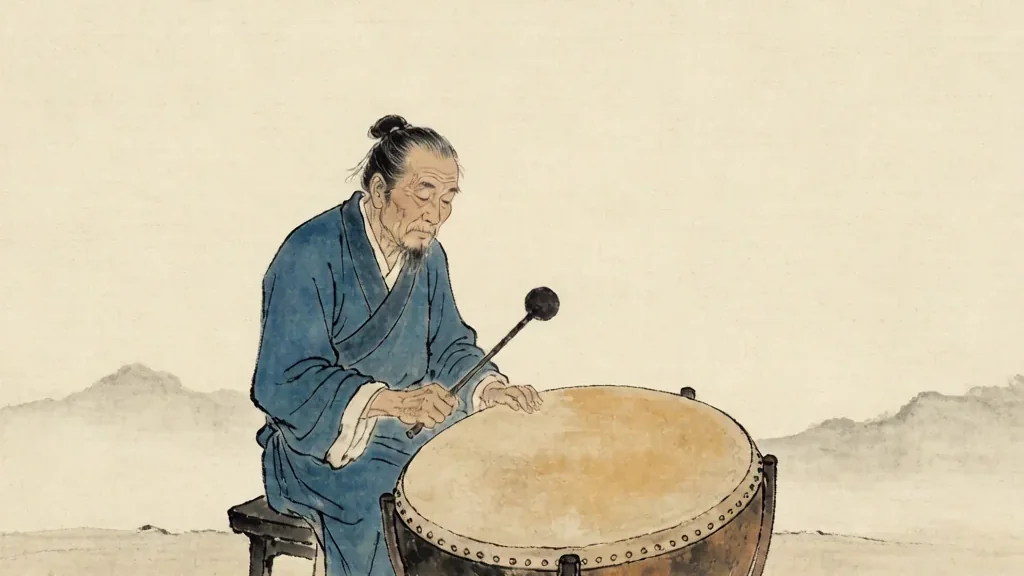
Luogu, written in Chinese as luó gǔ and translated literally as gongs and drums, refers to the loud, rhythmic percussion ensembles that accompany festivals, operas, wedding processions, and folk performances across China. More than a kind of music, luogu is the sonic backbone of communal celebration, a shared vocabulary of beats that signals joy, summons crowds, marks the turning of a dance, and drives performers forward through a parade. From village courtyards to grand opera houses, the driving pulse of gongs and drums has carried Chinese festive life for many centuries, and the tradition remains one of the most widespread and recognizable sounds in Chinese cultural expression, equally at home in a rural temple fair and a televised national gala.
What Luogu Means
The word pairs luó, meaning gong, with gǔ, meaning drum, the two core instruments whose contrast defines the entire sound. The deep roll of the drum against the bright clang of the gong creates a texture that is at once grounding and brilliant, and although ensembles may add cymbals, bells, wooden clappers, and horns, the gong-and-drum pairing gives the tradition its name and its identity.
Luogu is primarily rhythmic rather than melodic. Players communicate through patterns, accents, and cues rather than through tunes, and most repertoire is learned by ear and passed from master to apprentice within a village or troupe. This oral transmission means that a given pattern can vary subtly from place to place, carrying the local accent of a community in the same way a dialect carries its speech.
Because it relies on rhythm rather than notation, luogu is unusually open to participation. A newcomer can join a parade by following the drummer's lead, and an audience can feel the structure of a performance without needing to read music, which is a large part of why the tradition has remained so broadly popular across social classes.
The Drum at the Heart
The drum is the heart of any luogu ensemble, setting the tempo, the dynamics, and the emotional contour of the music. Large suspended drums mark grand processions and open-air gatherings, while smaller hand drums accompany opera and dance in tighter spaces. The lead drummer is effectively the conductor, signaling changes in speed and volume with rolls, accents, and shifts of pattern that the other players watch and echo.
In many troupes the relationship between drum and gong is almost conversational. A rolling drum may pose a question, a struck gong may answer it, and the two instruments trade phrases the way singers might trade lines in a call-and-response song. The physical power of the drum means it is felt as much as heard, especially in open settings where the low frequencies travel through the body as well as the ear.
The making of the drums themselves is a respected craft. Drum bodies are built from carefully selected wood and heads are stretched from animal hide, and the tone of a troupe's principal drum is a source of local pride, tuned and maintained so that it cuts cleanly through the surrounding noise of a festival street.
The Gong and Its Shimmer
The gong provides the shimmering, sustained tone that carries above a crowd and gives luogu its festive brilliance. Chinese gongs vary widely in size and timbre, from small sharp discs that snap like a clap to large booming bowls that sustain a long, shivering resonance. Struck at the rim or the center, the gong punctuates phrases and crowns climaxes with a wash of metallic sound.
Cymbals often join the gong to add further brilliance and edge, and together they create the bright, celebratory shimmer most people associate with Chinese New Year and temple fairs. The contrast between the drum's earthy thud and the gong's ringing decay is the essential drama of the music, a tension that keeps even simple patterns feeling alive.
Skilled gong players control not only when they strike but how, using the hand to damp or release the metal so that a note may either explode and fade or hang in the air. This subtle technique is part of what distinguishes a master ensemble from a merely loud one, and it is learned through long apprenticeship rather than written instruction.
Role in Festival Life
No major Chinese celebration feels complete without luogu. At Spring Festival, teams of players parade through streets and alleys, waking neighborhoods and announcing the arrival of the new year. At temple fairs the music marks the start of each act and keeps the crowd moving between performances, and its volume and energy are meant to dispel gloom and invite prosperity into the community.
In rural life the sound also carried practical messages across distances. The same instruments that celebrated a wedding could announce a funeral or call a community meeting, and a particular rhythm told listeners what kind of event was approaching before they could see it. The beat was, in effect, a kind of village broadcast, a shared signal system as useful as it was festive.
Because the music is so strongly tied to collective events, playing it is rarely a solitary act. A luogu ensemble is a social unit, rehearsed and performed as a group, and the act of playing together reinforces the bonds of the village or neighborhood that sponsors it, turning sound into solidarity.
Luogu in Opera and Dance
Traditional Chinese operas of every kind rely on a percussion section to cue entrances, fights, exits, and changes of emotion. The martial percussion of gongs and drums shapes the pacing of each scene, telling actors when to strike a pose, when to rush, and when to fall, so that the music is not decoration but choreography made audible. Without the drum and gong, the stylized movement of opera would lose its precise timing.
Folk dances such as yangge, and the lion and dragon dances, are unthinkable without luogu driving the steps. Dancers time their leaps, turns, and pauses to the lead drummer's pattern, making the musician a silent choreographer who directs the body of the performance from behind the drums. The closer the partnership between dancer and drummer, the more thrilling the spectacle becomes.
The interdependence of music and movement means that a great luogu player is also a student of dance and drama. The best drummers know the stories being acted and the steps being danced, so that their patterns rise and fall with the narrative, a skill that blurs the line between musician and director in the traditional performing arts.
Notable Regional Styles
Northern provinces such as Shaanxi and Shanxi are famed for powerful, athletic drumming, of which the hip-slung waist drum dance of Ansai is perhaps the best-known example, with dancers beating drums slung at the waist as they leap and spin. This vigorous style is a hallmark of northwest folk culture and projects strength, stamina, and communal energy across open fields and squares.
In the south, places such as Chaozhou cultivate refined gong-and-drum suites built on fixed compositions with named sections and intricate internal structures. These contrast the north's raw physical energy with a more orchestral sensibility, in which the gongs and drums are arranged like instruments in a chamber ensemble rather than deployed as pure rhythm.
Between these extremes lie countless local styles, each with its own signature patterns, preferred instruments, and occasions. The diversity of regional luogu is a reminder that Chinese folk music, far from being uniform, is a mosaic of local traditions, each shaped by the geography, dialect, and temperament of the people who keep it.
The Language of Signals
Experienced listeners learn to read luogu almost like speech. Different patterns announce arrivals, victories, comic moments, or processions, and a slow toll may mark sorrow at a funeral while a rapid roll signals excitement or urgency. The same instruments thus serve both joy and grief, their meaning changing with the pattern rather than the sound itself.
This coded vocabulary allowed a community to understand an event before seeing it. The beat told you whether to laugh, gather, mourn, or flee, and skilled players could improvise variations that communicated specific local messages known to everyone in the audience. In this sense luogu functioned as a public language written in rhythm rather than words.
The dual capacity of the ensemble to celebrate and to mourn also expresses a broader Chinese attitude toward ceremony, in which the same means serve the great transitions of life. A family might hear the very drums of a wedding reused, with different patterns, at a funeral, binding joy and loss into a single continuous musical tradition.
Learning and Transmission
Luogu is learned largely by imitation within troupes, families, and temple communities. A village ensemble might rehearse through the winter for a single major festival, and the close, repeated listening required to master a pattern builds both skill and loyalty among the players. Competition between teams spurs higher standards and deep local pride.
In earlier times the knowledge was almost entirely oral, with masters demonstrating patterns hand to hand and ear to ear. Today music schools, cultural centers, and intangible-heritage programs document patterns that were once purely remembered, recording performances so that regional styles facing rural depopulation can be preserved and taught to younger generations.
Even with notation and recording, the living heart of transmission remains the teacher-student relationship. The subtle feel of a roll, the exact moment of a gong hit, and the unspoken timing between players are things that notation captures only imperfectly, which is why the tradition still depends on human masters willing to pass it on.
Modern Stage and Heritage
In recent decades luogu has moved into concert halls and television galas, often staged as mass spectacle with dozens or even hundreds of drums arranged in sweeping formations. Such performances showcase the tradition's energy to audiences far from its village origins, while loosening its strict ritual ties and turning it into a kind of national pageantry.
As an officially recognized form of folk art, luogu enjoys support as intangible cultural heritage at both regional and national levels. This status brings funding, teaching positions, and performance opportunities that help ensure the ancient pulse of gongs and drums keeps sounding in modern China even as the rural contexts that birthed it change.
The challenge of the modern stage is to keep the music's communal soul while presenting it to spectators rather than participants. The most successful troupes manage to invite the audience's body into the rhythm even from seats, proving that luogu's essential invitation to join the beat survives translation into new settings.
❓ Frequently Asked Questions
What is luogu?
Luogu means gongs and drums and refers to Chinese percussion ensembles that accompany festivals, opera, processions, and folk dance across the country.
Is luogu melodic music?
It is primarily rhythmic; players communicate through beat patterns and cues rather than through tunes or melodies.
Where is it used?
It appears at Spring Festival parades, temple fairs, Chinese operas, lion and dragon dances, and many folk performances.
What are famous regional styles?
Shaanxi's waist-drum dance and Chaozhou's refined gong-drum suites are two well-known and contrasting examples.
Who leads the ensemble?
The lead drummer conducts, signaling changes in tempo and dynamics that the other players watch and follow.
Is it still performed today?
Yes; it thrives at festivals and on stage, and it is recognized as intangible cultural heritage in many regions.