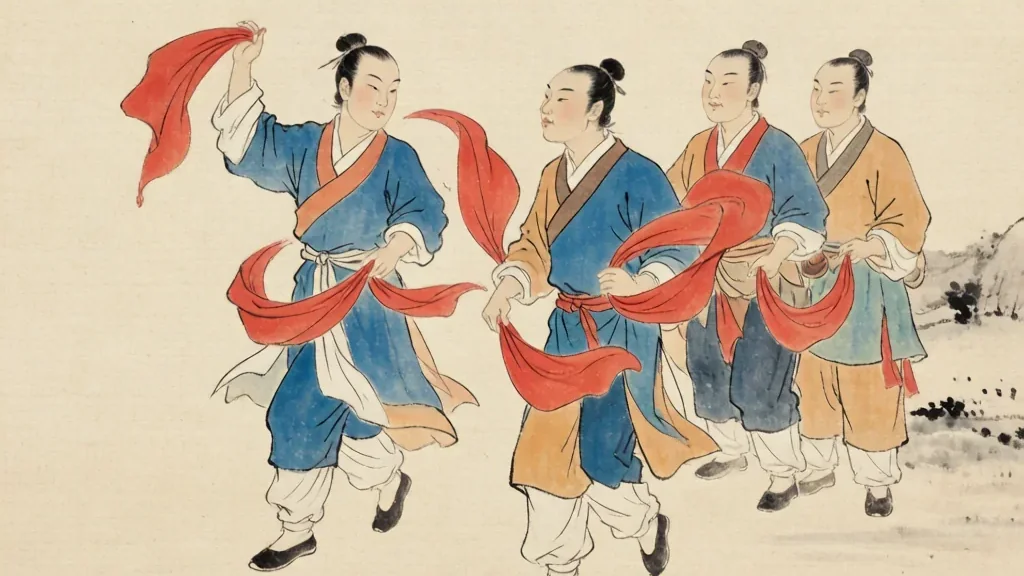
Yangge is a vibrant form of Chinese folk dance and song performed in northern villages and towns, especially during the Spring Festival. Characterized by swinging hips, flowing arm movements, and rhythmic steps to the beat of gongs, drums, and cymbals, yangge is both a dance and a communal street celebration. Rooted in the agricultural life of the north China plains, it remains one of the most widespread and beloved participatory folk arts in China, a form that anyone can join and that whole communities rehearse through the winter so that the streets fill with color and motion at the turning of the year.
What Is Yangge
The name combines yāng, meaning rice seedling, with gē, meaning song, pointing to its origin among farmers who sang while transplanting rice seedlings in the flooded fields. Over time those work songs grew into a dance form performed for entertainment and festival, and the agricultural root stayed embedded in the very word for the dance.
Today yangge describes both a dance and the troupes that perform it. Participants wear bright costumes and often cross-dress or caricature stock characters, blending dance with light comedy so that a performance is as much theater as movement, a traveling show put on by the neighborhood for the neighborhood.
The dual nature of yangge, song and dance, work and play, means it sits comfortably between labor and leisure. It began in the fields and ended in the festival square, carrying the rhythm of planting into the rhythm of celebration.
Agricultural Origins
Scholars link yangge to the songs sung during the labor of planting and harvesting across the north China plains. The bending and swaying of field work became stylized into performance, and the call-and-response of workers became the comic dialogue of the dance, so that the form remembers its working past in every step.
As rural society ritualized its calendar, these songs moved from the fields to festival squares and market days. The dance became a way for communities to celebrate the fruits of their labor together, transforming exhaustion into expression and turning the crowd of laborers into a chorus of performers.
This origin also explains the dance's earthiness. Unlike court dances built on restraint, yangge is grounded, cheerful, and physical, a body art made by people whose bodies knew fieldwork, and that frank physicality is a large part of its enduring charm.
Core Movements
Yangge is built on a walking step with a pronounced sway. The body tilts side to side, arms swing in opposing arcs, and the waist drives the motion, so that the whole upper body traces a continuous, flowing wave. The effect is cheerful and earthy rather than formal or austere.
Dancers often hold fans, silk ribbons, or handkerchiefs that amplify the arm sweeps, and the props turn simple steps into flowing, decorative patterns as the line winds through the street. The fan snaps open and shut, the ribbon draws loops in the air, and the handkerchief flicks like a small flag of joy.
The step looks easy precisely because it is built on a natural gait. This accessibility is deliberate, for yangge is meant to be joined, not merely watched, and the simple swaying walk is the open door through which a beginner enters the dance.
Accompaniment
Yangge is driven by luogu percussion, gongs, drums, and cymbals, that set its bouncing tempo, and a small band may add suona horns for a piercing, festive melody. The music tells dancers when to turn, quicken, or pause, functioning as an invisible choreographer walking with the troupe.
Because the beat is so strong, even beginners can join by following the drummer, and the openness of the form is key to its identity as a participatory rather than spectator art. The crowd and the performers share the same pulse, which is why a yangge line can swell from a dozen to a hundred without losing cohesion.
The suona in particular gives yangge its unmistakable voice, a bright, slightly nasal horn that cuts through wind and crowd and signals celebration from afar. Where the suona sounds, a troupe is near, and neighbors step out to join or watch.
Types of Yangge
Regional styles abound. Ground yangge is performed on flat ground by walking troupes, while stilt yangge has dancers on wooden stilts, adding height, comedy, and a measure of risk to the performance. Some areas feature sedan yangge with mock weddings or other comic processions built into the dance.
Northeastern yangge is exuberant and acrobatic, with big leaps and bold comedy, while northern Shaanxi styles are more restrained and rhythmic, emphasizing the sway over the stomp. Each locality prizes its own flavor, and the differences fuel friendly rivalry between troupes from neighboring towns.
This variety means there is no single correct yangge, only many living versions, each tuned to its place. The form's genius is that it absorbs local taste without breaking, so that a dancer from one county can join a line in another and still feel at home.
Characters and Costume
Performers adopt familiar roles. The clown jokes with the crowd, the old man and old woman mime domestic life, and beautiful maidens lead the line with flirtatious grace. Cross-dressing is common and playfully accepted, and the mixing of genders and ages keeps the performance warm and comic.
Costumes are saturated reds, greens, and yellows, with headpieces and painted faces for comic roles. The visual loudness matches the music and the season's mood of abundance, so that a yangge troupe reads as a moving patch of festival color against the winter street.
The characters are not random but drawn from opera and village life, generals, wenches, scholars, and fools, so that the dance also tells tiny stories as it moves. A troupe is thus a rolling cast of familiar types, recognizable to every spectator without a word being spoken.
Role in Spring Festival
Yangge troupes are a centerpiece of Lunar New Year celebrations in the north. They parade through neighborhoods, pause at doorways to bring luck, and gather in squares for contests of skill and stamina. Inviting a troupe to perform at a gate is said to bring the household prosperity for the year.
The dance also appears at temple fairs and harvest thanksgivings, and its timing with the new year makes it a symbol of renewal and collective joy. To dance yangge at the year's turn is to push the old year out and the new one in with the body itself.
The doorway pauses are especially meaningful. By performing at each gate, the troupe carries blessing from house to house, and the small gifts exchanged bind the performers and the residents into a single festive community for the duration of the holiday.
Social and Community Function
Yangge is fundamentally social. Whole villages join regardless of age, and rehearsing through the winter builds bonds across families that the ordinary year很少 loosens. In the past it was one of the few occasions for open mixed gathering and for young people to meet and court under the cover of public play.
Today it serves public health too, as retirees in city parks practice yangge-style exercise for fitness, turning the festival dance into a daily routine of movement and friendship. The dance has thus migrated from field to festival to daily life without losing its communal heart.
That continuity of function, celebration, exercise, courtship, and belonging, is why yangge has outlasted many more elaborate arts. It meets basic human needs for movement and togetherness, and it asks almost nothing of those who join.
Modern Revival
After periods of decline, yangge has been revitalized as intangible cultural heritage. Community centers teach children the steps, and television galas feature spectacular mass performances in which hundreds dance as one. The form has found new stages without losing its street soul.
Its blend of exercise, memory, and fun ensures survival. Far from a museum piece, yangge still fills northern streets with color every spring, and its simple invitation to sway along remains as open as it was when farmers sang between the rice rows.
❓ Frequently Asked Questions
What is yangge?
Yangge is a northern Chinese folk dance and song featuring swaying steps, fans or ribbons, and gongs-and-drums accompaniment, performed at festivals.
Where did it come from?
It grew from rice-field work songs sung by farmers during planting and harvesting in the north China plains.
What styles exist?
Common forms include ground yangge by walking troupes and stilt yangge on wooden stilts, with many local variations.
When is it performed?
Mainly during the Spring Festival and temple fairs, when troupes parade through neighborhoods bringing good fortune.
Is it participatory?
Yes; its strong beat lets anyone join, and whole communities rehearse and perform together.
Is yangge still alive?
Yes; it is intangible cultural heritage, taught to children and practiced by retirees as fitness across northern China.