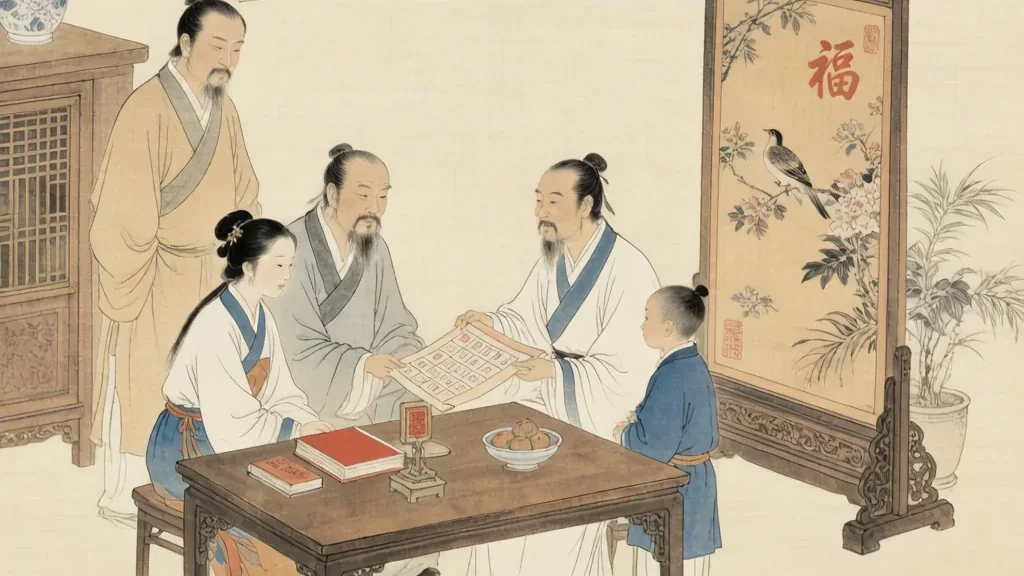
Choosing an auspicious day, known in Chinese as zé rì (择日), is the traditional practice of selecting a favorable date and time for important activities such as weddings, moving house, starting construction, or opening a business. Grounded in the Chinese calendrical system and the interplay of cosmic forces, date selection reflects a deep cultural belief that human affairs prosper when aligned with the rhythms of heaven and earth. It remains widely consulted in both rural and urban China today.
What Is Date Selection
Date selection is the art of matching a planned activity to a day whose cosmic qualities support success. Practitioners consult almanacs, the movements of heavenly stems and earthly branches, and the positions of zodiac animals to avoid clash and seek harmony. The underlying idea is that time is not uniform but charged with varying energies.
Unlike fatalistic fortune telling, choosing a day is practical and optional. It assumes that while one cannot control destiny, one can improve the odds by acting at the right moment. This optimistic logic made the custom popular across all social classes.
Foundations in the Calendar
The Chinese calendar weaves together heavenly stems (天干) and earthly branches (地支) into sixty combinations, each carrying its own character. Every day is also assigned a zodiac animal and a set of "duty officers" (值神) believed to govern fortune. Almanacs list which activities are suitable or forbidden on a given day.
These systems descend from ancient astronomical and agricultural observation. The imperial Astronomical Bureau long held the duty of issuing the official calendar, which ordinary people used to plan both farming and family events.
The Huangli Almanac
The key tool is the huáng lì (黄历), or "imperial calendar," still printed and sold in vast numbers each year. It marks each day with labels such as "suitable for" (宜) and "unsuitable for" (忌), alongside lucky directions and conflicting zodiac signs. Families often keep one on the wall.
Modern digital versions have carried the tradition online, letting users check a date in seconds. Despite the new format, the content follows the same classical logic developed over millennia.
Weddings and Milestones
Marriage is the most common reason to consult a date master. A wedding day is chosen to avoid clashing with the bride's and groom's zodiac signs and to fall in a season of abundance. Families may compare several candidate days before deciding.
Other life milestones — birth celebrations, coming-of-age, and funerals — are likewise scheduled with care. Even the cutting of a child's first hair or the naming ceremony can be timed for luck.
Building and Moving
Construction and relocation are treated with special caution. The "breaking ground" day for a house must avoid offending the local earth deity, and the "entering the house" day (入宅) is picked to invite prosperity. The main-beam raising, a separate rite, has its own requirements.
Businesses choose opening days to attract wealth and customers. A shop that opens on a "clash" day is thought to face early difficulty, so owners often pay for professional advice.
The Role of the Date Master
Specialists known as zé rì shī or fortune-tellers offer tailored calculations, weighing the client's birth information against the candidate days. Their work blends almanac reading with the client's八字 (eight characters of birth time). A good master explains the reasoning rather than simply dictating.
In villages the date master was often a respected elder; in cities today the role is filled by professionals operating from shops or online platforms. The social function — reassurance and shared tradition — remains constant.
Astrology and the Zodiac
The twelve zodiac animals form the popular face of date selection. Each year, month, and day carries an animal, and clashes between animals (for instance, Rat and Horse) are avoided for key events. People also note their own sign when planning.
This zodiac logic is easy to grasp and accounts for much of the custom's endurance. Even those skeptical of deeper metaphysics may glance at zodiac compatibility out of habit or fondness for tradition.
Modern Practice and Skepticism
Today date selection coexists with modern planning. Couples may book a venue first, then adjust the ceremony to the nearest auspicious day. Many see it as cultural comfort rather than strict obligation, a way to honor parents and ancestors.
Critics dismiss it as superstition, yet the practice shows no sign of vanishing. Its persistence illustrates how Chinese culture balances pragmatic modernity with reverence for cosmic order.
Relation to Other Arts
Date selection overlaps with feng shui, fortune telling, and divination. All share the premise that the cosmos is patterned and knowable. A household might consult the same master for a building's orientation, a wedding day, and a yearly forecast.
These arts together form a practical cosmology that helps people act with confidence in uncertain matters, from marriage to migration.
Seasonal Rhythms and the Solar Terms
Date selection does not operate in isolation from the agricultural year. It overlaps closely with the twenty four solar terms, the traditional calendar markers that guided planting, harvest, and seasonal festivals. Many auspicious days are chosen to align with these natural turning points, so that a wedding, a market opening, or a family rite falls in step with the rhythm of weather and growth. The logic is the same as almanac reading: act when heaven and earth are in a supportive phase.
In rural life especially, the choice of day was bound to practical timing as much as to symbolism. Sowing, threshing, and moving livestock were scheduled to favor both the crop and the cosmos, blending farmer's wisdom with calendrical custom. Even today, festivals and family gatherings tend to cluster on dates already charged with positive association, so that cultural habit and cosmic calculation reinforce one another. Date selection can therefore be seen as the personal, event by event expression of a larger traditional calendar that maps human plans onto the turning seasons, keeping daily decisions in tune with the older pulse of the year.
❓ Frequently Asked Questions
What does zé rì mean?
It means "choosing a day" — selecting an auspicious date and time for important activities based on the traditional calendar.
What is the huangli?
The huangli is the traditional almanac that lists each day's suitable and unsuitable activities, lucky directions, and zodiac clashes.
Which events use date selection?
Weddings, moving house, construction, business openings, funerals, and other major life or family events are commonly scheduled this way.
Is it the same as fortune telling?
It is related but distinct; date selection picks favorable times, while fortune telling reads a person's destiny from birth data.
Do people still do this today?
Yes, it remains common in both cities and villages, often as cultural reassurance rather than strict obligation.
What is a zodiac clash?
It is a hostile relation between two of the twelve animals; days clashing with one's sign are avoided for key events.