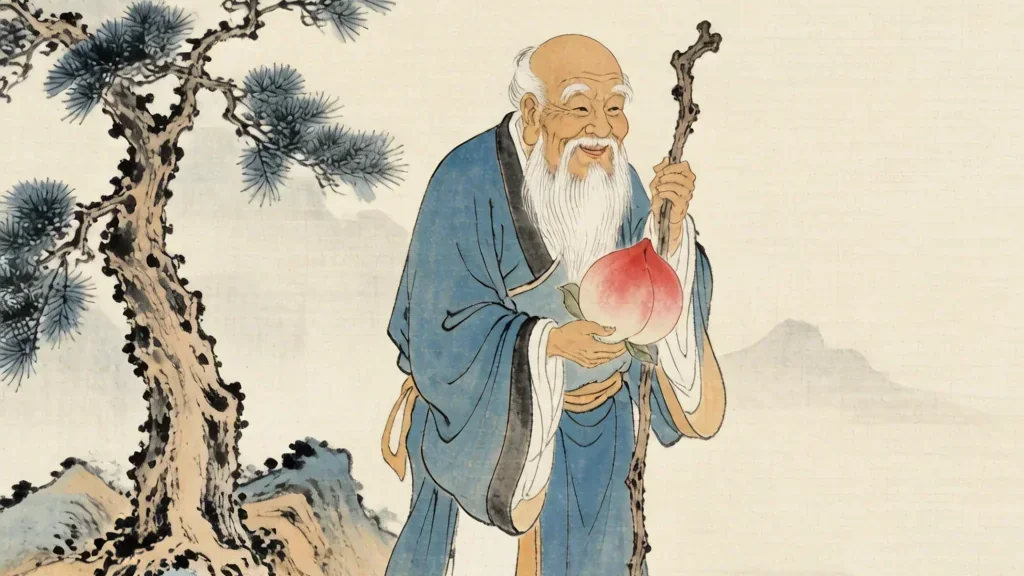
Shouxing (寿星), the "Star of Longevity," is the white-robed, bald-headed old immortal who personifies long life in Chinese culture. Usually shown with a towering, bulging forehead, a staff, and a peach of immortality, he is the most beloved of the Three Stars (三星)—Fortune, Prosperity, and Longevity—who together answer a family's three great wishes. To honor Shouxing is to honor the deep Chinese esteem for a long, healthy life, especially the survival and respect of the aged.
From Star to Deity
Like Wenchang and Kuixing, Shouxing began as a celestial body: the star Canopus (the "Old Man Star," 老人星) in the southern sky, associated in early astronomical lore with the lifespan and welfare of the people. Sky-watchers held that when the star shone brightly, the realm enjoyed peace and long-lived rulers; its dimming foretold trouble.
Over centuries this stellar portent was personified into the kindly old man of folk art, a god one could approach for a blessing of years.
The Three Stars
Shouxing is almost never alone. He forms the trio of Sanxing with Fuxing (福星), the Star of Fortune, and Luxing (禄星), the Star of Prosperity or official rank. Printed and carved together, the three smile and hold emblems of their gifts—fortune's scroll, prosperity's child or ruyi, and longevity's peach and staff.
This grouping compresses the Chinese definition of a good life into three figures: wealth, career success, and a long life to enjoy them.
Iconography of the Old Immortal
Shouxing's image is unmistakable. His most striking feature is an enormous, domed forehead, a sign in Chinese physiognomy of wisdom and longevity. He leans on a gnarled staff, often with a gourd or scroll hanging from it, and holds or stands beside a large peach, the fruit of immortality in Taoist myth.
He may be carried or accompanied by a crane and a deer, both traditional symbols of long life, weaving him into a whole vocabulary of age-blessing imagery.
The Peach and the Crane
The peach (蟠桃) comes from the legend of the Queen Mother of the West's orchard, whose fruits ripen only once in centuries and grant eternal life to those who eat them. The crane (鹤) is said to live a thousand years, and the deer (鹿) similarly signals longevity and gentle virtue.
These companions turn a single deity into a small ecology of symbols, so that any image of Shouxing reads as a wish for decades of healthy life.
Birthday Celebrations for the Elderly
Shouxing is most honored at the birthday celebrations of the old. At a senior's sixtieth, seventieth, or eightieth birthday, families display his image, serve longevity noodles (长寿面) that must not be broken, and present a "shou" (寿) character cake or peach-shaped buns. Guests offer the word "shou," meaning long life.
The "shou" character itself becomes décor—embroidered, painted, or written in a circle—transforming the celebration into a tribute to the star.
Longevity in Chinese Values
The reverence for Shouxing reflects a civilization that has long prized old age as the fruit of virtue and experience. Filial piety (孝) requires caring for parents into their later years, and a full lifespan was historically seen as a sign of a life well and rightly lived.
In this frame, longevity is not merely personal luck but a family achievement and a moral good.
Shouxing in Art and Daily Life
The Star of Longevity appears on wedding and birthday gifts, on New Year prints, and on the embroidery of celebratory robes. His figure is a staple of the "hundred boys" and "nine elders" motifs, always pointing back to the wish that the family line endure and its seniors thrive.
Because his meaning is so warm and uncontroversial, his image travels freely across religious boundaries, cherished by Buddhists, Taoists, and the non-devout alike.
Modern Resonance
In an aging society the symbol of Shouxing has if anything gained relevance. He remains a polite and common birthday motif, and health-and-longevity goods are often branded with his benign face. The ideal he embodies—a long life lived in the bosom of one's family—still anchors Chinese hopes for the life course.
He is, in the end, the gentlest of the popular gods: one who asks nothing and gives only years.
Shouxing and the Art of the Shou Character
No symbol of longevity is more versatile than the character shou (寿) itself, and Shouxing is its living emblem. The character is written, painted, embroidered, and carved in countless forms—straight, circular, or woven into the shape of the god and his crane—and displayed at birthdays and in the homes of the aged as a standing wish for years of life and health.
Artisans built whole genres around it: the "hundred shou" pattern arrays a hundred variations of the character in a single lattice, while birthday scrolls pair it with poems on the value of a long life. Because the character is both legible and decorative, it crosses the line between writing and image, much as Shouxing himself crosses the line between a distant star and a familiar, kindly person.
In daily speech, too, shou appears in blessings—"fu shou kang ning" (good fortune, long life, health, and peace) remains a standard greeting to elders. The star thus lives not only in temples but in the very vocabulary of courtesy, a constant, gentle reminder that to wish someone long life is to wish them well at the root, addressing the span of years in which all other good things must happen.
A Guest at Every Birthday
Because he grants the years themselves, Shouxing is the unseen guest at every Chinese birthday, especially those of the elderly. His image or the character shou is placed at the seat of honor, and the first cup of wine or tea is raised to him before the family begins its toasts. In this quiet way the god attends gatherings he never physically joins, his blessing assumed rather than pleaded for.
The custom reveals how deeply longevity is woven into the celebration of life. To grow old among one's descendants is, in the Chinese view, the fullest form of success, and Shouxing is the patron of exactly that fortune—proof that the star's light, though distant, falls on every household that honors its elders.
❓ Frequently Asked Questions
Who is Shouxing?
Shouxing is the Star of Longevity, the old immortal who personifies a long life, and one of the popular Three Stars.
What does he look like?
He is a white-robed elder with a huge domed forehead, a staff, and a peach of immortality, often with a crane or deer.
What are the Three Stars?
They are Fortune (Fuxing), Prosperity (Luxing), and Longevity (Shouxing), who together embody the good life.
How is he honored?
At elders' birthdays, families display his image, serve longevity noodles, and give peach-shaped buns and "shou" gifts.
Why the peach and crane?
Both are traditional symbols of immortality and long life in Taoist and folk imagery.
Is longevity especially valued in China?
Yes; long life is a moral and family good tied to filial piety, making Shouxing a central cultural figure.