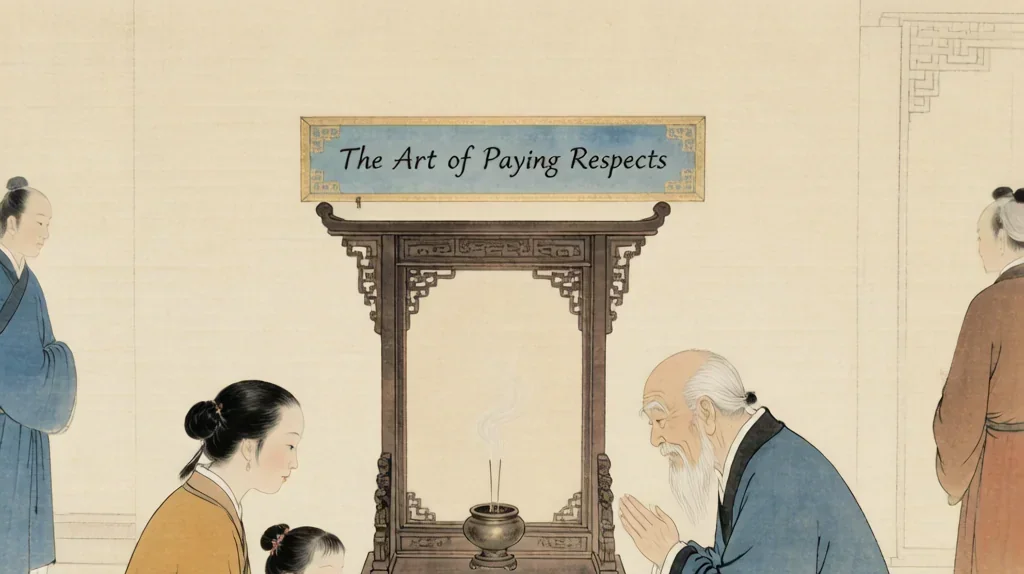
Every culture has its own way of ringing in the new year, but few traditions are as warm, structured, and socially rich as the Chinese custom of 拜年 (Bài Nián), literally "to pay respects for the new year." Taking place during the first days of the Lunar New Year, Bài Nián is the joyful ritual of visiting relatives, friends, and neighbors to offer good wishes for the months ahead. More than a simple courtesy, it is a living expression of Chinese values: the honoring of elders, the tightening of family bonds, and the public renewal of community goodwill. To understand Bài Nián is to understand how Chinese society weaves respect, affection, and hope into a single moving celebration that travels from door to door.
Origins and Ancient Roots
The practice of paying New Year visits is ancient, with roots stretching back more than two thousand years to the Han dynasty and maturing through the Tang and Song eras. In imperial times, court officials were required to present formal greetings to the emperor at the start of the year, a ceremony known as chaohe. This top-down etiquette gradually filtered into ordinary society, where families adopted the habit of calling on one another at the turn of the year. The core idea was seasonal renewal: just as heaven and earth were reborn with spring, human relationships needed to be refreshed through personal appearance and spoken blessing.
Over the centuries the custom acquired layers of meaning. A visit was never merely a social call; it was a moral act that affirmed one's place in the web of kinship and neighborhood. To skip an elder's home was a small breach of filial duty, while to be visited in turn was a quiet measure of one's standing. Folk sayings encouraged people to "go out on the second day" or "visit teachers early," reflecting an unspoken calendar of who should be seen and when.
The Order of Visits
Tradition prescribes a careful hierarchy of whom to see first. On the morning of the first day, families worship ancestors and greet the elders within their own household, offering them deep bows or the modern clasped-hand salute known as zuoyi. From the second day onward, married daughters return to their natal homes, and the circle widens to include grandparents, uncles, aunts, teachers, and close friends. The first visit of the year to one's parents-in-law carries particular weight and is often scheduled with care.
Neighborhood visiting once followed a friendly, open-door rhythm: doors were left ajar, sweets and melon seeds were set out, and callers drifted in and out throughout the day. In the countryside this could mean dozens of households in a single morning. The greeting itself is formulaic yet heartfelt, built around phrases like "gongxi facai" (wishing you wealth and prosperity) and "xinnian kuaile" (happy new year), spoken with a smile and often accompanied by the exchange of small gifts.
The Ritual of Greetings and Gifts
Speech is the heart of Bài Nián. Each relationship calls for its own fitting blessing: longevity for the aged, success in study for children, safe travels for those who work far away, and thriving business for shopkeepers. These words are not empty politeness but performative good fortune, thought to help set the tone of the coming year. Children especially look forward to the visit, because goodwill is made tangible through hongbao, red envelopes containing money given by married adults.
Gifts have evolved with the times. Traditionally visitors carried modest tokens such as oranges (a pun on luck), tea, or pastries, always in even numbers and never in sets of four, which sounds like "death." Today fruit baskets, alcohol, and branded treats are common, yet the etiquette of presentation remains: offerings are made with both hands, received with thanks, and never opened in front of the giver. The exchange is less about the object than about the gesture of showing up.
Bài Nián in the Modern Age
The twentieth and twenty-first centuries transformed how respects are paid. With families scattered across cities and continents, the door-to-door round became impractical, and new forms emerged. Telephone and text greetings arrived first, followed by elaborate digital red envelopes sent through messaging apps, complete with animated coupons and luck-based draws that millions open at the stroke of midnight.
Yet the physical visit has not disappeared. In China the annual Spring Festival travel rush is the world's largest human migration, driven in large part by the desire to be home for Bài Nián. Offices and schools hold pre-holiday group visits, and communities organize public blessing events. The medium changes, but the message endures: that the new year is best begun by facing the people you care about and wishing them well to their faces.
Regional Variations
While the spirit is shared, local color abounds. In some northern villages the first visitor to cross a threshold is blessed as a bringer of fortune, so households hope for a lucky, cheerful guest. In parts of the south, lion dances wind through the streets and pause at doorways to "pluck the greens," a playful ritual that turns a business's lettuce-and-red-packet offering into a dance of prosperity. Ethnic minority regions blend their own new-year calls with Han customs, producing distinct greetings, costumes, and foods.
Overseas Chinese communities keep the practice alive with temple visits and open houses where friends of every background are welcomed with nibbles and good wishes. In Malaysia and Singapore, for instance, the phrase "kong hei fat choy" rings out in multiple languages, proof that Bài Nián travels as readily as the families who carry it. Each variation is a reminder that the custom is less a fixed script than a flexible language of goodwill.
Why Bài Nián Still Matters
In a fast-paced society where relationships are often maintained through screens, the deliberate act of visiting carries unusual force. Bài Nián forces a pause, a walk, a knock on the door, and a few honest words of blessing. It repairs small rifts, reassures the elderly that they are remembered, and teaches children that good fortune is something shared rather than hoarded. The red envelopes, the sweets, and the sayings are delightful, but the deeper gift is continuity.
To take part in Bài Nián is to step into a chain of practice that links today's apartment blocks to ancient courtyards, and one's own family to a civilization that has prized harmony above almost everything else. That is why the custom survives economic change, migration, and technology: because at its core it answers a need no app can fully replace, the need to show up for the people who matter when the year is new.
The Etiquette of Bowing and the Zuoyi Salute
The words of Bài Nián are accompanied by a physical gesture that carries its own etiquette. Within the household, younger members bow deeply or perform the zuoyi, the clasped-hand salute in which the right hand is folded over the left and raised before the chest. The depth and direction of the bow signal respect: the greater the age or status of the recipient, the lower the bow. In formal or martial-family contexts a full kneel and kowtow might once have been expected before the eldest. The salute is offered with both hands and a slight forward lean, never casually, because the point is to show the body as well as the voice honoring the other. Even today, when many greet by text, the in-person zuoyi remains the respected form, a small choreography of deference that makes the blessing feel embodied rather than merely spoken.
New Year Visits in the Workplace and Community
Bài Nián is not only domestic; it spills into offices, schools, and streets. Before the holiday, colleagues hold a group visit to supervisors, and shops send representatives to thank their patrons with calendars, oranges, or small gifts. Community groups organize open-house blessings where neighbors of every background are welcomed with sweets. These public rounds extend the logic of the home visit, that goodwill should be renewed face to face, into the wider social world. They also soften hierarchy, a junior wishing a senior happy new year briefly reverses the usual distance between them. In this public form Bài Nián becomes a kind of social oil, smoothing relations across ranks and neighborhoods at the one time of year when courtesy is expected to flow upward, downward, and sideways at once.
❓ Frequently Asked Questions
📝 Chinese Vocabulary
拜年 — : paying New Year respects or visits.
恭喜发财 — : wishing you wealth and prosperity.
红包 — : red envelope of money given as a gift.
作揖 — : the traditional clasped-hand salute.
新年快乐 — : happy new year.
橘子 — : The tangerine or orange; a lucky gift whose name sounds like 'good fortune'.
利是 — : The Cantonese term for the New Year red envelope given during visits.
守岁 — : Keeping the old year; staying up late on New Year's Eve before the visits begin.
🎉 Fun Facts
- The Spring Festival travel rush connected to Bài Nián is the largest annual human migration on earth, with billions of trips taken each year.
- Some villages consider the very first person to enter a home on New Year's Day a luck-bringer and treat them royally.
- Digital red-envelope campaigns launched at New Year have drawn hundreds of millions of users within minutes of midnight.
- The custom of formal New Year greetings at court dates back over two thousand years to the Han dynasty.
- In some areas children who complete the rounds of bowing to elders receive not only a hongbao but also a lucky orange pressed into their hand.
- Workplace 'group bai nian' before the holiday lets colleagues exchange wishes and small gifts, blurring the line between duty and festivity.