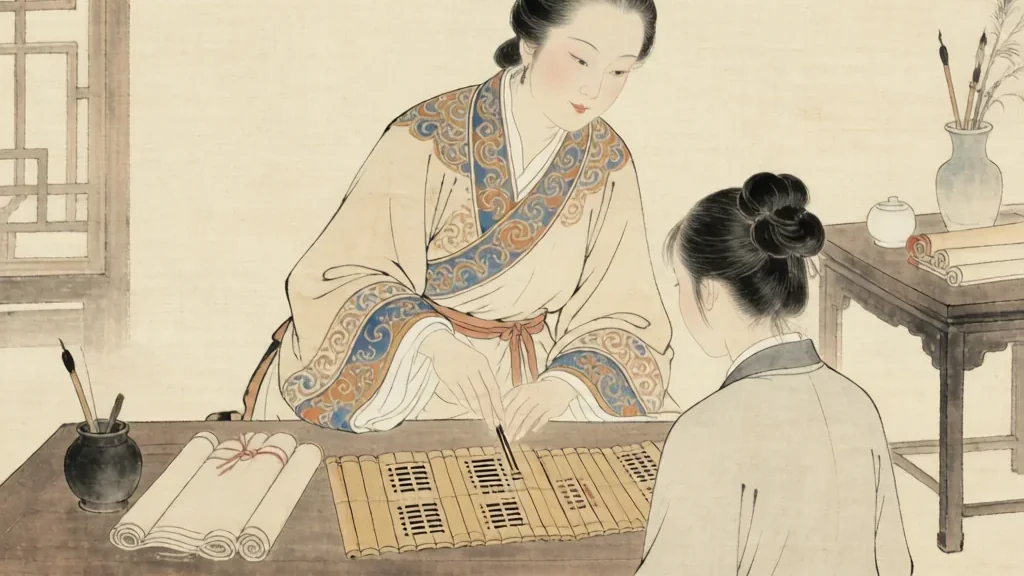
Fortune telling, known in Chinese as suàn mìng, is the traditional practice of calculating a person's destiny and fortune from birth data such as the year, month, day, and hour of birth. For more than a thousand years it has offered ordinary people a framework for understanding character, relationships, and the turning points of life, and it remains a living part of popular culture consulted for marriage, career, and family decisions. Though often dismissed by modern critics as superstition, it is better understood as a rich vernacular psychology, a vocabulary and a set of stories that help people think through uncertainty, and its methods, from the eight characters to face reading, continue to shape everyday speech and family ritual across the Chinese-speaking world.
The Meaning of Suanming
The term combines suàn, meaning to calculate, with mìng, meaning fate or allotted destiny. The premise is that the moment of birth imprints a person with cosmic patterns that shape the course of life, and a skilled reader decodes those patterns to describe the client's strengths, challenges, and likely fortunes. The word itself stresses calculation rather than vague intuition, framing the art as a kind of reckoning.
Importantly, fate in this tradition is usually not absolute. Many schools teach that effort and virtue can modify destiny, so fortune telling is advice and interpretation rather than final judgment. This flexible view helped the practice survive moral and official criticism, because it could be presented as moral guidance rather than forbidden prediction of the future.
The calculating frame also explains the esteem in which numerate arts were held. To read a life was to work with the same cosmic mathematics that governed the calendar and the heavens, a serious intellectual activity rather than mere entertainment, which lent practitioners a measure of social respect.
The Eight Characters
The most influential method is bā zì, the eight characters drawn from the heavenly stems and earthly branches of the four birth pillars: year, month, day, and hour. Each pillar contributes two characters, one stem and one branch, yielding eight that together form a unique cosmic fingerprint for the individual. The system depends on the sexagenary cycle shared with the traditional Chinese calendar.
Analysts examine the balance of the five elements, wood, fire, earth, metal, and water, among the characters. A surplus or lack of an element is thought to suggest where a life needs support, guiding choices in career, health, and partners, and remedies may be proposed such as wearing certain colors, choosing a favorable direction, or selecting an auspicious name.
The precision of the method rests on the birth hour, which is why practitioners ask for the exact time and often for the location, since local time and the traditional clock differ. The day master, the element of the day pillar representing the self, becomes the reference point against which the rest of the chart is read.
Four Pillars of Destiny
Building on bazi, the Four Pillars of Destiny system maps each stage of life onto the birth data. Practitioners assess the strength of the day master and trace how luck cycles shift across time, allowing them to describe periods of rise and fall rather than a single fixed fate. The structure turns a static chart into a moving story.
These ten-year luck periods, called great fortune cycles, plus yearly changes, let a reader forecast roughly when fortune is likely to rise or fall. Clients often seek such readings at transitions like graduation, marriage, starting a business, or retirement, moments when the chart's timing feels most relevant to real decisions.
The appeal of the system is that it gives anxiety a shape. By naming a difficult period as temporary and a good one as coming, the reading can steady a worried person, which is part of why the practice persists even among those who claim not to believe in it.
Face and Palm Reading
Besides birth data, readers study the body. Physiognomy interprets facial features, the shape of the forehead, eyes, nose, and mouth, as signs of temperament and fate, while palmistry reads the palms' lines and mounds for similar clues. These visual arts require no birth time, making them convenient at temples and markets.
A reader may combine several methods to build a fuller picture of the client, checking the face against the eight characters and the palms for consistency. The combination lends an air of thoroughness, and the reader's confident synthesis of different signs is part of the experience that clients value.
Face and palm reading also illustrate the embodied logic of the tradition, the belief that character and destiny are written into the body as surely as into the stars. This made the arts accessible to anyone, since the evidence was visible and required no calculation to observe.
Ziwei Doushu and Other Schools
Around the Song dynasty the Ziwei Doushu system emerged, plotting the birth data onto a star chart of palaces representing areas of life such as wealth, children, career, and travel. It rivals bazi in popularity in parts of southern China and among overseas communities, and its visual chart appeals to those who like a map-like presentation of fate.
Other methods include Qimen Dunjia for strategy and timing, Liuren for divination, and various local schools that blend numerology with observation. The variety shows how deeply the desire to read fate penetrated Chinese thought, producing many complementary systems rather than a single orthodoxy.
The coexistence of schools also meant that a dissatisfied client could seek a second opinion from a different method, a built-in pluralism that softened the claim of any one reader to absolute truth and kept the whole field flexible and competitive.
Role in Marriage and Family
Traditionally families exchanged the eight characters of bride and groom to test compatibility before betrothal. A mismatched pair might be rejected to protect both households from future discord, and the comparison of charts was a standard step in arranged marriage. Though less rigid now, many parents still quietly check a couple's bazi.
Fortune telling also eases family anxiety, for a reassuring reading about a child's future can comfort worried parents whatever its literal truth. The practice thus serves an emotional function alongside its reputed predictive one, offering reassurance at exactly the moments families feel most uncertain.
In this domestic role suanming is less about fate than about blessing. To read a child's chart auspiciously is to wish that child well in a culturally legible form, and the reading becomes a kind of spoken good fortune attached to a life event.
Fortune Tellers in Society
Readers operate from temple courtyards, street stalls, and now websites and apps, ranging from earnest practitioners to entertainers. The social bond, a sympathetic ear plus a cultural script, is part of the service, and many clients return less for prediction than for the comfort of being heard within a familiar framework.
In imperial times certain officials were trained in calendrical and astronomical arts, blurring the line between state astronomy and popular fate-reading. That prestige still lends the craft a measure of respect, and the same computational tradition underlies both the almanac and the fortune teller's chart.
The modern internet has transformed the trade, with automated bazi calculators and chat-based consultations reaching people who would never visit a temple stall. This democratization has spread the vocabulary further while loosening the personal, face-to-face character that once defined the encounter.
Modern Attitudes
Today suanming sits comfortably beside modern life. Young people may joke about their zodiac sign online while still consulting a master before a wedding, and urban professionals use it for career timing, treating it as one input among many rather than a ruling authority. The practice has adapted to a skeptical age by presenting itself as reflection.
Scholars study it as cultural heritage rather than science, and its vocabulary has entered everyday speech, so that references to five-element personality or lucky directions appear in media, advertising, and casual conversation. What was once esoteric has become a shared cultural idiom.
This normalization means suanming is unlikely to disappear. So long as people face uncertain choices and seek a language for them, the eight characters and the star chart will remain available as tools of interpretation, comfort, and self-narration.
Criticism and Boundaries
Authorities and educators often label excessive reliance on fortune telling as superstition that can delay rational decisions or extract money from the vulnerable. Reputable readers themselves warn against using readings to justify harm or to prey on the desperate, and most traditions include cautions against abusing the art.
The healthier boundary treats suanming as reflection and storytelling, a mirror for thinking about one's life rather than a script to obey. Within that frame it can be harmless and even useful, providing structure to anxiety and a vocabulary for hope, without claiming the false certainty of prediction.
❓ Frequently Asked Questions
What is suanming?
It is the traditional Chinese practice of calculating a person's destiny from their birth data, especially the year, month, day, and hour of birth.
What are the eight characters?
They are the eight stems-and-branches drawn from the four birth pillars, forming a unique cosmic profile used to read fate.
Is destiny considered fixed?
Most schools hold that fate can be modified by effort and virtue, so readings are guidance rather than absolute prediction.
How is it used in marriage?
Families traditionally compared the couple's eight characters for compatibility, a custom still quietly practiced by some parents.
Are there methods besides bazi?
Yes, including Ziwei Doushu star charts, face reading, palmistry, and several other schools of analysis.
Why does it remain popular today?
It offers a familiar vocabulary for uncertainty and comfort at life transitions, and its terms now permeate everyday speech and media.