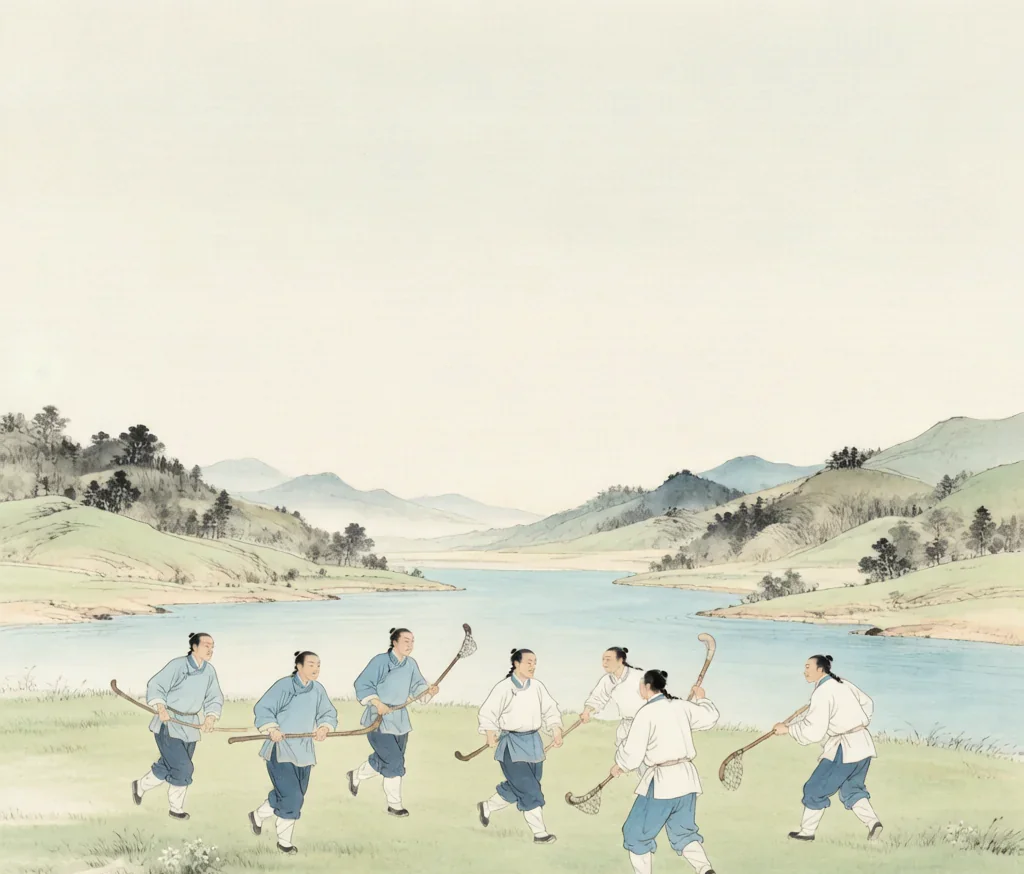
The Daur, also written Dawo'er, are a Mongolic-speaking people of northeast China who have long inhabited the fertile river valleys and mixed forests of the Nenjiang basin and the upper Amur region, with communities also found in Xinjiang relocated in the eighteenth century. Closely related in language and custom to the Mongols yet historically distinct, the Daur built a society of settled agriculture, fishing, and horsemanship on the northern frontier, renowned for archery, wrestling, and a vigorous tradition of communal sport. Their social life blends ancestral shamanism with Tibetan Buddhist and later Confucian influences, and their seasonal round of planting, fishing, and festival reveals a people who turned a harsh borderland into a stable home.
Origins and Historical Roots
The Daur are generally considered descendants of the ancient Mongolic peoples of the Amur and Nenjiang region, and some scholars connect them to the broader confederation that produced the Mongol Empire, though they retained a separate identity through centuries of frontier life. Early records place Dauric chiefdoms along the Amur encountered by Russian explorers in the seventeenth century, after which many were drawn southward under Qing administration.
Under the Qing dynasty the Daur supplied skilled soldiers and archers to the imperial banner system, guarding the northern marches and joining campaigns. A portion was later settled in Xinjiang as part of frontier garrison communities, creating the western branch that persists today. This martial role shaped a culture that prized discipline, riding, and marksmanship alongside farming.
Recognition as a minority nationality in the twentieth century consolidated dispersed Dauric communities under one official name and supported the documentation of language and custom. Their history as both farmers and frontier defenders gives the Daur a dual identity unusual among the peoples of the northeast forest zone.
Language and Literature
The Daur language belongs to the Mongolic family, sharing core vocabulary and grammar with Mongolian yet distinct enough to be mutually unintelligible in speech. Traditionally the people had no separate script of their own and used Mongolian or Chinese characters for writing when needed; in the modern period the Latin-based pinyin alphabet is used to record the spoken language and to support bilingual schooling.
Oral literature carries the weight of memory: epic tales of heroes, historical ballads of migration and war, and a rich store of proverbs about horses, weather, and neighborly conduct. Storytelling in the long winter evenings is the chief educational institution, and the best narrators are honored as keepers of the people's story.
Today most Daur are fluent in Mandarin, and younger speakers often use Mongolian or Uyghur in the Xinjiang branch depending on locality. Preservation efforts compile dictionaries and record folktales, mindful that a language with few native speakers needs active transmission to survive.
Landscape and Livelihood
The Daur homeland is a land of wide rivers, black-soil plains, and bordering forest, ideally suited to a mixed economy. The Nenjiang and its tributaries supply abundant fish, while the surrounding fields yield wheat, millet, soybeans, and maize. The nearby woods provide timber, game, and pasture, allowing a household to farm, fish, and keep livestock in balanced measure.
Settled village life centers on the timber house with a heated kang platform for sleeping and sitting, surrounded by fenced fields and livestock pens. Fishing is conducted with nets, weirs, and spears in season, and dried fish becomes a winter staple and trade good. Cattle, horses, and pigs round out the homestead, with horses especially prized for work and sport.
The rhythm of the year moves from spring planting through summer fishing and haying to autumn harvest and winter craft, a cycle that demands cooperation in threshing and ice fishing. The Daur thus exemplify a boreal agrarian adaptation, mastering both field and river in a climate of long cold.
Horsemanship, Archery and Sport
Among the Daur, skill with horse and bow is a cultural cornerstone and a source of communal pride. Boys learn riding almost as they learn walking, and archery contests, mounted and on foot, are held at festivals and between villages. Wrestling in the Mongolic style completes the triad of traditional sport that also serves as military training.
The people are credited with a particular fondness for hockey-like ball games played on horseback and on foot, using a wooden stick and a ball, a pastime that historians sometimes cite as an early form of the sport in the region. Such games build coordination, courage, and fellowship, and the best players gain renown beyond their village.
Sport is inseparable from celebration: a festival without archery, wrestling, and riding is unthinkable, and the competitions reinforce bonds of alliance and friendly rivalry. The disciplined body of the archer is also the disciplined citizen of the frontier community, linking play to the older martial ideal.
Belief and Ritual Life
Daur religion traditionally combines ancestral shamanism with Tibetan Buddhism absorbed through Mongol contact, and later layers of Chinese folk custom. The shaman, able to communicate with spirits and ancestors, presides at healing, purification, and seasonal rites, while Buddhist monks conduct funerals and merit ceremonies in communities that built small temples.
Ancestor veneration is central: the hearth and the family altar are focal points where offerings sustain the goodwill of the departed, and major life events open with invocation to forebears. Nature spirits of mountain, river, and tree are appeased before fishing and felling, reflecting a reciprocal attitude toward the land that supported the village.
The great winter and spring festivals gather the community for sacrifice, feast, and sport, renewing the covenant between living, dead, and spirits. Even as formal observance has thinned, the etiquette of respect for elders and ancestors remains strong, carried in daily greeting and in the layout of the home.
Village Life and Architecture
Daur villages are planned clusters of timber dwellings oriented to shelter from the northwest wind, each house built of logs or framed timber with a thick thatch or shingle roof and a sunken or bordered courtyard. The heated kang running along the wall is the heart of the interior, where the family eats, talks, and sleeps through the long winters.
Communal space includes the threshing ground, the fishing weir, and the open square used for sport and dance, while the family granary and the livestock shed organize the working yard. Water comes from the river or from wells, and woodpiles denote the household's preparation for the cold months. Order and storage are virtues born of a hard climate.
Modern building has introduced brick and tile while keeping the kang and the courtyard, and electrification has eased winter life. Yet the village square and the riverbank remain the true centers of social life, where the seasonal tasks and pleasures of the people are enacted.
Festivals and the Calendar
The Daur year follows the agricultural and lunar calendar with festivals that blend sacrifice, sport, and feasting. The lunar New Year is the grandest, marked by ancestor offering, visiting, and the opening of archery and wrestling contests once the snow settles. A spring fishing festival blesses the first catch, and autumn thanks the harvest with shared meat and beer.
Shamanic rites at critical moments—sowing, first ice, illness—seek protection and balance, while Buddhist observances add scripture chant and charity. Weddings and name-givings are scheduled by auspicious reading and accompanied by horsemanship displays that show the groom's skill to the bride's family.
These occasions are also the stage for music and dance, ensuring that the calendar teaches cooperation and reverence in alternating rhythm. The festival square, trampled firm by dancers and hoof, is the physical emblem of Daur community.
Music, Dance and Oral Epic
Daur performance pairs the string and wind instruments of the steppe with vigorous group dances performed in a circling line. Songs celebrate horses, heroes, and the river, and the epic of past chiefs and warriors is sung in recited verse that can span an evening. The mouth harp and the fiddle provide intimate accompaniment at home.
Oral narrative preserves historical memory: the coming of the banners, the moves southward and westward, and the deeds of famed archers are told and retold, each telling reaffirming identity. Children learn the melodies and the tales together, so that music is the medium through which the past is inherited.
Dance steps echo the motions of sowing, reaping, and riding, mapping labor onto celebration and keeping the body trained for the year's work. The performative arts thus function as both recreation and a living curriculum of Daur values, geography, and history.
Social Order and Kinship
Daur society is organized around patrilineal clans and village councils, with land and fishing rights held through customary tenure overseen by elders. Marriage is negotiated with bride wealth and is traditionally exogamous across clans; the wedding is a multi-day event of gift exchange, horsemanship, and feast that joins two families and their villages.
Elders command deference as bearers of memory and arbitrators, and the shaman advises on spiritual matters. Reciprocal labor groups accomplish harvest and house raising, embedding mutual aid in the social contract. Hospitality to travelers is a strong norm rooted in the sparse settlement of the frontier.
Modern administration adds elected committees and civil law, yet many families still observe traditional gift and labor exchanges as a matter of honor. The persistence of clan consultation shows how older institutions adapt rather than vanish under the state system.
Modern Changes and Preservation
Roads, schools, and clinics have reached Daur valleys, raising literacy and health and drawing young people into wider employment while they keep ties to the village. Cultural programs document the language, the archery tradition, and the epic, and festival sports have been revived as heritage rather than only pastime.
The Xinjiang branch maintains contact with the northeastern homeland through family ties and cultural exchange, and both preserve distinct local variants of custom. The challenge is to keep the language alive as Mandarin dominates public life, and to sustain the river and forest that the livelihood depends on.
The Daur show how a frontier people balanced the plow and the bow, building stable villages while keeping the skills of the march. Their story contributes a northern chapter to the diverse heritage of China's ethnic peoples.
Cuisine of the River and Field
Daur food centers on millet and wheat with fish, beef, and pork, flavored with wild herbs, onion, and the sour notes of fermented milk. Smoked and dried fish, dairy curds, and hearty noodle soups sustain the cold season, and millet or barley beer accompanies every feast and negotiation.
The ethic of offering the first catch and the first fruits to ancestors and guests reflects both reverence and the borderland necessity of mutual support, making the hearth and the shared table central institutions of Daur social life and the practical expression of their reciprocal ethic.
❓ Frequently Asked Questions
Where do the Daur live?
They live mainly in the Nenjiang river valley of northeast China, with a branch in Xinjiang settled as a Qing frontier garrison.
What language do the Daur speak?
They speak a Mongolic language related to Mongolian but distinct, traditionally written with Mongolian or Chinese characters and now recorded in pinyin.
What are the Daur known for?
They are renowned for horsemanship, archery, wrestling, and an early form of stick-ball play, as well as settled agriculture and fishing.
What do the Daur believe?
Their religion blends ancestral shamanism with Tibetan Buddhism and Chinese folk custom, centered on ancestor veneration and nature spirits.
How do the Daur make a living?
They practice mixed farming of grain, fish the rivers, keep livestock, and historically served as frontier soldiers within the banner system.
What is distinctive about Daur festivals?
New Year and harvest festivals feature ancestor offering, archery, wrestling, and riding contests that reaffirm community bonds and the martial heritage.