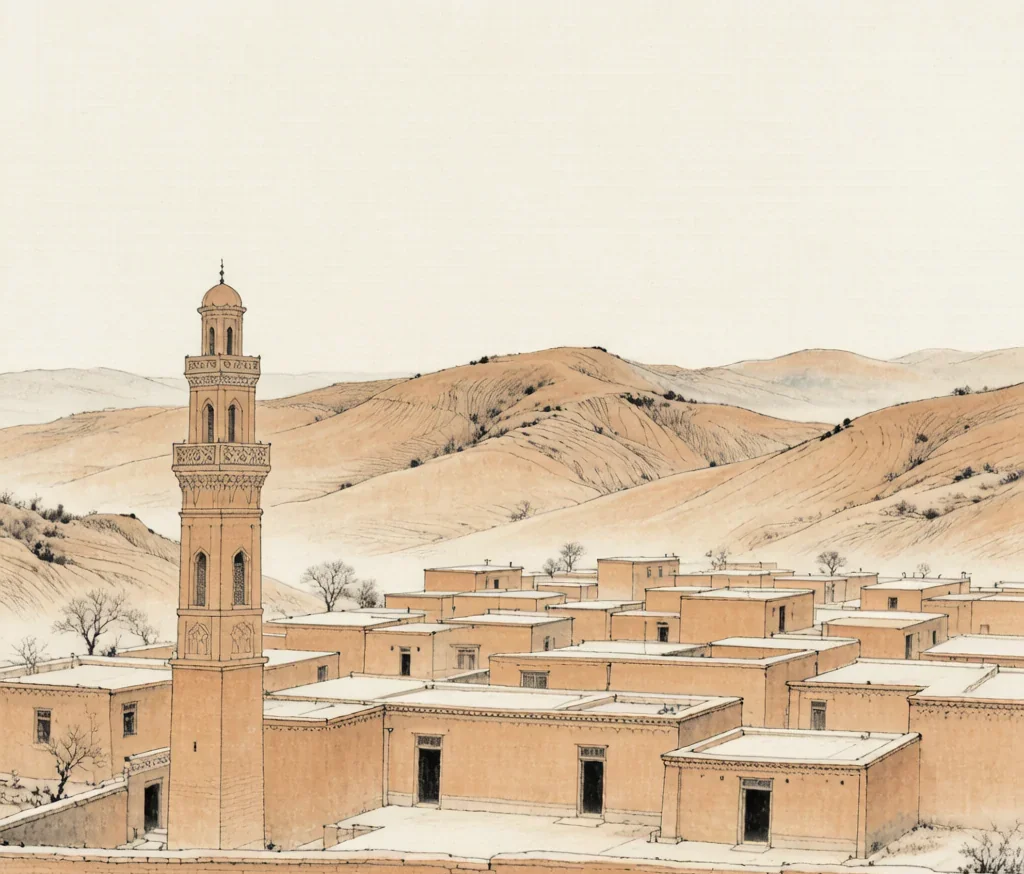
The Dongxiang, also called the Santa, are a Muslim people of northwest China concentrated in the Dongxiang Autonomous County of Gansu Province, on the loess hills around the former episcopal seat of the Mongol empire at Liazhou. Descended from a mixture of Mongol, Central Asian, and local Han and Tibetan populations who embraced Islam in the Yuan period, the Dongxiang speak a Mongolic language written in Arabic script and have built a culture defined by dryland agriculture, devout Sunni practice, and a distinctive culinary tradition centered on hand-pulled noodles. Though living in a harsh, eroded landscape, they have sustained a cohesive identity through faith, kinship, and the shared table.
Origins and Formation
The Dongxiang are generally understood as the product of the Yuan dynasty's mobilization of peoples, when Mongol garrisons and Central Asian Muslim soldiers, artisans, and settlers were stationed on the northwestern frontier and intermarried with local populations. The adoption of Islam by this mixed community, under the influence of Sufi missionaries and the Mongol court's tolerance, gave them a religious identity distinct from their Mongol kin who remained Buddhist or shamanist.
Their heartland around the old Liazhou site became a center of Islamic learning and of the Mongolic speech that the people preserved as a home language. Over centuries the Dongxiang absorbed Hui and Salar neighbors through trade and marriage while keeping a separate name and custom, recognized officially as a minority nationality in the twentieth century.
The label Santa, by which they are also known, reflects the historical self-designation tied to the garrison origin, and the memory of a martial, pious ancestry remains a source of pride. Their formation thus illustrates how frontier empire produced new peoples through the meeting of steppe, oasis, and faith.
Language and Script
The Dongxiang language is a member of the Mongolic family, conservatively close to Middle Mongol in some respects, and is traditionally written in a modified Arabic script used for religious and personal notes. It preserves vocabulary lost in other Mongolic tongues, making it valuable to historical linguists studying the legacy of the Yuan court.
Daily communication, however, increasingly uses Mandarin Chinese, and many Dongxiang are trilingual in their mother tongue, Chinese, and the Arabic of religious study. The Arabic-script tradition links the language to the mosque and the madrasa, where boys learn to read the Quran and to write the vernacular in the same alphabet.
Modern documentation projects compile dictionaries and folk texts in both Arabic and Latin transcription to support teaching. Because speaker numbers are modest and Chinese dominates public life, the language's survival depends on its continued use in home and worship, the two spheres where it remains most alive.
Landscape and Dryland Farming
The Dongxiang homeland is a stark world of loess ravines and gullied hills with thin, drought-prone soil and little surface water. This difficult terrain has shaped a frugal agriculture of wheat, barley, potatoes, and peas grown on terraced slopes, with careful water harvesting and rotation to resist erosion and famine.
Settlement spreads in scattered hamlets of flat-roofed, sun-dried brick houses clinging to the hillsides, each with a walled courtyard and a cistern for scarce rain. The mosque anchors the community both spiritually and socially, and narrow paths connect households across the broken ground. Mobility is on foot or donkey, and the landscape demands constant labor to keep soil and terrace in place.
Despite the aridity, the people have developed a resilient economy of grain, orchard, and small livestock, and remittance and trade with nearby Linxia have supplemented income. Their mastery of a fragile ecology is itself a cultural achievement, encoded in terrace technique and in a cuisine that wastes nothing.
Islam and Community Life
Islam is the defining bond of Dongxiang identity, practiced in the Sunni form with strong Sufi orders whose lodges historically guided spiritual and social life. The mosque is the pivot of the village, marking the times of prayer, the rhythm of the week, and the gathering for feast and funeral. Religious scholars hold high status, and pilgrimage to Mecca is a cherished aspiration.
The five daily prayers, the fast of Ramadan, and the almsgiving obligation structure the year, while the two great festivals of Eid mark the calendar with communal prayer, visiting, and shared meat. Sufi dhikr gatherings cultivate inward devotion, and the saint shrines of the region draw pilgrims seeking blessing.
Faith also governs diet, dress, and family law, aligning the Dongxiang with the wider Muslim communities of Gansu while distinguishing them by language and origin from the Hui. The mosque courtyard is thus both sanctuary and forum, where the affairs of this-world and next are continually joined.
Traditional Dress and Adornment
Dongxiang clothing follows the modest convention of northwestern Muslim peoples, adapted to the cold, dry climate. Men wear a white cap, a robe or jacket over trousers, and in winter a sheepskin or padded coat, while women wear a headscarf, a long dress, and a jacket, with married women covering the hair in accord with custom.
The white embroidered cap for men and the colored headscarf for women are the most visible markers, and festival dress adds finer cloth and the occasional brocade gifted at marriage. Adornment is restrained compared with many ethnic neighbors, reflecting the Islamic preference for humility, yet weddings display silver and brightly colored textiles as signs of joy.
Cloth is often bought from Linxia markets, though home sewing remains common, and the cut favors warmth and ease of prayer. Dress thus signals both faith and belonging to the loess-hill homeland, a portable identity carried wherever Dongxiang migrate for work.
Cuisine and the Noodle Tradition
Dongxiang food is justly famous, built on wheat and mutton with the signature dish of hand-pulled noodles served in a rich broth with radish, chili, and herbs. The art of pulling dough into fine strands is a test of skill taught to boys and girls alike, and the best noodle makers are celebrated at home and market. Mutton eaten with flatbread, stuffed pastries, and sweet fried dough complete the repertory.
The communal meal is central to hospitality and to religious feast, where a whole sheep may be shared according to rules of portion and respect for elders and guests. Tea, poured from a long-spouted pot, accompanies every visit, and the etiquette of pouring and receiving affirms rank and affection within the gathering.
Frugality shapes the kitchen: grains and vegetables are stretched with broth and fat, and nothing of the animal is wasted. This cuisine, born of scarcity and faith, has become the people's best-known cultural export, drawing visitors to Linxia and the Dongxiang hills for a bowl of noodles.
Festivals and the Religious Year
The Dongxiang year is the Islamic lunar calendar, opened and closed by the fast and feast of Ramadan and Eid, with the sacrifice festival marking the trial of Abraham. These occasions bring communal prayer on the open ground, the slaughter and distribution of livestock, and the visiting of graves. The prophet's birthday and the ascension are observed with recitation.
Life-cycle events follow religious law: the naming of a child, the circumcision of boys, and the Islamic wedding contract are performed before the imam, followed by feast. Mourning observes prescribed rites of washing, prayer, and burial oriented to Mecca, with ongoing charity for the dead's soul.
These observances bind scattered hamlets into one ummah, the community of believers, transcending the gullied isolation of the land. The festival ground, where the faithful stand shoulder to shoulder, is the truest image of Dongxiang solidarity.
Music, Song and Oral Art
Dongxiang expressive culture is shaped by the prohibition on musical instrument in strict observance and by the centrality of the recited word. Quranic chant and the call to prayer are the highest musical forms, while folk songs in the mother tongue treat love, labor, and migration in a plain, affecting style sung without accompaniment.
Oral literature includes tales of the garrison ancestors, verses of the saints, and proverbs about thrift and faith transmitted by elders. The telling of folktales in the winter courtyard keeps the language alive and teaches the young the values of patience, piety, and mutual aid in a hard land.
Though less elaborate than the staged arts of some neighbors, Dongxiang performance is intimate and devout, finding beauty in the cadence of chant and the wit of a sung proverb. The voice raised in prayer and in song is the chief instrument of a people who value the word over the object.
Social Order and Kinship
Dongxiang society is organized around patrilineal clans and village neighborhoods bound by Islamic law and customary practice. Marriage is arranged within the faith, often between allied villages, with bride wealth and the wedding feast affirming the union before the community. Lineage and the mosque council together guide conduct and settle dispute.
Elders and religious scholars command deference as bearers of law and memory, and the imam advises on both ritual and civil matters. Reciprocal labor and food sharing embed mutual aid, and the duty to host the traveler and feed the poor is a religious as well as social norm in a land of frequent shortage.
Modern civil administration adds elected committees and equal-rights provisions, yet the clan and the mosque remain the true anchors of order. Kinship and faith together form the safety net that lets a scattered hill people endure drought, distance, and change.
Modern Life and Preservation
Roads, schools, and clinics have reached the Dongxiang hills, improving health and opening education, though the terrain still limits travel and the soil still limits yield. Young people attend school and many migrate to cities for work, sending money home and returning for festivals in a rhythm now familiar across rural China.
Cultural and religious revival has accompanied economic change: new mosques and schools record the language and the noodle craft, and heritage tourism around Linxia highlights Dongxiang food. The challenge is to keep the Mongolic mother tongue alive as Chinese and Arabic dominate, and to repair the eroded land that sustains the homeland.
The Dongxiang show how faith, language, and the shared table let a small people thrive on unforgiving ground. Their story enriches the Muslim and Mongolic heritage of China's northwest frontier.
Architecture of the Hills
Dongxiang building uses the local sun-dried brick and timber, producing flat-roofed courtyard houses that conserve heat and resist wind, with thick walls and small windows suited to the climate. The mosque, often with a simple minaret and a domed or pitched roof, stands as the tallest and most cared-for structure of the hamlet.
Courtyards are walled for privacy and shelter, containing the cistern, the stove, and the livestock corner, while terraces climb the slope behind to hold the precious soil. Order, storage, and shade are the principles of construction, born of a landscape that punishes waste and exposure in equal measure.
❓ Frequently Asked Questions
Where do the Dongxiang live?
They live mainly in the Dongxiang Autonomous County of Gansu Province on the loess hills near the old Liazhou site in northwest China.
What language do the Dongxiang speak?
They speak a Mongolic language traditionally written in Arabic script, while also using Mandarin Chinese in daily and public life.
What is the Dongxiang religion?
They are Sunni Muslims with strong Sufi orders, and Islam defines their calendar, diet, dress, and community organization through the mosque.
What food are the Dongxiang known for?
They are famous for hand-pulled wheat noodles in mutton broth, flatbread, and sweet fried pastries shared at feast and hospitality.
What is the Dongxiang homeland like?
It is a stark world of eroded loess ravines with thin dry soil, demanding frugal terraced farming and careful water harvesting.
Who are the ancestors of the Dongxiang?
They formed from Mongol garrisons and Central Asian Muslim settlers who intermarried with local peoples and embraced Islam in the Yuan period.