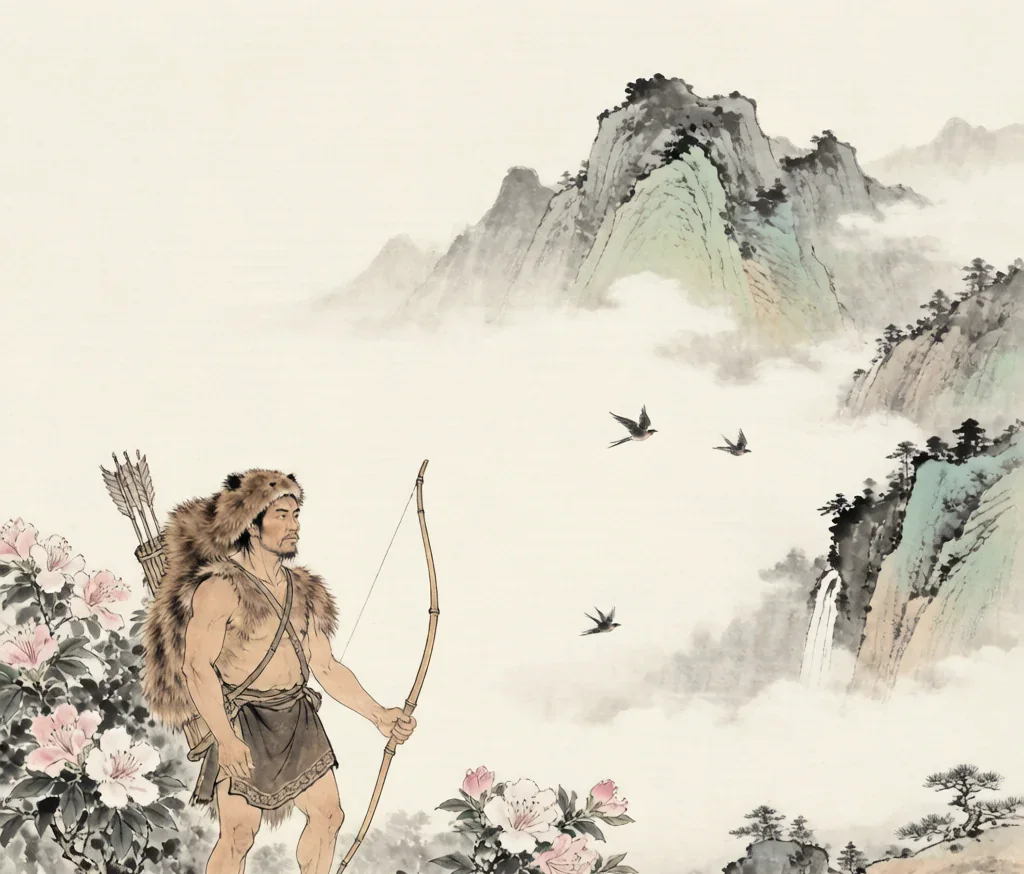
The Lhoba, also written Luoba, are a Tibeto-Burman people of the southeastern Tibetan Himalaya, recognized as one of the smallest of China's fifty-five minority nationalities and concentrated in the river valleys and forested middle slopes around the lower Yarlung Tsangpo in the vicinity of Loyu, as well as across the border in neighboring Arunachal communities. Long known as skilled hunters, trappers, and weavers of bamboo, the Lhoba have in recent generations shifted toward settled agriculture while retaining a rich inheritance of oral epic, shamanic belief, and distinctive dress. Their closeness to the land, their knowledge of the mountain ecosystem, and their position on the old trans-Himalayan frontier make them a vital thread in the cultural fabric of the Tibetan borderlands.
Homeland and Environment
The Lhoba inhabit a dramatically layered zone where the great river cuts deep gorges and the surrounding slopes climb through broadleaf and conifer forest to alpine meadow. This vertical world supplies bamboo for weaving, game and fish for protein, medicinal plants for trade, and eventually terraced ground for millet and maize as families settled lower valleys. The climate is milder than the open plateau, allowing a longer growing season than most Tibetan regions.
Settlement historically followed the seasonal round: winter homes in the warmer valleys, summer camps near high hunting and gathering grounds. With the spread of settled farming, permanent village clusters of raised timber houses became the norm, linked by narrow paths and rope bridges across torrential streams. The environment demands intimate knowledge of weather, animal movement, and safe passage that elders transmit to youth.
Because the frontier region is remote and politically sensitive, Lhoba communities developed self-reliant practices of food storage, trail marking, and mutual aid. Their ecological expertise—knowing which plants heal, which woods bend, which slopes avalanche—remains a cornerstone of identity even as livelihoods modernize.
Language and Voice
The Lhoba speak a Tibeto-Burman language distinct from Tibetan, with several local varieties spoken across the dispersed valleys, and they have historically lacked a native script, recording nothing in writing and relying wholly on memory and recitation. Intercourse with Tibetan neighbors made Tibetan the language of trade and religion, while modern schooling introduces Mandarin as a third idiom.
Oral literature is the heart of Lhoba culture. The great creation and migration epics, performed by specialist singers over several nights, recount the origin of the people, the deeds of culture heroes, and the taming of the wild landscape. Beast fables and love songs circulate more informally, and proverbs encode hunting and weather wisdom. The spoken word is therefore both art and archive.
Today bilingual and trilingual competence is common, and recording projects led by regional institutes work to transcribe epics before the oldest singers pass. The language, though small in speaker number, carries a unique window into the pre-literate highland world of the eastern Himalaya.
Belief and Shamanism
Traditional Lhoba religion is animistic and shamanic, centered on a pantheon of mountain, river, and forest spirits and on the practice of appeasement through sacrifice and chant. The shaman, usually a man trained through vision and apprenticeship, mediates between the living and the spirit world, diagnosing illness, blessing hunts, and guiding the soul of the dead to the ancestral realm.
Over time Tibetan Buddhism influenced the people, especially in areas of close contact, adding monastery rites and the custom of prayer flags, yet the older shamanic layer remained strong because it spoke directly to hunting, fertility, and the daily hazards of the forest. Life-cycle rituals—birth, naming, marriage, and funeral—blend the two traditions according to local preference.
The worldview holds that every feature of the land is inhabited by power that must be respected; thus hunting taboos, restricted slopes, and offerings before a kill are moral as well as practical. This reciprocal ethic helped conserve game and forest long before modern conservation appeared, linking reverence to survival.
From Hunting to Farming
For centuries the Lhoba were renowned as hunters and trappers, supplying fur, horn, and meat to trade networks and reading the forest like a text. Skill with the bow, the crossbow, and the poisoned arrow was a measure of adulthood, and hunting societies regulated access to grounds and the sharing of large catches. The hunt was as much ritual as subsistence, opened with prayers and closed with offerings.
Gradual sedentization brought the clearing of fields for millet, maize, and buckwheat, and the adoption of rice in warmer pockets through contact with valley neighbors. Livestock—pigs, chickens, and some cattle—supplemented the diet, and kitchen gardens added vegetables. The transition was driven by both choice and policy, as settled agriculture offered steadier food than the uncertain forest.
Even as farming dominates, hunting and gathering persist as seasonal supplements and as cultural practice, and the knowledge of traps, snares, and edible plants is still taught. The shift from bow to plow reshaped social life without erasing the hunter's esteem for patience, accuracy, and respect for the quarry.
Craft and Material Culture
Lhoba material culture is defined by bamboo. Men split, heat, and weave cane into baskets, quivers, mats, and the famed backpack frames that enable porters to carry astonishing loads over passes. Bamboo also yields traps and musical tubes, and the quality of a man's weaving is a public mark of competence admired across villages.
Textiles are woven from wool and cotton on simple looms, producing the dark, practical clothing suited to forest travel, and women decorate garments with shell, bead, and silver trims acquired through trade. Woodworking supplies the house frame, the mortar and pestle, and the carved implements of daily life, while bone and horn are fashioned into tools and ornaments.
Unlike peoples with elaborate court arts, the Lhoba aesthetic is utilitarian and restrained, finding beauty in the clean line of a basket and the balance of a bow. This craft honesty reflects a life measured by usefulness in a demanding landscape rather than by display.
Dress and Identity
Lhoba dress is among the most distinctive in the Himalaya. Men traditionally wear a short tunic, a waistcloth, and a cane or bark cap, carrying the crossbow and a back-basket as constant companions, while women wear a long skirt, a jacket, and a profusion of shell and bead ornaments, with the broad belt and the embroidered apron marking married status.
The use of conch-shell discs, bone, and later silver as adornment signals both beauty and the history of trade with the lowlands, since shell reached the mountains as a valued import. Hair is worn in styles that indicate community and age, and festival dress adds woven bands and feather or fur trims recalling the hunting heritage.
Clothing is adapted to movement: short hems, bound leggings, and sturdy belts allow climbing and wading, and the back-basket distributes load along the spine for long treks. Thus dress encodes ecology as surely as identity, a portable technology of the mountain trail.
Festivals and Seasonal Rites
The Lhoba calendar turns on the agricultural and hunting rhythm. A New Year observance, often shared in timing with Tibetan neighbors, brings household cleaning, offerings to spirits, and communal feasting with millet beer. Pre-hunt and post-hunt rites thank the forest and ask permission for the taking of life, while harvest ceremonies honor the grain spirit.
Shamanic festivals feature all-night chant and dance in which the spirit medium enters trance to heal or to divine, and the community joins in songs that recount epic history. Weddings and name-givings are scheduled by auspicious reading and accompanied by the exchange of meat, beer, and woven goods between families.
These gatherings are also the principal stage for the epic singer, whose performances bind scattered families into a single remembered people. The festival thus serves memory, ecology, and alliance at once, repeating the order of the world through song and sacrifice.
Music, Epic and Dance
Lhoba music is vocal and percussive, built on the drum, the gong, and the bamboo mouth instrument, with the epic sung in a restrained, narrative style that can extend across nights. Circle dances at festivals let all join, while hunting songs and lullabies belong to work and home. The voice is the chief instrument because the people kept no written notation.
The epic tradition deserves special note: specialist singers memorize thousands of lines describing cosmic origins, the first shamans, and the journeys that brought the ancestors to their valleys. Performance is both entertainment and school, teaching geography, law, and morality to listeners who may never handle a book. The loss of a singer is felt as the loss of a library.
Dance mimics the motions of the hunt and the grind of grain, mapping labor into celebration and keeping the body trained for the work of the year. Song contests between valleys allow the young to display wit, and the best voices are commemorated in later epics as ancestors worthy of recall.
Social Order and Kinship
Lhoba society rests on clans and village neighborhoods bound by reciprocal obligation and by the authority of elders and shamans. Marriage is negotiated with bride wealth that includes cloth, silver, and meat, and exogamy across clans is the rule. Property in land and bamboo groves passes through customary inheritance, with the household as the basic economic unit.
Disputes over fields, trails, or injury are settled by elder councils advised by the shaman on matters of spirit, and restitution in goods or feast restores balance. The ethic of sharing large catches and of mutual help on house building embeds cooperation in daily life, reducing the risk inherent in isolated mountain existence.
Modern civil administration adds elected committees and equal-rights law, yet traditional councils still meet for customary matters, showing how older institutions persist beneath the state framework. Kinship remains the true safety net, and visiting obligations keep far valleys connected.
Modern Life and Recognition
Recognition as a minority nationality brought the Lhoba schools, clinics, and roads that earlier isolation had denied, raising literacy and life expectancy. Young people now attend school and some migrate for wage work, even as they return for festivals and family duties. Mobile networks link remote homesteads to the wider world.
Cultural documentation efforts record the epic, the dialect, and the weaving craft, while small tourism and heritage projects introduce Lhoba bamboo work to outside markets. The challenge is to keep the forest knowledge alive when fewer youths hunt, and to protect sacred slopes from unchecked extraction.
The Lhoba stand as a testament to a hunting people who became farmers without losing their voice. Their epics, their bamboo, and their quiet expertise in the mountain world enrich the diverse heritage of China's southwestern border.
Cuisine of the Forest and Field
Lhoba food blends wild and cultivated: millet and maize cakes, buckwheat noodles, forest greens, mushrooms, and river fish, with smoked meat and dried game in season. Chili, wild pepper, and fermented relishes give heat, and millet or maize beer accompanies every feast and negotiation.
Hospitality demands that a guest be fed and given beer, a norm born of the danger of travel in gorges where the next hearth may be a day away. The shared meal, like the shared hunt, remains the fundamental bond of Lhoba social life and the practical expression of their reciprocal ethic.
❓ Frequently Asked Questions
Where do the Lhoba live?
They live in the forested middle slopes and river valleys of southeastern Tibet around the lower Yarlung Tsangpo, with related communities across the nearby frontier.
What language do the Lhoba speak?
They speak a Tibeto-Burman language without a native script, relying on oral transmission, and use Tibetan and Mandarin in wider communication.
What were the Lhoba traditionally known for?
They were renowned as hunters, trappers, and bamboo weavers, with deep knowledge of the mountain ecosystem and a rich oral epic tradition.
What do the Lhoba believe?
They practice animist and shamanic religion centered on nature spirits, later blended with Tibetan Buddhism in areas of close contact.
How has Lhoba life changed?
Families have shifted from hunting to settled agriculture while keeping oral epics, bamboo craft, and festival custom as markers of identity.
What is distinctive about Lhoba dress?
Men wear short tunics with crossbow and back-basket, women wear skirts with shell and bead ornaments, all adapted for forest travel and climbing.