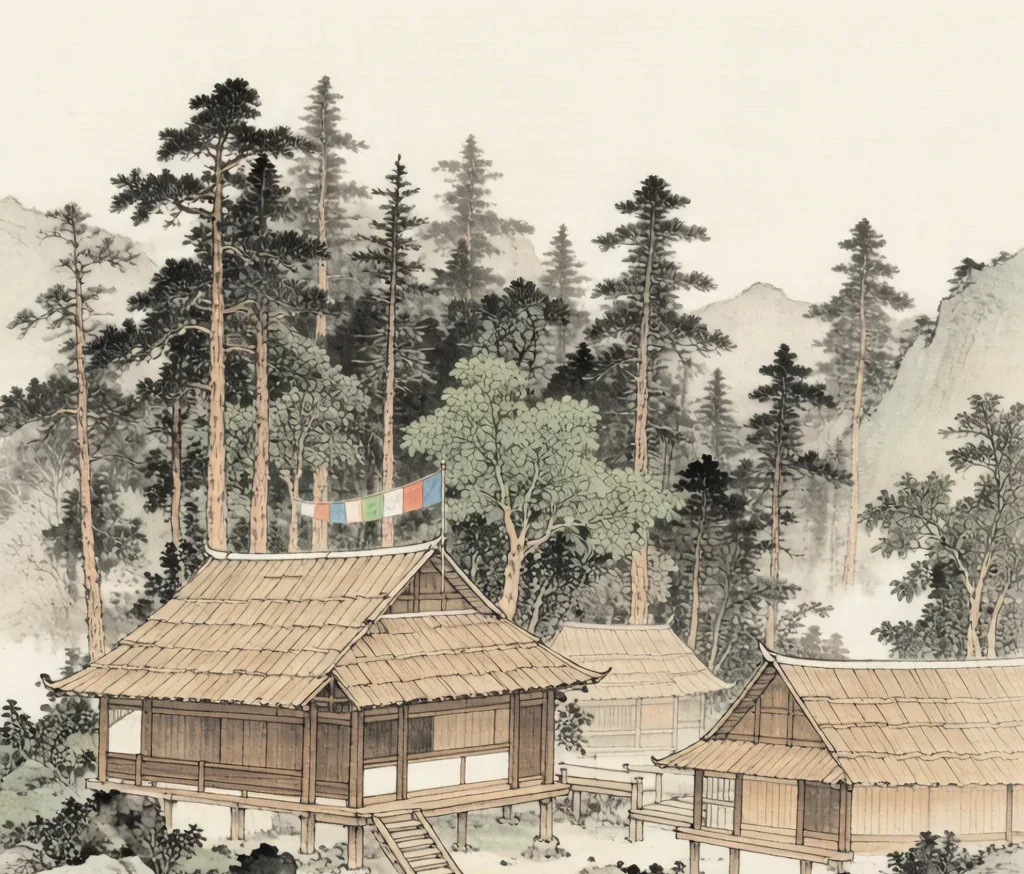
The Monba, also spelled Menba, are a Tibeto-Burman people living in the warm, forested river valleys of the southern Tibetan Himalaya, concentrated in the regions historically known as Lhoyu and Menyu around the lower course of the Tsangpo and in the Tawang and Dirang areas adjoining the Indian frontier. Closely related in language and faith to their Tibetan neighbors yet preserving a distinct identity, the Monba have built a culture of intensive terrace agriculture, fine craftsmanship, and devout Mahayana and Vajrayana Buddhist practice. Though modest in number, they are celebrated for the quality of their weaving, bamboo work, handmade paper, and woodturning, and for a seasonal rhythm of pilgrimage, harvest, and communal labor that binds village to monastery in the high borderland.
Homeland and Geography
The Monba homeland occupies a strikingly varied landscape where the deep, humid valleys of the southern Himalaya rise through temperate forests to alpine pasture. This vertical geography allows a single community to combine rice and maize cultivation at lower elevations with herding and the collection of cordyceps and medicinal plants higher up. The mild climate of the sheltered valleys supports two or even three crops a year, a rarity on the Tibetan Plateau proper.
Settlement is organized in compact village clusters linked by footpaths and suspension bridges, with fields terraced along the slopes and orchards of peach, walnut, and citrus in the warmer pockets. Because the region lies on historic routes between the Tibetan interior and the Assam plain, Monba communities have long served as intermediaries in trade, carrying salt, wool, and religious goods upward and bringing rice, cane, and tropical products down.
The borderland setting has shaped a culture comfortable with movement and exchange while fiercely attached to local valley deities and monasteries. Seasonal migration to high pastures for livestock and to forests for gathering remains integral to the annual round, preserving ecological knowledge suited to a fragile mountain environment.
Language and Literature
The Monba speak a cluster of Tibeto-Burman dialects closely allied to spoken Tibetan, and historically they used the Tibetan script for religious and administrative writing. Several local varieties exist, with the Menyu and Tawang speech forms the best documented, and mutual comprehension with neighboring Tibetan dialects is high. As with many small highland peoples, everyday Monba is increasingly supplemented by Tibetan and, in modern contexts, by Mandarin.
Oral literature thrives in the form of folk tales, beast fables, and sung narratives of local saints and mountain deities. The great Tibetan epic of Gesar is performed and retold in Monba rendering, and households preserve genealogical songs that anchor families to particular valleys. Monastic education transmits Buddhist philosophy and liturgy in Tibetan, the language of scripture throughout the region.
Contemporary bilingual schooling aims to maintain Monba speech as a spoken heritage while ensuring access to wider literature and civil communication. Elders note that proverbs and place-name lore encode practical warnings about weather, avalanches, and safe passage that remain useful to herders and travelers.
Religion and Monastery Life
Monba religious life is rooted in Mahayana and Vajrayana Buddhism of the Tibetan tradition, with the monastery at Tawang and smaller local gompas serving as spiritual, educational, and festival centers. Monks perform rites of blessing, funeral, and harvest, and lay devotees accumulate merit through offerings, pilgrimage, and the sponsorship of ceremonies. The monastery also historically coordinated labor and dispute resolution in the valley.
Beneath the Buddhist layer persist older practices of mountain worship, lake deities, and household protectors addressed with libations and flags. Life-cycle events—birth, marriage, and death—combine monastic chant with folk custom, and the dead are typically given sky burial or water burial according to local consecrated sites. Omens read from natural signs still guide the timing of planting and travel.
Pilgrimage is a cherished duty, and Monba devotees join wider Tibetan circuits to sacred mountains and lakes, carrying prayer wheels and reciting mantras. The integration of faith with landscape means that conservation of forests and waters around holy sites is both spiritual and practical, shielding watersheds that sustain the terraces below.
Agriculture and Forest Economy
The agricultural base of Monba life is the wet-terraced field, where rice dominates in the warmest valleys and maize, millet, and buckwheat fill higher or drier plots. Intercropping with beans, chili, and gourds enriches the diet, while kitchen gardens supply leafy greens and fruit. The productivity of these valleys allows surplus that supports craftsmen and monks who do not farm full time.
Forest resources are central: bamboo and cane are harvested for weaving, paper mulberry bark for handmade paper, and hardwoods for turnery and construction. Gathering of wild mushrooms, ferns, honey, and medicinals supplements household income, and the careful rotation of cutting areas reflects an inherited forestry ethic. Highland pasture supports yak, dzomo, sheep, and goats brought up seasonally by herding families.
Modern extension services have introduced improved seed, terrace engineering, and cash crops such as kiwi and apple, yet the essential pattern of mixed farming and forest use endures. Cooperative marketing of specialty produce and crafts has begun to link remote valleys to broader markets without erasing the subsistence core.
Traditional Crafts and Weaving
Monba craftsmanship enjoys a reputation across the Himalaya for refinement and utility. Women weave woolen and cotton cloth on backstrap looms, producing the striped aprons, jackets, and shawls worn locally and traded widely; the distinctive woolen belt and the patterned tunic are markers of Monba taste. Vegetable and mineral dyes yield deep reds, indigos, and ochres.
Men excel in bamboo and cane work, fashioning baskets, mats, quivers, and the famous lightweight containers used in trade, and in woodturning that produces bowls, cups, and ritual objects on foot-powered lathes. Papermaking from mulberry bark supplies the durable sheets used for scriptures and accounts, a craft concentrated in particular villages and taught within families.
These crafts are not merely decorative but infrastructural: a well-made basket determines how much grain a porter carries, and strong cloth determines comfort in cold passes. Skill is therefore a public virtue, and master artisans are honored at festivals and consulted in the layout of community buildings.
Dress and Adornment
Monba dress follows the broad Tibetan highland model adapted to a warmer, wetter climate. Men wear a long robe of wool or cotton bound at the waist with a wide belt, often with a short cape for rain, while women wear a long dress with a brightly striped woolen apron and a fitted jacket. Turquoise, coral, and amber beads, together with silver ornaments, are treasured as both beauty and stored wealth.
The striped apron, or pangden, is the most recognizable female garment and signals married status and regional origin through its pattern. Headgear ranges from embroidered caps to wrapped turbans, and in cold seasons a sheepskin or woolen cloak is added. Children's clothing mirrors adult form in miniature, and festival dress adds brocade and conch-shell trims.
Because the valley climate is mild, lighter fabrics predominate compared with the plateau interior, and indigo-dyed cotton is common for everyday wear. On pilgrimage and at major monastery festivals, finer wool and silk acquired through trade appear, displaying the family's connection to the wider Buddhist world.
Festivals and the Annual Cycle
The Monba year follows the Buddhist lunar calendar interwoven with agricultural markers. The Tibetan New Year opens a season of household cleaning, offering, and visiting, while monastery festivals feature masked dances that dramatize the triumph of doctrine over adversity. Harvest ceremonies give thanks to local deities and feature communal meals of fresh rice and beer.
A distinctive event is the prayer-flag and sky-rite observance at which new poles are raised and scriptures recited for the welfare of the valley. Pilgrimage festivals draw crowds to sacred sites where circumambulation, song, and the exchange of blessed threads reinforce shared belonging across villages. Weddings and house blessings are scheduled to avoid inauspicious months read by monastic astrologers.
Seasonal labor feasts mark the collective tasks of terrace repair, transplanting, and threshing, when neighbors exchange work and food. These occasions double as the main venue for music and dance, ensuring that the calendar itself teaches cooperation and ritual respect in alternating rhythm.
Music, Dance and Oral Art
Monba performance centers on communal circle dances accompanied by drums, cymbals, and the two-string fiddle, with singers leading call-and-response verses that narrate local history and praise the land. Monastic masked dance, performed by lamas in elaborate costumes, conveys doctrinal lessons through stylized movement and is the climax of major festivals.
Oral narrative includes trickster tales, stories of the sage who tamed a valley demon, and lullabies that encode weather lore. Song contests between villages at New Year allow young people to display wit and voice, and the best singers are remembered for generations. Instrument making, especially the drum and fiddle, is a respected specialist craft.
Dance steps imitate sowing, grinding, and the gait of yaks, mapping labor onto celebration and binding the body to the agricultural year. The performative arts thus function as both entertainment and a living curriculum of Monba values, geography, and faith.
Social Order and Kinship
Monba society is organized around village communities and extended families, with land and water rights held through customary tenure overseen by a headman and the monastery. Marriage is generally monogamous and negotiated with gift exchange, and exogamy across villages is preferred to widen alliance. Inheritance passes through recognized customary rules, with household property typically divided among sons.
Elders command respect as bearers of oral knowledge and as arbitrators, and the monastery provides moral authority in matters of conduct and festival schedule. Reciprocal labor groups, called out by turn, accomplish terrace building and roof raising, embedding mutual aid in the social contract. Hospitality to travelers and pilgrims is a strong norm rooted in the hazards of mountain travel.
Modern administration adds elected village committees and civil law atop these customs, yet many families still observe traditional gift and labor exchanges as a matter of honor. The persistence of headman-monastery consultation shows how older institutions adapt rather than vanish under the state system.
Modern Changes and Preservation
Roads, schools, and clinics have reached formerly isolated Monba valleys, improving health and opportunity while exposing communities to rapid cultural change. Young people attend boarding schools and some migrate for work, returning with new skills and expectations. Mobile communication connects remote households to markets and kin.
Cultural preservation projects document dialect, dance, and craft, and monastery restoration has revived festival life. Handmade paper, woven cloth, and turned wood now find niche markets as heritage goods, giving artisans incentive to teach apprentices. The challenge lies in balancing tourist interest with the sanctity of monastery space and the quiet of the valleys.
The Monba illustrate how a small borderland people sustain identity through Buddhism, terrace agriculture, and fine craft while engaging the modern world. Their continuity enriches the cultural mosaic of the Himalaya and of China's southwestern frontier.
Cuisine of the Valleys
Monba cooking makes use of rice, maize, and buckwheat with chili, fermented soybean, and wild greens, producing hearty soups and steamed cakes. Barley beer and butter tea are everyday beverages, and dried meat and cheese sustain herders on high pasture. Bamboo shoots and river fish add variety from forest and stream.
Festival feasts present rice with ghee, dried fruit, and fried pastries, shared freely with guests and monks. The ethic of offering food to visitors reflects both Buddhist generosity and the mountain necessity of mutual support, making the hearth a central institution of Monba social life.
❓ Frequently Asked Questions
Where do the Monba live?
They live in the warm forested valleys of southern Tibet, especially Menyu and the Tawang and Dirang areas bordering India, in terraced villages along the lower Tsangpo.
What language do the Monba speak?
They speak Tibeto-Burman dialects close to spoken Tibetan and write with the Tibetan script, while also using Mandarin in modern administration.
What crafts are the Monba known for?
They are celebrated for bamboo and cane weaving, woolen weaving, woodturned bowls, and handmade paper from mulberry bark.
What is the Monba religion?
They follow Mahayana and Vajrayana Buddhism of the Tibetan tradition, with monasteries central to ritual, education, and festivals, layered with local deity worship.
How do the Monba make a living?
They practice terraced rice and maize agriculture, herd livestock on high pasture, and gather forest products, supplemented by renowned crafts and trade.
What is distinctive about Monba dress?
Women wear a brightly striped woolen apron and jacket with silver and turquoise ornaments, while men wear a belted robe suited to the mild valley climate.