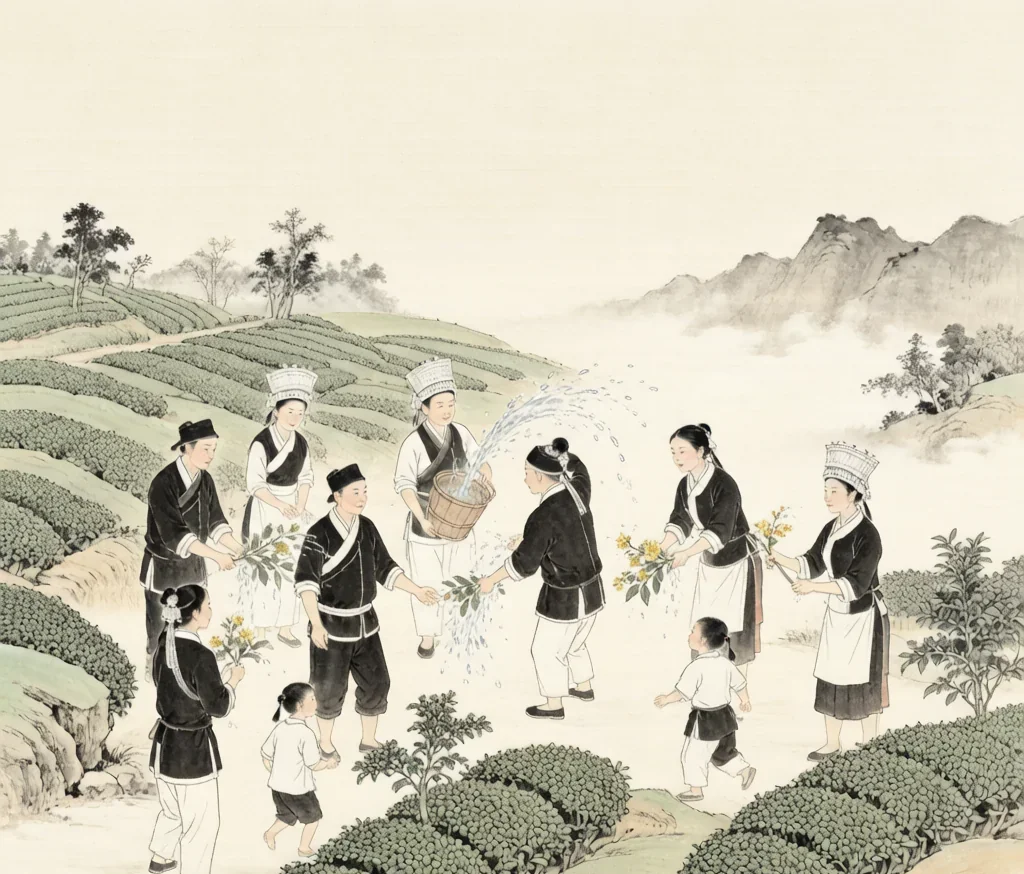
The De'ang, also written as the Deang or formerly the Benglong, are one of the oldest tea-growing peoples of southwest China, residing primarily in the mountainous borderlands of Yunnan Province adjoining Myanmar. A member of the Palaungic branch of the Austroasiatic linguistic family, the De'ang have sustained a distinctive highland culture built around terraced agriculture, forest stewardship, and a deeply rooted tea economy that reaches back more than a thousand years. Though small in population, the community is renowned for its elaborate silver ornament, layered hand-woven textiles, and a syncretic religious life blending Theravada Buddhism with older ancestral customs. Their villages, clustered on cool mountain slopes, preserve oral traditions, courtship music, and festival calendars that reveal a resilient identity within the broader tapestry of Chinese ethnic diversity.
Origins and Ancestry
The De'ang trace their heritage to the ancient Boku or Palaung peoples who inhabited the broad upland zone stretching across what is now southwest Yunnan and northern Southeast Asia. Historical Chinese records from the Tang and later dynasties refer to related communities of the frontier as participants in the wider Nanzhao and Dali polities, and the De'ang, together with the closely related Blang and Wa, are often grouped by scholars as descendants of the early Austroasiatic settlers of the Himalayan southeast. Their own origin narratives frequently describe emergence from a gourd or a tea tree, linking human life directly to the plant that sustains their economy.
Linguistic and archaeological evidence places continuous Austroasiatic presence in the region for millennia, and the De'ang language preserves archaic vocabulary shared with Mon and Khmer. Over centuries the group absorbed influences from neighboring Tibeto-Burman and Tai peoples while retaining a separate identity. Migration legends tell of movement from lower river valleys upward into the mountains to escape conflict and to find cooler lands suited to tea, a pattern that explains the dispersed village geography seen today.
Within Chinese administration the De'ang were formally recognized as one of the fifty-five minority nationalities in the mid twentieth century, an act that consolidated several locally named subgroups under a single official designation. This recognition affirmed their status within the multiethnic framework of the People's Republic and supported efforts to document language, costume, and custom.
Language and Script
The De'ang language belongs to the Palaungic subgroup of the Austroasiatic family and exists in several mutually intelligible regional varieties corresponding to the traditional branches of the people, often identified as the Bulei, Ruomeng, and Raojin speech communities. It is a tonal, monosyllabic language with a rich system of prefixes and infixes that mark grammatical relations, and it shares structural features with the Blang and Wa languages of the same family.
Traditionally the De'ang had no indigenous writing system and relied entirely on oral transmission for history, law, and poetry. With the spread of Theravada Buddhism came literacy in a form of the Pali script used by monks for scriptures, though this remained limited to religious specialists. In the modern period vernacular materials have been produced using the Latin-based pinyin alphabet to record folktales and to support bilingual education in village schools.
Today most De'ang speakers are bilingual in Mandarin Chinese, and younger generations increasingly use Chinese in daily administration and media. Language preservation projects, often coordinated with cultural centers in Yunnan, work to compile dictionaries and to teach the mother tongue as a marker of heritage rather than as a primary medium of public life.
Traditional Dress and Silver Adornment
De'ang clothing is among the most distinctive of the Yunnan highland peoples, characterized by tightly woven indigo and black cotton textiles decorated with bold geometric bands. Women wear long wrapped skirts, fitted jackets, and broad waist sashes, while men don historically short tunics and leggings suited to mountain labor. The most striking element is the profusion of silver: girls and women accumulate heavy neck rings, breast plates, ear tubes, and hemispherical ornaments that signal both beauty and family wealth.
The quantity of silver a woman wears historically marked her stage of life and her standing within the community, and bridal adornment could weigh several kilograms. Artisans hammer and repoussé the metal into motifs of vines, circles, and stylized flowers, techniques passed from elder smiths to apprentices. Cotton thread is dyed with indigo grown locally, and the weaving of a single full costume may occupy many months of careful work.
Color conventions distinguish the branches of the people, with particular stripe arrangements identifying a woman's local community to informed observers. Although everyday dress has simplified with access to bought cloth, festive and ceremonial costumes remain carefully maintained and are displayed at weddings, temple festivals, and important visits.
Religion and Belief
The religious life of the De'ang centers on Theravada Buddhism, introduced from the Burmese lowland sphere over several centuries and now intertwined with older animist and ancestor-respecting practices. Nearly every village maintains a modest monastery where novice monks receive instruction, and the annual round of life-cycle and agricultural rituals is timed in relation to the Buddhist calendar as well as to planting and harvest needs.
Alongside monastery Buddhism, households preserve beliefs in village guardians, mountain spirits, and the protective power of ancestors. Rites at the rice fields, at the hearth, and at the birth of a child blend chanted Pali passages with offerings of food, tea, and paper symbols. Elders serve as ritual specialists who recite genealogies and appease local spirits when illness or misfortune is attributed to supernatural causes.
The integration of Buddhism with indigenous custom is visible in the custom of sending boys to the monastery for a period of training, a practice that builds merit for the family and transmits moral teaching. Lay devotion finds expression in almsgiving, the construction of stupas, and participation in the annual observance marking the Buddha's birth, enlightenment, and death.
Agriculture and the Tea Culture
Tea is the economic and cultural cornerstone of De'ang life, and the people are celebrated as archaic cultivators of the ancient tea forests that cloak the slopes of their homeland. They manage both old-growth tea trees, some centuries old, and younger planted bushes, harvesting tender leaves by hand in spring and again in summer. The processed leaf, often a dark or fermented variety, is traded down to lowland markets and valued for its mellow, aged character.
Beyond tea, the De'ang cultivate rice in terraced fields, maize on drier slopes, and a variety of vegetables, tubers, and fruit in household gardens. Betel nut, pepper, and sugarcane supplement the diet and the small trade economy. Animal husbandry is modest, centered on poultry and pigs, while gathering forest products such as mushrooms, bamboo shoots, and medicinal herbs remains an important seasonal activity.
The tea economy has gained new prominence as regional interest in heritage and ancient-tree tea has grown, bringing both income and outside attention. Cooperative processing and branded village teas have allowed families to capture more value, though elders caution that commercial pressure must not sever the spiritual relationship between the people and the living tea groves their ancestors planted.
Architecture and Village Life
De'ang villages are typically sited on ridges and cool mountain shoulders, arranged as clusters of raised timber houses surrounded by bamboo, banana, and tea. The traditional dwelling is a stilted structure with a steep thatch or shingle roof, a raised veranda for work and socializing, and a partitioned interior that separates the hearth, the sleeping area, and a guest space. Elevation protects against damp and allows livestock to shelter beneath the floor.
Communal space is defined by the monastery, the village drum tower or gathering tree, and open threshing yards where harvest is shared and celebrated. Paths link houses in a loose pattern rather than a grid, reflecting a social order built on kinship and neighborly reciprocity. Water is drawn from protected springs, and forests above the village are often conserved as sacred watersheds.
Domestic architecture has steadily modernized, with many families adopting tiled roofs, brick foundations, and concrete floors while keeping the elevated form suited to the terrain. The monastery and the ceremonial ground, however, remain conservative in construction, preserving the silhouette that identifies a De'ang settlement from a distance.
Festivals and Calendar Customs
The De'ang year is punctuated by festivals that weave Buddhist observance with agricultural and courtship themes. The most important is the Water-Splashing or New Year festival, celebrated in common with several Tai-related neighbors, during which people pour blessed water on one another to wash away misfortune and welcome renewal. Temple rituals, dances, and shared feasts accompany the splashing.
The Rice-Planting and Harvest festivals mark the turning points of the agricultural cycle with songs performed in the fields and offerings to the rice spirit. The Open Door festival concludes the Buddhist retreat season and invites the spirits of the deceased back to the household for brief reunion and food. Each event follows a recognized order of chanting, procession, and communal meal.
Courtship festivals hold special place, as young people gather to sing antiphonal love songs, exchange gifts, and negotiate matches under the relaxed rules of holiday time. These occasions double as the principal venue for musical expression and for the transmission of poetic language between generations.
Music, Dance and Oral Literature
De'ang artistic expression is overwhelmingly vocal and percussive. The gourd flute, the free-reed mouth organ, and the bronze drum provide accompaniment for circle dances performed at festivals and life events. Women's processional songs and men's responsive verses form a dialogic tradition in which poetic skill signals maturity and attractiveness as much as musical talent.
Oral literature comprises origin myths, clan histories, and moral tales transmitted by elders during the long evenings of the cold season. The gourd-origin story, the tale of the tea tree mother, and accounts of the culture hero who taught weaving and rice cultivation circulate in multiple local versions. Such narratives are not merely entertainment but the primary archive of law, etiquette, and memory.
Instrument making is a respected craft, with bamboo and gourd instruments constructed to precise proportions that determine pitch. Dance movements imitate the gestures of planting, pounding, and bird flight, encoding the rhythm of labor into celebratory form and linking the body directly to the agricultural year.
Social Organization and Marriage
Traditional De'ang society is organized around exogamous clans and village neighborhoods bound by reciprocal labor exchange. Marriage outside the clan is required, and unions are negotiated through a sequence of gift exchanges, singing visits, and the formal presentation of bride wealth that includes tea, silver, and cloth. The wedding itself is a multi-day affair joining two families and their villages in feasting.
Elder men and women hold authority in dispute settlement and in the scheduling of communal work, though decisions are typically reached through consensus rather than command. The monastery head and senior ritual specialists advise on matters touching spirits and merit. Kinship terminology distinguishes maternal and paternal lines, and property in land and tea passes through recognized customary rules.
Contemporary legal structures overlay these customs with civil registration and equal-rights provisions, yet many families still observe the traditional gift and singing customs as a matter of honor and continuity. The persistence of matchmaking songs demonstrates how social bonds are continually renewed through performance.
Modern Life and Recognition
In recent decades the De'ang have gained improved access to roads, schools, clinics, and electric power, even as their remote mountain location long delayed such services. Government development programs have supported tea cooperatives, sanitary water, and cultural centers that document costume and language. Young people increasingly pursue secondary and tertiary education and migrate seasonally for wage work while retaining ties to the village.
Cultural revival efforts emphasize the teaching of silverwork, weaving, and the mother tongue in community classes, and festivals have become occasions for respectful tourism that generates income without overwhelming sacred space. Scholars from Yunnan institutes collaborate with elders to record vocabulary and rituals before the oldest bearers pass.
The De'ang exemplify how a small highland community sustains a cohesive identity through tea, Buddhism, and ornament while engaging the modern state. Their story contributes a vital thread to the understanding of Austroasiatic heritage within China and of the diverse peoples who shape the southwestern frontier.
Cuisine and Daily Sustenance
De'ang food centers on rice, maize, and vegetables, flavored with chili, fermented bamboo, wild herbs, and the sour notes of pickled tea leaf eaten as a relish. Tea is consumed constantly, both as a brewed beverage and as a chewed or cooked leaf mixed with salt, garlic, and oil. Betel chewing remains a social habit shared across generations and genders.
Feasting for festivals and weddings features glutinous rice cakes, smoked pork, sour soups, and dishes seasoned with the peppercorn family plants the people cultivate. Communal eating reinforces solidarity, and the host's duty to offer tea and rice to any visitor reflects a deep ethic of hospitality rooted in mountain neighborliness.
❓ Frequently Asked Questions
Where do the De'ang people live?
They live mainly in the mountainous border region of Yunnan Province in southwest China, adjoining Myanmar, in clustered highland villages suited to tea cultivation.
What language do the De'ang speak?
They speak a language of the Palaungic branch of the Austroasiatic family, with regional varieties, and most are also bilingual in Mandarin Chinese.
What is the De'ang religion?
Their life centers on Theravada Buddhism combined with older animist and ancestor-respecting customs observed in both monastery and household rites.
Why is tea so important to the De'ang?
Tea is both their economic foundation and a sacred heritage; they manage ancient tea forests and regard the tea tree as kin to humanity in origin belief.
What makes De'ang dress distinctive?
Indigo hand-woven textiles with geometric bands and heavy silver neck rings, plates, and ear ornaments mark identity, wealth, and life stage.
How do the De'ang celebrate the new year?
They observe a Water-Splashing festival of renewal with blessed water, temple rituals, circle dances, and communal feasting shared with neighbors.