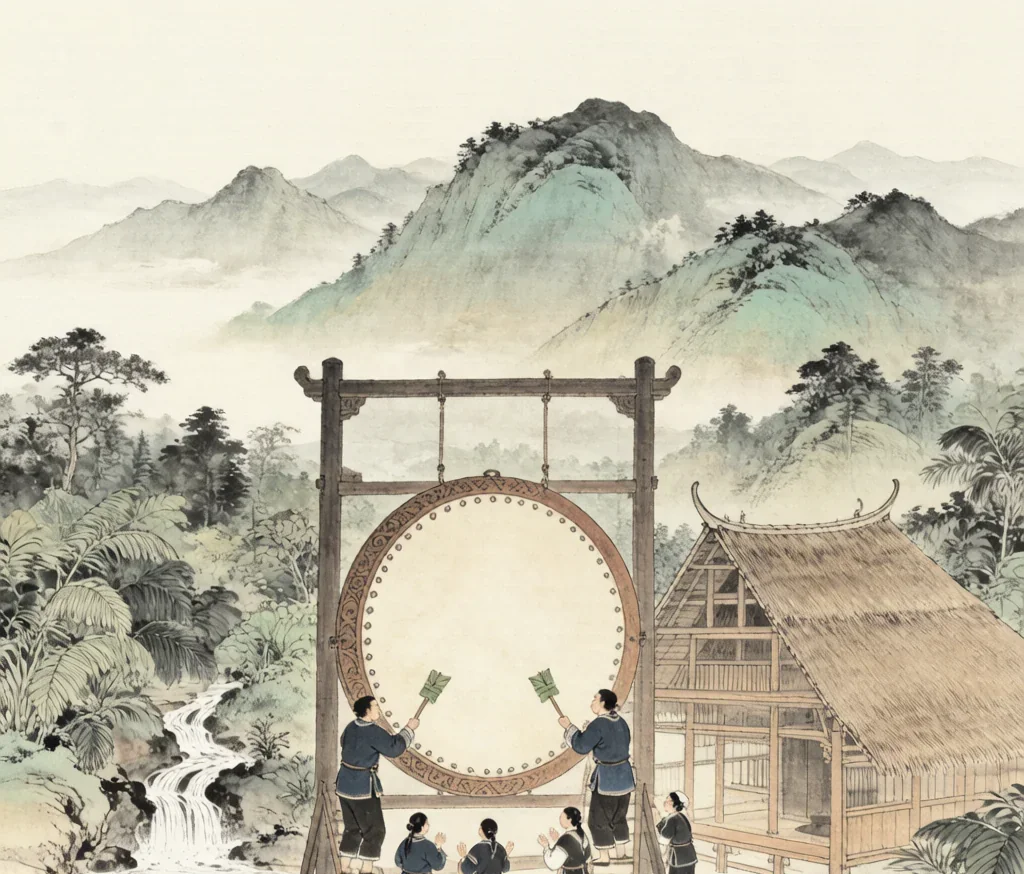
The Jinuo, also written Jino, are a Tibeto-Burman people of the Xishuangbanna tropical hills in southern Yunnan Province, recognized as one of the last ethnic groups to be formally identified as a minority nationality in China, in the late twentieth century. Living in the warm, forested slopes above the Mekong basin, the Jinuo built a culture of swidden agriculture centered on upland rice and tea, governed by a village-based system of elders and the worship of the sun and the village founders. Their oral epics, distinctive unison singing, and the famous sun-drum make them a vivid example of a small highland community preserving a coherent identity within the Dai and Han-dominated lowlands.
Homeland in the Tropical Hills
The Jinuo inhabit the mountainous country of Jinghong and the surrounding Xishuangbanna hills, a zone of monsoon forest, bamboo, and terraced stream where the climate is warm year-round and the vegetation luxuriant. This environment supplies rice land on the slopes, tea bushes in the groves, and the timber and rattan of daily construction, while the lowlands below belong to the Dai rice kingdoms.
Settlement is in compact hill villages sited for defense and water, each surrounded by its swidden fields, tea plots, and the sacred grove where the village founders rest. The vertical relation to the Dai plain shaped a culture of highland autonomy balanced by trade in tea, game, and forest goods for rice and salt from below.
The tropical forest remains the source of medicine, food, and spirit, and the Jinuo hold certain slopes and trees as off-limits, a conservation ethic rooted in reverence rather than regulation. Their place-names and trails record a detailed knowledge of a fecund but demanding hill world.
Origins and Late Recognition
The Jinuo are considered descendants of Tibeto-Burman migrants who moved into the Xishuangbanna hills centuries ago, possibly as a branch separated from the related Lahu or Yi peoples, and who developed a distinct language and custom in relative isolation above the Dai plains. Oral tradition speaks of brothers who emerged from a gourd and settled the mountains as the first villagers.
Because they lived in small, scattered hill communities with no written record, the Jinuo were long counted loosely among neighboring groups and were only officially recognized as a separate minority nationality in the late twentieth century, among the last such identifications in China. This act affirmed a distinct identity and supported the documentation of language and custom.
Recognition brought schools, clinics, and roads into the hills and linked the Jinuo to the wider administration while preserving village autonomy in ritual and land. Their late naming makes them a useful case for understanding how highland peoples were classified within the modern ethnic framework.
Language and Oral Epic
The Jinuo language belongs to the Tibeto-Burman family, close to the Lahu and Yi languages, and was traditionally unwritten, preserved entirely through speech. Neighboring Dai and later Mandarin served as languages of trade and administration, while modern schooling introduces the pinyin alphabet to record the mother tongue.
Oral literature is rich: the epic of the gourd-born ancestors, the tale of the sun and the moon, and the histories of each village's founding are performed by specialist singers and elders. The great chant of origin and migration can span a night, teaching geography, law, and morality to listeners who may never handle a book.
Today bilingual schooling aims to maintain Jinuo speech as a spoken heritage while ensuring access to wider literature. Documentation projects compile dictionaries and record the epics, mindful that a small highland tongue needs active transmission to survive the pull of Mandarin and Dai.
Swidden Agriculture and Tea
The Jinuo economy is built on swidden, or slash-and-burn, cultivation of upland rice supplemented by maize, vegetables, and a household garden, practiced with long fallow that lets the forest regenerate. Skill in reading soil, slope, and weather determines the yield, and the rice spirit is honored at every stage from clearing to storage.
Tea is a historic crop: the Jinuo manage both old tea trees in the forest and planted bushes, harvesting leaves for the local dark and fermented varieties traded down to the plains. Alongside rice and tea, gathering of bamboo shoots, mushrooms, and herbs, plus small hunting and fishing, rounds out the subsistence and the small trade economy.
Modern agriculture has introduced terraced wet rice and cash crops, reducing the swidden area under conservation rules, yet the mixed hill garden and the tea grove remain the ideal of a self-sufficient Jinuo home. Cooperative processing has let families capture more value from heritage tea.
Village Organization and Elders
Jinuo society is famously organized around the village as the sovereign unit, governed by a council of male and female elders who decide on farming, ritual, and dispute. The chief elder and the ritual elder together lead, and consensus rather than command marks decision-making, with the whole community assembled at the threshing ground for major affairs.
Land and forest are held in trust by the village, allocated to households for cultivation and returned to fallow by custom, a system that balanced use with regeneration. Marriage is exogamous across villages and negotiated with bride wealth of silver, cloth, and livestock, and the wedding joins two communities in feast and exchange.
Elders command deference as bearers of the epic and arbitrators of custom, and the young learn by participation in work and rite. Modern committees overlay this structure with civil law, yet the elder council still meets for customary matters, showing how village autonomy persists beneath the state.
Belief and the Sun Drum
Jinuo religion centers on the worship of the sun, the village founders, and a host of nature spirits, expressed most powerfully through the sun drum, a large upright drum painted with the solar sign that is the sacred emblem of the people. The drum is beaten at the great festival to summon the village ancestors and to ensure fertility and peace.
The sun is revered as the source of life, and origin myth tells of a solar mother who sent the first people from the gourd; accordingly the solar disk appears on houses, clothing, and the drum itself. Ancestor spirits of the founders watch over the fields and the hearth, addressed with offerings of rice, meat, and tea at critical moments.
Ritual specialists lead the rites of planting, harvest, and healing, blending chant with the drum, and the sacred grove is the consecrated ground of the founders where no tree may be cut. This solar and ancestral faith binds the village to its land and its dead in a single living order.
Dress and Adornment
Jinuo dress is striking and symbolic. Men traditionally wear a short jacket with the sun emblem, a loincloth, and a broad hat, while women wear a collarless jacket, a short skirt, and a striking headdress of white striped cloth, with both sexes bearing the solar sign as a badge of identity. Indigo and red dominate, with cotton grown and dyed locally.
The white-striped women's cap is the most recognizable mark and signals community at a glance, while silver and bead ornaments appear at festival and marriage. Cloth is woven on backstrap looms by women, and the cut favors the warm climate and the work of the swidden, loose and ventilated.
Because the solar motif is sewn or painted onto garments, dress itself becomes a creed, carrying the people's central symbol on the body. Festival attire adds finer weave and conch or silver trim, displaying the family's connection to the village founders.
Festivals and the Annual Round
The Jinuo year turns on the agricultural and lunar calendar, crowned by the great spring festival of the sun drum, when the village assembles, the drum is beaten, and offerings are made to the ancestors for a good rice year. Rice-planting and harvest rites follow with song, sacrifice, and communal meals in the fields.
Life-cycle events—birth, name-giving, marriage, and funeral—observe clan custom before the elder council, and the dead are mourned with sung lament and with the placing of rice and tea in the grave. Omens read from natural signs still guide the timing of planting and travel.
These gatherings are also the stage for the unison song and the dance, ensuring the calendar teaches cooperation and reverence in alternating rhythm. The threshing ground, marked by the drum, is the true center of Jinuo celebration.
Music, Song and Dance
Jinuo music is notable for its unison singing, in which the whole village joins a leader in a single melodic line without harmony, a sound said to imitate the call of the ancestors across the hills. The sun drum, the bamboo mouth organ, and the gourd flute provide accompaniment, and the bronze or wooden slit drum marks the festival beat.
Oral narrative preserves the gourd origin, the solar mother, and the founding of each village, performed in recited verse that can span an evening. Children learn the melodies and the tales together, so that music is the medium through which the past is inherited and the language kept alive.
Dance steps mimic the motions of clearing, sowing, and pounding, mapping labor onto celebration and keeping the body trained for the year's work. The performative arts thus function as both recreation and a living curriculum of Jinuo values, geography, and faith.
Social Life and Kinship
Jinuo kinship is organized around clans and the village, with exogamy across both clan and settlement preferred to widen alliance. The household is the economic unit, and reciprocal labor groups accomplish clearing, transplanting, and threshing, embedding mutual aid in the social contract. Hospitality to the traveler is a strong norm rooted in the hill distances.
Elders and ritual specialists hold authority in matters of custom and spirit, and the council arbitrates dispute through restitution and feast. The ethic of sharing the rice and the catch binds scattered families into one remembered people, and visiting obligations keep far villages connected.
Modern administration adds elected committees and equal-rights provisions, yet the clan and the elder council remain the true anchors of order. Kinship and the village together form the safety net that lets a small highland people endure change.
Modern Life and Preservation
Roads, schools, and clinics have reached the Jinuo hills, raising literacy and health and drawing young people into wider employment while they keep ties to the village. Cultural programs document the language, the sun drum, and the epic, and heritage tourism around Xishuangbanna highlights Jinuo song and dress.
The challenge is to keep the mother tongue and the swidden knowledge alive as Mandarin and the market dominate, and to protect the sacred groves that supply both spirit and ecology. The Jinuo, last named yet fully themselves, stand as a vivid chapter in the highland heritage of Yunnan.
Cuisine of the Hills
Jinuo food centers on upland rice with pork, chicken, and small game, flavored with chili, wild herb, and the sour bamboo shoot, and sweetened with banana and sugarcane. Tea is constant, both brewed and chewed, and the feast at festival and wedding presents the whole pig and jars of rice wine shared by strict custom.
The ethic of offering the first fruits and the first catch to ancestors and guests reflects both reverence and the hill necessity of mutual support, making the hearth and the shared table central institutions of Jinuo social life and the practical expression of their reciprocal ethic.
❓ Frequently Asked Questions
Where do the Jinuo live?
They live in the tropical hills of Xishuangbanna in southern Yunnan, above the Dai rice plains of the Mekong basin.
What language do the Jinuo speak?
They speak a Tibeto-Burman language close to Lahu and Yi, traditionally unwritten and preserved orally, now recorded in pinyin.
What is the Jinuo sun drum?
It is the sacred emblem of the people, a large drum painted with the solar sign beaten at festival to summon the village ancestors for fertility and peace.
How is Jinuo society organized?
The village is the sovereign unit governed by a council of elders who decide farming, ritual, and dispute by consensus, holding land in trust for the community.
What are the Jinuo known for?
They are known for sun worship, the sun drum, unison village singing, swidden rice and tea culture, and a late official recognition as a minority.
What is distinctive about Jinuo dress?
Both sexes bear the solar emblem on indigo and red cloth, and women wear a white-striped cap that signals community at a glance.