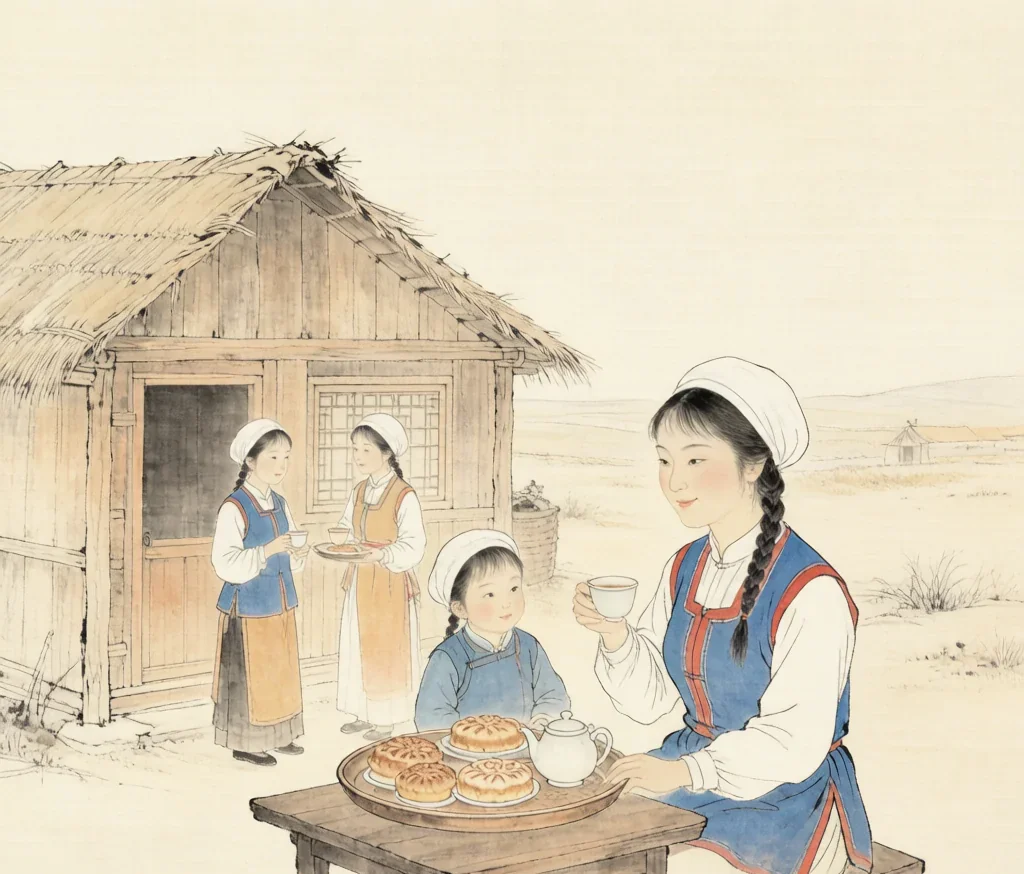
The Tatar, also written Tata'er, are a Turkic Muslim people residing mainly in the Xinjiang Uygur Autonomous Region of northwest China, with historic communities in the cities of Yining, Tacheng, and Urumqi. Descended from Volga Tatars who migrated eastward along the trade routes of the Russian empire and Central Asia from the nineteenth century, the Tatar brought a literate, mercantile, and devout culture that blended Turkic heritage with Islamic scholarship and Russian-influenced education. Though small in number, they are noted for their role in commerce, teaching, and the musical life of the oasis towns, and for a cuisine and dress that reflect the crossroads of steppe, desert, and Islam.
Origins and Migration
The Tatar of China trace their ancestry to the Volga Tatars of the Kazan region, a Turkic people long under Russian rule who developed a strong tradition of trade, religious learning, and modern schooling. From the eighteenth and nineteenth centuries onward, merchants and clerics moved east along the caravan roads through Kazakhstan and Central Asia into the oasis cities of Xinjiang, settling among Uygur, Kazakh, and Hui neighbors.
These migrants were often bilingual in Tatar and Russian and carried with them the reformed education and printing culture of the Volga, establishing schools and lending libraries that served several Muslim communities. Their reputation for honesty in trade and seriousness in study eased integration into the multilingual bazaar society of the frontier.
Recognition as a minority nationality in the twentieth century gave the Chinese Tatar a distinct official identity separate from the larger Uygur and Kazakh populations, even as they shared language family and faith. Their story is one of a diaspora merchant people who planted a small but literate community at the far end of the Silk Road.
Language and Education
The Tatar language is a member of the Kipchak branch of the Turkic family, close to Kazakh and Bashkir, and was traditionally written in a variant of the Arabic script before the Latin and Cyrillic reforms of the twentieth century. The Chinese Tatar community used Arabic-script Tatar for home and school, alongside the Russian they often knew through migration.
Education has been the community's hallmark: Tatar migrants founded modern schools teaching science, geography, and languages alongside the Quran, and they valued sending daughters to school as well as sons. This emphasis produced a disproportionately literate and professional class of teachers, doctors, and clerks within the oasis towns.
Today most Tatar in China speak Uygur or Kazakh and Mandarin in addition to their heritage tongue, and the number of native speakers is modest. Documentation and cultural projects work to record the language and the community's history before the oldest bearers pass, mindful that a small diaspora tongue needs deliberate care.
Homeland in the Oasis Towns
The Tatar in China are an urban and market people rather than a village or pastoral group, concentrated in the trading cities of the Ili and Tacheng regions and in Urumqi. They thrived in the mixed bazaar economy where Turkic, Mongol, Han, and Russian merchants met, supplying goods, credit, and the written word across linguistic lines.
Their neighborhoods combined the courtyard house of the oasis with Russian-influenced detailing, and the mosque and the school stood at the center of communal life. Because they were few, the Tatar relied on tight kinship and association networks, holding mutual-aid societies that helped newcomers find work and buried the dead according to rite.
Living as a minority within minorities, the Tatar developed a flexible, cosmopolitan identity, at home in several languages and comfortable brokering between communities. The oasis market, with its call of many tongues, is the true setting of Tatar history in China.
Islam and Scholarship
Islam is the defining faith of the Tatar, practiced in the Sunni Hanafi form shared with the Uygur and Kazakh neighbors, and enriched by the scholarly tradition of the Volga madrasas. The mosque and the religious school anchored the community, and the pilgrimage to Mecca was a cherished goal marking a family's standing.
The Tatar brought a reformist spirit to Islamic education, promoting printed books, modern subjects, and the education of women alongside the classical texts. This produced a cadre of imams and teachers who served not only Tatar congregations but the wider Muslim public of the towns, earning respect across ethnic lines.
The religious year of Ramadan, Eid, and the sacrifice festival structures communal time, and the ethics of honest trade, charity, and hospitality frame daily conduct. Faith thus bound the dispersed Tatar to a worldwide ummah while marking them as a people of the book and the ledger alike.
Trade, Craft and Urban Life
Commerce has been the Tatar vocation, from caravan trade in wool, tea, and manufactured goods to shopkeeping, milling, and money-changing in the bazaars. Their reputation for fair dealing and bookkeeping made them trusted intermediaries, and many served as clerks and translators in the multilingual frontier administration.
Craft skills included leatherwork, tailoring, and the baking of the layered bread that became a local staple, while Tatar women were noted for fine embroidery and for running the home economy during husbands' travel. The community's associations organized festivals, charity, and the care of orphans and widows.
Though small, the Tatar presence in the market was disproportionate to their number because literacy and trust compounded into influence. Their urban craft and trade ethos contrasts with the pastoral Turkic neighbors and shows the merchant face of the Turkic Islamic world.
Dress and Adornment
Tatar clothing reflects the meeting of Turkic, Russian, and oasis styles. Men wore a rounded cap, a fitted jacket over a shirt and trousers, and a robe for formality, while women wore a embroidered cap or headscarf, a long dress, and a vest, with silver and coral ornaments at festival and wedding.
The white embroidered cap is the most recognizable male mark, and women's headdress signals marital status according to Islamic and local custom. Russian influence appears in the cut of coats and boots, while the desert climate kept fabrics light in summer and padded in winter. Festival dress adds brocade and beadwork acquired through trade.
Because the Tatar were urban, their dress was town-made rather than home-spun, purchased from the bazaar and tailored to taste. Clothing thus signaled both faith and a cosmopolitan, mercantile identity carried through the markets of the frontier.
Cuisine and Hospitality
Tatar food blends Turkic steppe and Russian influences: baked breads, stuffed pastries, noodle soups, and mutton pilaf share the table with dairy, honey, and the sweet layered cake favored at feast. Tea poured from a long-spouted pot accompanies every visit, and the etiquette of pouring affirms rank and affection.
The communal meal is central to hospitality and to religious feast, where a whole sheep may be shared by prescribed portion and where guests are served the choicest cuts. Preserves, dried fruit, and the fermented drink of the north appear at celebration, marking the Tatar table as both generous and ordered.
Frugality and fairness shape the kitchen, and the duty to feed the traveler and the poor is a religious as well as social norm in a land of long caravan distances. The shared table remains the principal bond of Tatar community life in the oasis towns.
Music, Song and Dance
Tatar musical culture is among the richest of the Turkic communities, built on the accordion-like keyboard, the fiddle, and the frame drum, with a repertory of lyrical songs, spirited dances, and the call-and-response of the hearth. The Tatar song style, both melancholy and playful, traveled with migrants and influenced neighbors.
Oral literature includes love lyrics, traveler's songs, and tales of the Volga homeland kept alive across generations of eastward distance. Storytelling and singing at the association hall and the home taught the young the language and the values of the people, and the best musicians were honored across the town.
Dance at festival joins the community in circling steps that mimic the market and the meadow, mapping both trade and nature onto celebration. The performative arts thus function as both recreation and a living curriculum of Tatar identity, geography, and faith.
Social Order and Kinship
Tatar society is organized around extended families and voluntary associations rather than clan territory, reflecting an urban, migrant base. Marriage is arranged within the faith, often between allied families across the Turkic communities, with bride wealth and the wedding feast affirming the union before the congregation.
Elders and religious scholars command deference as bearers of law and memory, and the association council advises on both ritual and civil matters. Mutual aid, charity to the poor, and the duty to host the traveler embed cooperation in daily life, essential for a small people in a competitive bazaar.
Modern civil administration adds elected committees and equal-rights law, yet the family and the mosque remain the true anchors of order. Kinship and faith together form the safety net that lets a scattered merchant people endure distance and change.
Modern Life and Preservation
In the twentieth century the Tatar of China entered schools, offices, and professions in growing numbers, even as migration and intermarriage reduced the pool of native speakers. Young people attend university and work in cities, maintaining community ties through association and festival rather than through separate settlement.
Cultural preservation documents the language, the songs, and the migration history, and heritage events in Xinjiang highlight Tatar music and food. The challenge is to keep the mother tongue alive as Uygur, Kazakh, and Mandarin dominate, and to honor a mercantile heritage in a planned economy's wake.
The Tatar show how a small Turkic diaspora sustained identity through faith, schooling, and the shared table. Their story enriches the Muslim and Turkic heritage of China's northwest frontier.
Festivals and the Religious Year
The Tatar year follows the Islamic lunar calendar, opened and closed by the fast and feast of Ramadan and Eid, with the sacrifice festival marking the trial of Abraham. These occasions bring communal prayer, the sharing of meat, and the visiting of graves, while the prophet's birthday is observed with recitation.
Life-cycle events follow religious law before the imam, and the association hall hosts the feast that binds families and strangers alike. The festival ground and the mosque courtyard, where the faithful gather, are the truest images of Tatar solidarity in the oasis town.
❓ Frequently Asked Questions
Where do the Tatar live in China?
They live mainly in the oasis cities of Xinjiang, especially Yining, Tacheng, and Urumqi, as an urban and mercantile community.
What language do the Tatar speak?
They speak a Kipchak Turkic language traditionally written in Arabic script, and most also use Uygur, Kazakh, and Mandarin today.
What are the Tatar known for?
They are noted for trade, modern education, Islamic scholarship, and a rich musical tradition within the Xinjiang oasis towns.
What do the Tatar believe?
They are Sunni Muslims of the Hanafi school, with a reformist educational tradition that valued printing, science, and the schooling of girls.
How did the Tatar come to China?
Volga Tatar merchants and clerics migrated eastward along the caravan routes from the nineteenth century, settling among the Turkic peoples of Xinjiang.
What is distinctive about Tatar culture?
Their blend of Turkic, Russian, and oasis influences appears in dress, cuisine, and song, and in a mercantile, literate, association-based community life.