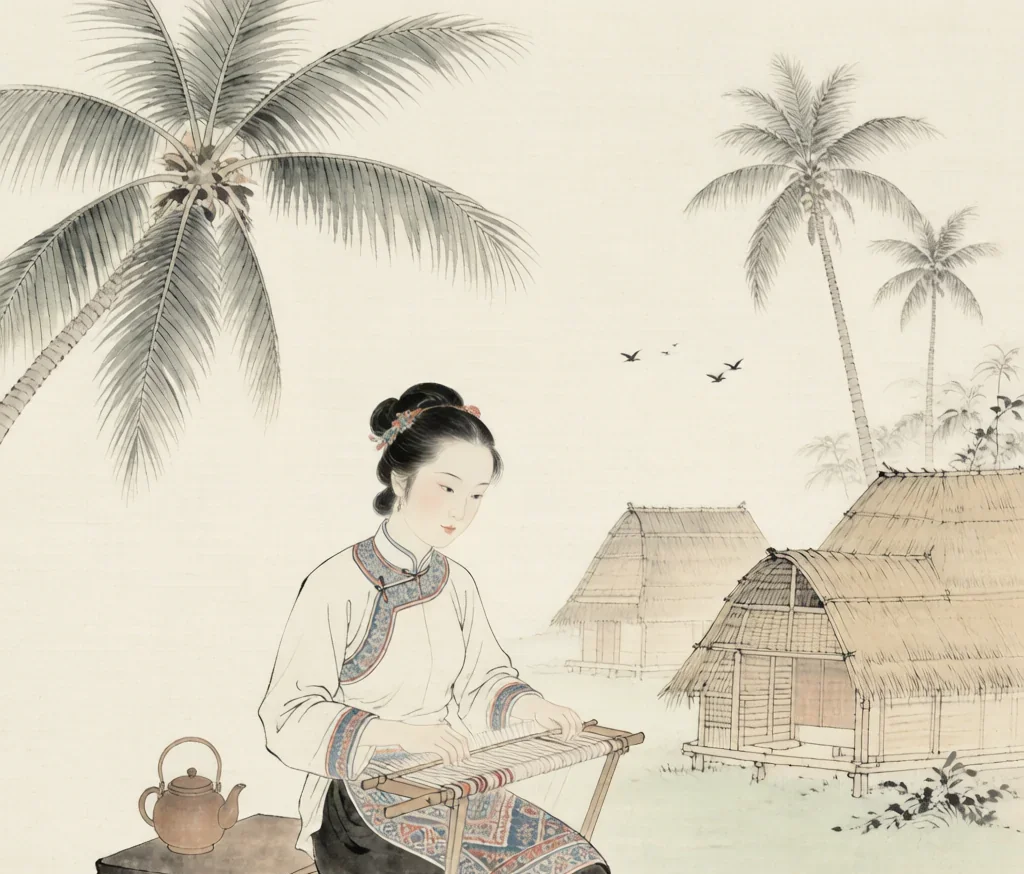
The Li, also written Lizu or Li nationality, are the principal indigenous people of Hainan Island in the South China Sea, residing in the mountainous interior of the province away from the coastal Han settlements. Speaking a language of the Tai-Kadai family related to Zhuang and to the languages of mainland Southeast Asia, the Li have built a culture of wet-rice and dry-field agriculture, renowned throughout China for the art of woven brocade with its striking human, animal, and geometric motifs. Their history of resistance to outside rule, their distinctive boat-shaped houses, and their vibrant song and dance traditions make them a foundational community of the island's cultural landscape.
Homeland of the Island Interior
The Li homeland is the central highlands of Hainan, a spine of forested mountains and fertile valleys rising from the tropical coast. This interior, warmer and wetter than the north, supports rice terraces, groves of coconut and betel, and the dense woods that supply the dye plants and fibers of the famous textile art. The sea lies beyond the coastal plain settled by later Han migrants.
Traditionally the Li occupied the mountainous core while Han Chinese farmed the rim, a pattern of concentric settlement that shaped centuries of tense but productive exchange in salt, iron, and cloth. The highland provided refuge and autonomy, and the rivers flowing down to the coast linked the two zones in trade and occasional conflict.
The tropical environment allowed a generous agriculture and a rich gathering of wild foods, and the Li developed deep knowledge of the forest medicine, rattan, and timber that the island supplies. Their place in Hainan is thus that of the original custodians of the interior world.
Language and Oral Tradition
The Li language belongs to the Tai-Kadai family, with several dialects corresponding to the major branches of the people, and is related to the Zhuang and to the languages of Thailand and Laos. Traditionally the Li had no widely used script of their own and relied on oral transmission, though in the modern period the Latin-based pinyin alphabet is used to record the language and to support bilingual schooling.
Oral literature comprises origin myths, clan histories, and a vast repertory of lyric and work songs performed in the fields, at festival, and in courtship. The sung dialogue between young men and women is the chief poetic art, and the best singers are admired as much for wit as for voice. Proverbs encode farming and forest lore.
Today most Li are bilingual in Mandarin, and younger speakers use Chinese in public life, so documentation projects record dialect and song to keep the mother tongue alive. The spoken word remains the vessel of an identity tied to the island's hills and waters.
Origins and History
The Li are among the earliest Austronesian-related or Tai-Kadai peoples to have settled Hainan, arriving in waves from the mainland over two thousand years ago and establishing wet-rice cultivation in the interior. Chinese records from the Han dynasty onward mention the island's native people and the tribute of cloth and incense they supplied to the court.
Across imperial history the Li alternated between tributary relation and open resistance to encroachment, mounting notable rebellions against taxation and land loss that the central state answered with garrisons and resettlement. Despite pressure, the Li retained autonomous highland communities and a distinct social order rooted in clan and village.
Recognition as a minority nationality in the twentieth century brought schools, clinics, and roads into the interior and affirmed Li identity within the multiethnic republic. Their long history of defense of the highlands is a source of communal pride and a recurring theme in song and story.
Agriculture and Forest Use
The Li economy rests on rice, grown both in flooded terraces and in dry swiddens on the hillsides, supplemented by maize, sweet potato, and a rich garden of vegetables, banana, and sugar cane. Skill in water control and in selecting seed for the wet valleys made them respected cultivators, and surpluses supported the specialist weavers and ritual specialists.
The forest supplies the raw materials of life: kapok and cotton for thread, indigo and other plants for dye, rattan and hardwood for building, and a profusion of medicinal herbs. Gathering and small hunting supplement the diet, and the betel-nut habit links social and ritual life across the generations.
Traditional practice included slash-and-burn rotation on the slopes, balanced by long fallow that let the forest recover, an ecology now constrained by conservation rules and population. Modern extension has introduced improved rice and cash crops, yet the mixed highland garden remains the Li ideal of a self-sufficient home.
The Art of Li Brocade
The Li are celebrated across China for their woven brocade, a textile of cotton and silk dyed in indigo, red, and yellow and patterned with human figures, frogs, deer, birds, and geometric signs. Women spin, dye, and weave on backstrap looms, and the finest cloth, once reserved for ceremony and tribute, is a landmark of Chinese ethnic art.
The motifs are not mere decoration but a coded record of cosmology, clan, and story: the double-faced figure, the ancestor spirit, and the mountain-and-water band each carry meaning taught from mother to daughter. The complexity of the pattern signals the weaver's skill and the family's standing, and the cloth accompanies the life-cycle from birth wrap to funeral shroud.
Because the art is gendered and hereditary, its transmission is a serious cultural duty, and master weavers are honored as bearers of the people's memory. Contemporary revival programs exhibit Li brocade and teach the loom to the young, recognizing it as a national intangible heritage worthy of protection.
Village and Boat-Shaped House
Li settlement forms scattered hamlets of the distinctive boat-shaped or saddle-roofed house, a low timber and thatch dwelling with a raised floor, a steep roof sweeping nearly to the ground, and an interior divided for hearth, sleep, and guest. The form is adapted to the tropical rain and heat, shedding storms and shading the living space.
The village centers on the threshing ground and the banyan or gathering tree where meetings, dances, and rites occur, and on the communal well or spring. Kinship compounds cluster by clan, and the headman and the ritual elder coordinate work and custom. Fences of live hedge mark the household yard and the precious rice store.
Modern building has introduced brick and tile while keeping the raised floor and the yard, and electrification has eased the humid nights. Yet the boat-shaped roof remains the emblem of Li home, recognizable from the hills as the signature of the island's first people.
Dress and Adornment
Li dress is defined by the brocade: women wear a short jacket, a sarong-like skirt, and a head cloth richly patterned, while men wear a tied waistcloth and a simple jacket, with both sexes barefoot in the warm climate. Silver and shell ornaments, bead necklaces, and the ceremonial waist string mark festival and life stage.
The patterns and the cut of the skirt identify a woman's clan and branch to informed observers, functioning as a kind of worn genealogy. Hair is dressed according to age and marital state, and the betel-stained teeth of elders were traditionally a mark of maturity and shared custom rather than defect.
Everyday clothing has simplified with bought cloth, but festival and wedding dress still display the full brocade, and the loom remains a presence in the home. Dress thus carries both beauty and the encoded history of the people on the body itself.
Festivals and the Annual Cycle
The Li year follows the agricultural and lunar calendar with festivals that blend farming ritual and courtship. The most important is the Spring Festival of the third month, a gathering for singing, swinging, and matchmaking under the banyan, when youth display poetry and voice in antiphonal song.
Harvest and rice-soul ceremonies give thanks and invite the spirit of the grain back to the store, with communal feasting and the sacrifice of a pig. Life-cycle rites of birth, name-giving, and funeral follow clan custom, and the dead are mourned with sung lament and with the placing of brocade in the grave.
These occasions are also the stage for dance and the mouth harp, ensuring the calendar teaches cooperation and reverence in alternating rhythm. The banyan ground, trampled firm by dancers, is the true center of Li celebration.
Music, Dance and Song
Li performance centers on the voice: the antiphonal love song, the work song of the terrace, and the lament of mourning are the principal forms, accompanied by the mouth harp, the nose flute, and the bronze drum. The bronze drum, shared with neighboring Zhuang, marks festival and rite with its deep call.
Oral narrative preserves origin myth—of the gourd siblings who repopulated the world, of the culture hero who taught weaving and rice—and the etiquette of song contest that teaches the young the language and the values of the people. The best singers are remembered in later tales as ancestors worthy of recall.
Dance mimics planting, pounding, and the flight of birds, mapping labor onto celebration and keeping the body trained for the year's work. The performative arts thus function as both recreation and a living curriculum of Li identity, geography, and faith.
Social Order and Kinship
Li society rests on exogamous clans and village neighborhoods bound by reciprocal labor and the authority of elders and a headman. Marriage is negotiated with bride wealth of silver, cloth, and livestock and is exogamous across clans; the wedding is a multi-day event of song, feast, and the exchange of brocade that joins two families.
Elders command deference as bearers of memory and arbitrators, and the ritual specialist advises on spiritual matters of field and hearth. Reciprocal labor groups accomplish terrace repair and house raising, embedding mutual aid in the social contract. Hospitality to the traveler is a strong norm rooted in the island's distances.
Modern administration adds elected committees and civil law, yet many families still observe traditional gift and labor exchanges as a matter of honor. The persistence of clan consultation shows how older institutions adapt rather than vanish under the state system.
Modern Life and Preservation
Roads, schools, and clinics have reached the Li highlands, raising literacy and health and drawing young people into wider employment while they keep ties to the village. Cultural programs document the language, the brocade, and the bronze-drum dance, and heritage tourism around Hainan highlights Li weaving and song.
The challenge is to keep the loom and the mother tongue alive as Mandarin dominates public life, and to protect the forest that supplies dye and fiber. The Li stand as the original people of Hainan, whose brocade carries the encoded memory of the island's first farmers and weavers.
Cuisine of the Island
Li food centers on rice with pork, chicken, and river fish, flavored with wild herbs, chili, and the sour bamboo shoot, and sweetened with coconut and banana. Betel nut and tea are constant, and the feast at festival and wedding presents the whole pig and jars of rice wine shared by strict custom.
The ethic of offering the first fruits and the first catch to ancestors and guests reflects both reverence and the island necessity of mutual support, making the hearth and the shared table central institutions of Li social life and the practical expression of their reciprocal ethic.
❓ Frequently Asked Questions
Where do the Li live?
They live in the mountainous interior of Hainan Island in the South China Sea, the original custodians of the highland region.
What language do the Li speak?
They speak a Tai-Kadai language related to Zhuang and to the languages of mainland Southeast Asia, traditionally oral and now recorded in pinyin.
What are the Li known for?
They are celebrated for Li brocade, a patterned woven textile of human and animal motifs, and for their boat-shaped houses and song traditions.
What is distinctive about Li houses?
They build low boat-shaped or saddle-roofed timber dwellings with a raised floor and a steep thatch roof adapted to tropical rain and heat.
How do the Li make a living?
They practice wet-rice and dry-field agriculture, gather forest products, and weave brocade, with betel and small hunting supplementing the diet.
What is the Li spring festival?
The third-month festival gathers youth for antiphonal singing, swinging, and matchmaking, with dance and the bronze drum marking the occasion.