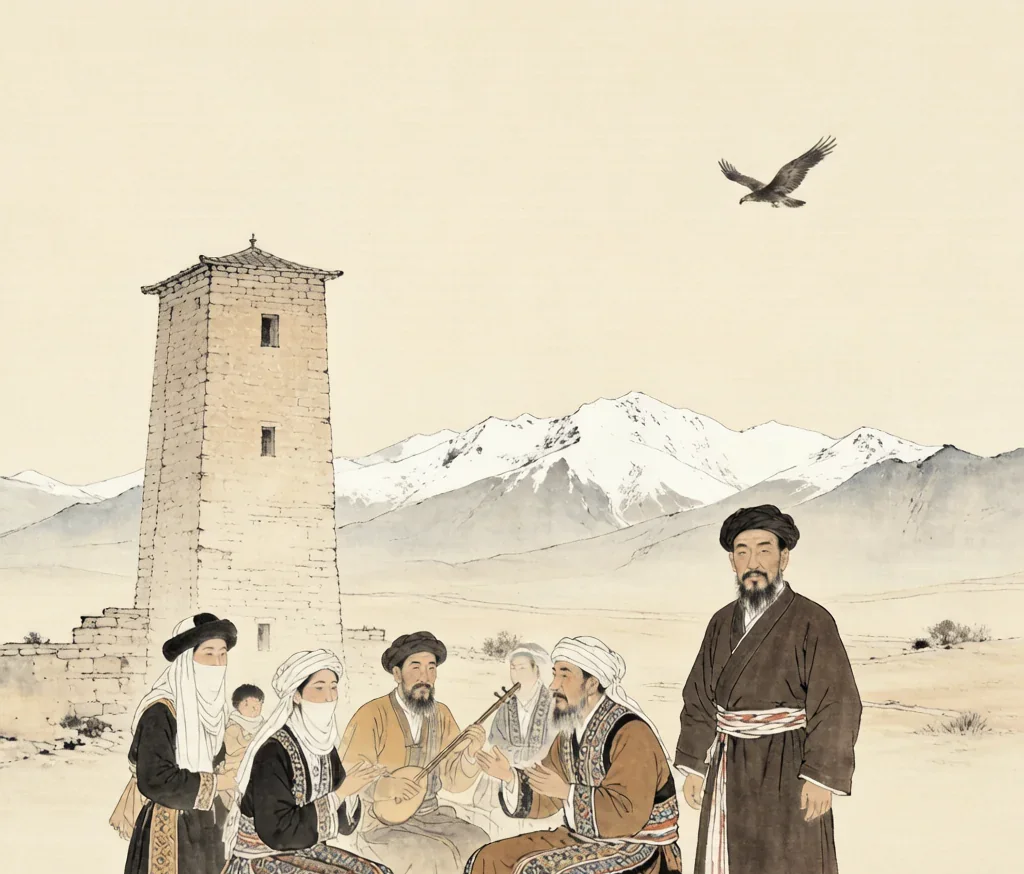
The Tajik, or Tajikezu (塔吉克族), are a people of about 50,000 in China who live almost entirely on the Pamir Plateau in Tashkurgan Tajik Autonomous County of southwestern Xinjiang, where the borders of China, Pakistan, Afghanistan, and Tajikistan meet. Distinct from the Tajik of Tajikistan — who speak a Persian dialect — China's Tajiks speak Eastern Iranian languages (Sarikoli and Wakhi) and are mostly Ismaili Shia Muslims. Celebrated for the exuberant "Eagle Dance" (Tiaoyue), their high-altitude agropastoral life, and the legendary "father of the eagle" folklore, they are the only Iranian-speaking minority among China's peoples of the east. Strangers to lowland China, the Tajiks have nonetheless guarded the roof of the world for countless generations, their culture shaped by thin air, snow, and the long caravans that once crossed their passes.
The Pamir Homeland
The Chinese Tajiks inhabit the "Roof of the World" — the Pamir Plateau — at altitudes often above 3,000 meters, in Tashkurgan along the Karakoram Highway. The stark, snow-bound landscape shapes every aspect of life.
Tashkurgan ("stone tower" in Uygur) was a stop on the ancient Pamir crossing of the Silk Road, and the Tajiks have long been mountain custodians of this strategic high pass between Central and South Asia.
Eastern Iranian Heritage
China's Tajiks are Iranian-speaking, but unlike the Tajiks of Tajikistan they do not speak Tajik (a Persian dialect). Instead they speak Sarikoli and Wakhi, two Eastern Iranian languages close to the ancient Saka tongues of the Pamirs. This linguistic distance from their co-ethnic namesakes underscores how isolation on the roof of the world preserved an older stratum of Iranian speech long after Persian dialects spread elsewhere, making the Pamir languages a living archive of the region's deep past.
This makes them linguistically unique in China: the only Iranian-speakers among the country's minorities, distant cousins of the Persian world yet isolated for centuries in the high mountains.
Language and Script
Sarikoli and Wakhi are oral languages with no standard traditional script; the Tajiks use Chinese for writing and administration, and many also speak Uygur and Mandarin. The two languages are not mutually intelligible.
Because speaker numbers are small, both tongues are vulnerable, and local efforts record vocabulary and oral poetry. The spoken word carries the eagle legends and love songs of Pamir culture.
Religion: Ismaili Shia
Most Chinese Tajiks are Ismaili Muslims, a branch of Shia Islam, following the Aga Khan as their spiritual leader — distinct from the Sunni Uygur and Kazakh neighbors of Xinjiang. Their practice is moderate and locally adapted.
Mosques and pious gatherings mark the religious year, but Pamir custom also honors the natural world. The blend of Ismaili devotion and mountain folklore gives Tajik ritual a distinctive cast. Pilgrimage to local shrines and the blessing of flocks sit comfortably beside Friday prayer, so that faith and highlands life are entwined rather than separate. This moderate, locally rooted practice has helped the Tajiks maintain their identity while living among Sunni neighbors with different observance.
The Eagle Dance
The signature Tajik performance is the Eagle Dance (Tiaoyue), a solo or paired dance mimicking the soaring and turning of the golden eagle, accompanied by the "surnai" (oboe) and "daf" (frame drum).
The eagle is the Tajik totem, and the dance expresses both reverence and joy. Performed at weddings and festivals, it is a celebrated symbol of Pamir identity and a recognized intangible tradition.
Eagle Folklore
Tajik myth tells of a "father of the eagle" who taught the people to sing and dance, and of eagles as messengers between humans and the mountain spirits. The bird pervades song, ornament, and self-image.
This eagle symbolism distinguishes Tajik culture from the neighboring Turkic peoples and ties it to a broader Central Asian highlands aesthetic of the raptor as noble spirit.
Agropastoral Life
On the cold plateau the Tajiks combine limited agriculture — barley, wheat, and peas grown in sheltered valleys — with transhumant herding of sheep, goats, and yaks on high summer pastures. The short growing season and thin air make farming precarious, so livestock and trade across the passes supplement the diet. Mobility between valley homes and upland camps structures the year, and the careful stewardship of meltwater channels is a communal art passed down through generations of mountain farmers.
The short growing season and thin air make farming precarious, so livestock and trade across the passes supplement the diet. Mobility between valley homes and upland camps structures the year.
The Water-Leading and Sowing Festivals
Two key Tajik festivals are the "Yin Shui Jie" (Water-Leading Festival) and the "Bo Zhong Jie" (Sowing Festival), held in spring to inaugurate the agricultural cycle with rites for water and seed.
Communities clean and open the irrigation channels, offer prayers, and feast, celebrating the return of growth to the plateau. These rites underscore the Tajiks' dependence on managed meltwater.
Clothing and Adornment
Tajik dress is adapted to the Pamir cold: men wear long woolen coats, tall boots, and the round, embroidered "tilah pok" hat; women wear embroidered dresses, trousers, and a distinctive embroidered cap with trailing tassels.
Ornament of silver, coral, and coins frames the face, and the hat is a proud marker of identity. Bright embroidery contrasts with the monochrome snowscape of the homeland.
Cuisine
Tajik food centers on wheat flatbread, dairy (butter, yogurt), and mutton, with milk tea as the constant companion. Barley and hand-pulled noodles appear in winter, and dried fruit sweetens feasts.
Hospitality is lavish despite the harsh surroundings; a guest is pressed with tea, bread, and meat. The diet reflects both pastoralism and the limited agriculture of the high valleys.
Modern Life on the Plateau
The Karakoram Highway and border trade have connected Tashkurgan to the world, bringing schools, clinics, and tourism to the plateau. Many Tajiks now engage in trade and services alongside herding.
Cultural programs promote the Eagle Dance and festivals as heritage, while language preservation faces the usual pressures of a small mountain community. The Tajiks remain a vivid emblem of China's Pamir frontier.
❓ Frequently Asked Questions
Where do China's Tajiks live?
Almost entirely in Tashkurgan Tajik Autonomous County on the Pamir Plateau of southwestern Xinjiang.
What language do they speak?
Eastern Iranian languages — Sarikoli and Wakhi — not the Tajik Persian of Tajikistan; they write in Chinese.
What religion do they follow?
Most are Ismaili Shia Muslims, following the Aga Khan, distinct from the Sunni Uygur and Kazakh neighbors.
What is the Eagle Dance?
A dance mimicking the golden eagle, accompanied by oboe and drum, performed at weddings and festivals as a Pamir symbol.
What is their traditional livelihood?
High-altitude agropastoralism: barley and wheat in valleys plus herding sheep, goats, and yaks on summer pastures.
What are their main festivals?
The Water-Leading and Sowing festivals in spring, which open irrigation and bless the seed for the short growing season.