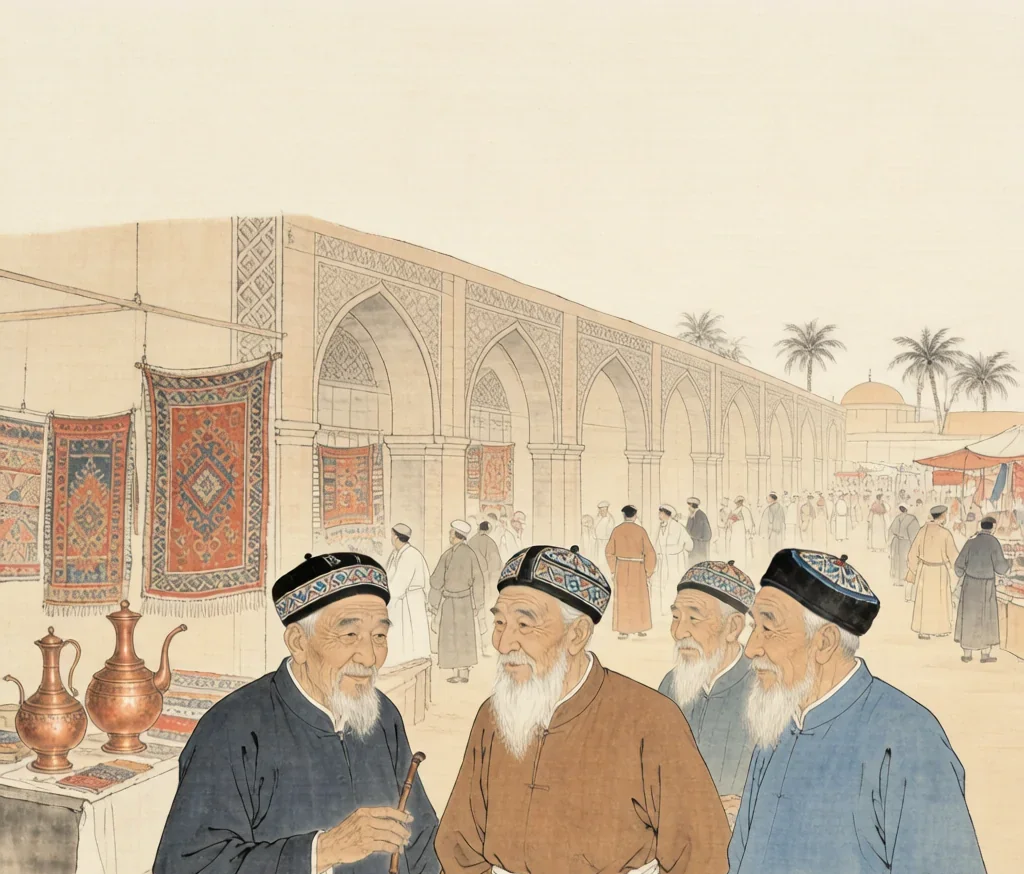
The Uzbeks in China, known as the Wuzibiekezu (乌孜别克族), form a small but culturally rich Turkic Muslim community of roughly 10,000 people, almost all resident in the Xinjiang Uygur Autonomous Region. Descended from the Uzbek merchants and settlers who traveled the Central Asian oasis cities for centuries, they are concentrated in the bazaar towns of Kashgar, Yining (Ghulja), and Urumqi. Long celebrated as traders, craftsmen, and bearers of a refined musical and literary heritage, the Chinese Uzbeks maintain close cultural ties to the broader Uzbek world while contributing a distinct thread to China's multi-ethnic tapestry.
Historical Background
The name Uzbek traces to Öz Beg Khan, a fourteenth-century ruler of the Golden Horde, but the people themselves are the product of millennial mixing among Sogdian, Turkic, and Mongol populations of the Central Asian steppes and oases. Caravan routes funnelled Uzbek communities into what is now Xinjiang, where they acted as middlemen between China, Persia, and Russia.
By the Qing period, Uzbek merchants were well established in the Tarim Basin and the Ili valley, running shops and inns that served the Silk Road trade. Their mobility and commercial networks made them a recognizable urban minority in the region's principal towns. Unlike the oasis farmers around them, the Uzbeks were quintessential townspeople, their wealth and status measured in ledgers and caravans rather than fields, a profile that set them apart within Xinjiang's predominantly rural Muslim societies.
Distribution in China
Within Xinjiang the Uzbeks are an overwhelmingly urban people. The largest concentrations are in Kashgar and Yining, historic trading hubs, with a smaller presence in Urumqi, the regional capital. Unlike many of China's minorities who are defined by a rural homeland, the Chinese Uzbeks have long been town-dwellers.
Because their numbers are small and they share language and faith with the Uygur and Kazakh neighbors, Chinese Uzbeks have often lived intermingled in mixed neighborhoods, preserving identity through family, cuisine, and performance rather than territorial autonomy.
Language and Literature
The Chinese Uzbeks speak Uzbek, a Turkic language written historically in Arabic script and closely related to Uygur and Kazakh. In daily life many also speak Uygur or Mandarin Chinese, and formal education uses Chinese and, in some contexts, Uygur.
Uzbek literary culture is celebrated for classical poets such as Alisher Navoi, whose Chagatai-language works are revered across the Turkic world. Chinese Uzbek families often treasure handwritten songbooks and poetry, keeping a written tradition alive even as spoken use narrows.
Religion and Community Life
Like their Central Asian kin, the Chinese Uzbeks are Sunni Muslims of the Hanafi school. Daily prayer, the Friday congregation, and the festivals of Eid al-Fitr and Eid al-Adha structure the religious year, and neighborhood mosques serve as both worship and social centers.
Islamic observance blends with local custom: charitable giving, ritual circumcision for boys, and communal feasting mark the rhythm of community life. Religious identity is a central marker of Uzbek distinction within Xinjiang's diverse Muslim populations.
Economy and Traditional Crafts
Trade has been the signature Uzbek occupation for generations. Historically they dealt in livestock, hides, tea, silk, and dried fruit, and many ran caravanserais that housed traveling merchants. Today Uzbeks participate in retail, catering, and small manufacturing across Xinjiang's cities.
Traditional crafts include fine embroidery, felt-making, and the production of skullcaps (doppi) and woven goods. Uzbek bazaars remain lively spaces where this mercantile heritage is visibly performed in the display of spices, textiles, and metalwork.
Music and Dance
Uzbek performing arts are among the community's proudest offerings. The muqam classical suites — shared across Central Asia and related to the Uygur Muqam (a UNESCO intangible heritage) — combine sung poetry with lutes, drums, and fiddles in modes that can last for hours.
Social dances such as the lively "Tanovar" are performed at weddings and holidays, with performers in embroidered robes executing precise, graceful steps. Uzbek song, whether folk ballad or art music, is noted for its lyricism and ornamented melody.
Cuisine
Uzbek food reflects the oasis civilization of Central Asia: plov (pilaf of rice, carrot, and mutton), hand-pulled noodles, stuffed pastries (samsa), and flatbreads baked in tandoor-like ovens. Meals center on mutton and wheat, with dairy from sheep and goats.
Tea culture is central, and hospitality dictates that a guest be offered bread, tea, and at least a small spread. Festive tables groan with dried fruit, nuts, and sweets, underscoring the Uzbek ideal of generous hosting.
Festivals and Ceremonies
The great Islamic festivals anchor the year, but Uzbek life also marks life-cycle events with elaborate ritual. Weddings unite families through negotiated matches, music, and several days of celebration; circumcision ceremonies for boys are likewise communal affairs.
Nowruz, the pre-Islamic spring new year observed across Turkic Central Asia, is celebrated by some Uzbek families with special foods and gathering, weaving older pastoral calendars into the Muslim year.
Identity and Modern Life
Chinese Uzbeks today navigate a delicate balance: a small population dispersed among larger Turkic neighbors, yet proud of a distinct heritage carried through language, music, and faith. Intermarriage with Uygur and Kazakh communities is common, which has accelerated linguistic shift toward Uygur and Chinese.
Cultural preservation efforts by local authorities and community elders document Uzbek songs, recipes, and oral history, recognizing the group's contribution to Xinjiang's plural society even as younger Uzbeks increasingly join the region's modern urban economy.
Links with the Wider Turkic World
Because the Chinese Uzbeks are a northern offshoot of a people centered in Uzbekistan, their culture cannot be understood in isolation. Family ties, trade, and shared faith have long bound them to Samarqand, Bukhara, and Tashkent across the border, and many Chinese Uzbek songs and recipes trace directly to those cities.
This transnational character means that even as their numbers shrink within China, the community remains a living bridge between Xinjiang and Central Asia, carrying a cosmopolitan mercantile ethos into the region's bazaars and courtyards.
❓ Frequently Asked Questions
Where do China's Uzbeks live?
Almost all reside in Xinjiang, concentrated in the cities of Kashgar, Yining, and Urumqi rather than a rural homeland.
What language do they speak?
They speak Uzbek, a Turkic language related to Uygur and Kazakh, and many also use Uygur and Mandarin Chinese.
What is their religion?
They are Sunni Muslims of the Hanafi school, observing the major Islamic festivals and life-cycle rites.
What are they known for economically?
Historically they were Silk Road traders and innkeepers; today they work in trade, catering, and crafts.
What is distinctive about Uzbek culture?
Their muqam music, embroidered skullcaps, plov cuisine, and the poetry of Navoi mark a refined Central Asian heritage.
How is their identity maintained?
Through family, faith, music, and cuisine, since small numbers and intermarriage have shifted daily speech toward Uygur and Chinese.