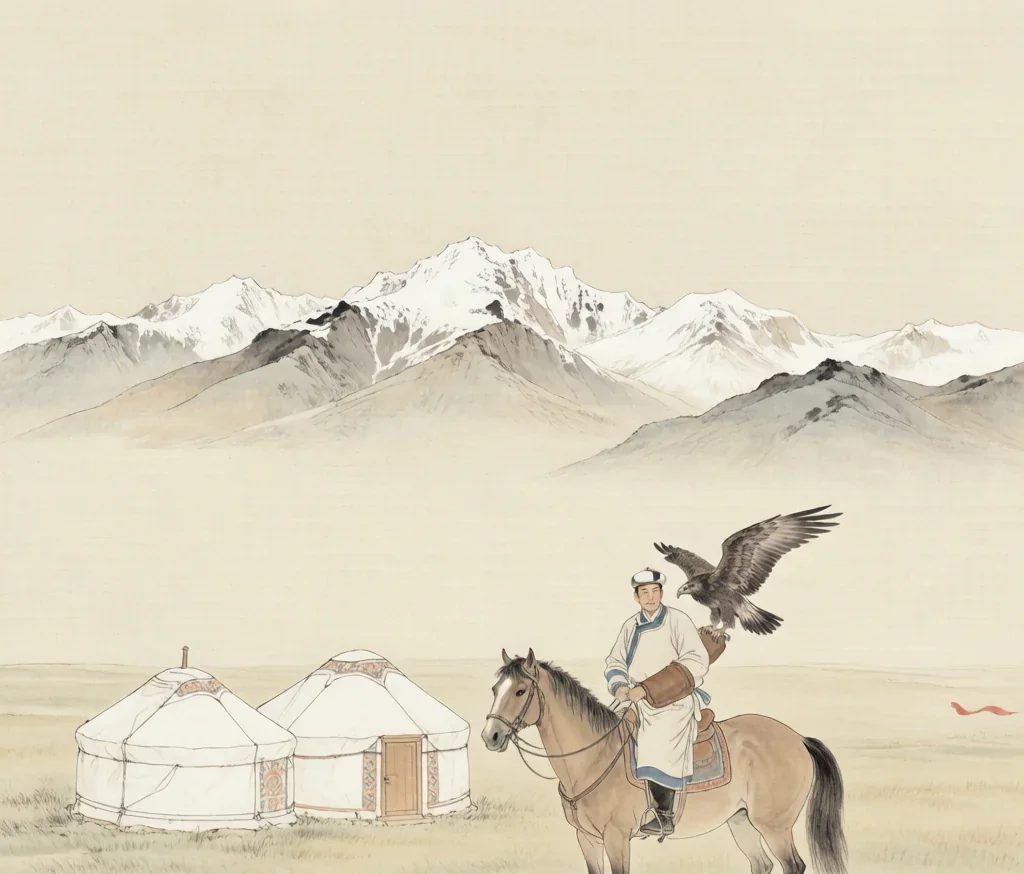
On the vast grasslands of northern Xinjiang, where the Tian Shan mountains rise snow-capped against an impossibly blue sky, the Kazakh people (哈萨克族, Hā sà kè zú) have maintained a nomadic pastoral culture among the most magnificent in the world. With a population of approximately 1.6 million in China, the Kazakhs are renowned for their mastery of the horse, their ancient art of eagle hunting, and traditions of hospitality that turn every stranger into an honored guest.
The Eagle Hunters
Eagle hunting (猎鹰, liè yīng) is an ancient Kazakh tradition practiced primarily in the Altai Mountains. Hunters capture young golden eagles from nests, train them over years, and use them to hunt foxes and wolves. The relationship between hunter and eagle is profound — the eagle is not a pet but a hunting partner. After seven to ten years, the eagle is traditionally released back into the wild, ensuring the wild population is maintained. Today, Kazakh eagle hunters have become cultural ambassadors, demonstrating their skills at international events.
The Horse Culture
The Kazakh saying goes: "A Kazakh is born on a horse and dies on a horse." The horse provides transportation, milk for the fermented beverage kumis (马奶酒, mǎ nǎi jiǔ), and is celebrated in song, poetry, and equestrian games. The most spectacular game is kokpar (叼羊, diāo yáng) — a fierce competition where two teams of riders battle for possession of a goat carcass at full gallop. Another traditional game, kyz kuu (姑娘追, gū niáng zhuī — "girl chasing"), is a playful courtship ritual where a young woman chases a young man on horseback.
The Yurt — Portable Home
The traditional Kazakh dwelling is the yurt (毡房, zhān fáng), a circular tent that can be assembled or disassembled in hours. The felt walls provide insulation against temperatures ranging from -40°C to +40°C. The interior is organized according to strict cultural rules, with designated spaces for men, women, honored guests, and the hearth at the center. The walls are decorated with embroidered hangings and felt carpets featuring geometric patterns.
Music and Oral Tradition
The dombra (冬不拉, dōng bù lā), a two-stringed lute, is the national instrument. The art of aitys (阿依特斯) — improvised poetic duels between singers accompanying themselves on the dombra — combines verbal wit, musical skill, and deep knowledge of Kazakh tradition. The great Kazakh epics, such as "Kozy Korpesh and Bayan Sulu" — a tragic love story compared to Romeo and Juliet — are performed by professional bards called akyns (阿肯), with performances lasting hours or even days.
More About This Ethnic Group
The ethnic minority groups of China represent an extraordinary tapestry of cultural diversity, stretching across the vast landscapes of this ancient land. With 55 officially recognized minority nationalities alongside the Han majority, each group contributes unique traditions, languages, and customs that have been carefully preserved and passed down through countless generations. These communities are primarily concentrated in the autonomous regions of Tibet, Xinjiang, Inner Mongolia, Ningxia, and Guangxi, as well as in the culturally rich provinces of Yunnan, Guizhou, Sichuan, and Qinghai, where some of the most diverse concentrations of ethnic cultures in the world can be found.
China's ethnic minority policies provide important protections for minority languages, cultural practices, and regional autonomy. Many minority communities have autonomous prefectures or counties where their languages are used in local government, education, and media. Traditional festivals, such as the Dai Water-Splashing Festival, the Yi Torch Festival, and the Mongolian Naadam, are celebrated with government support and draw visitors from around the world. These celebrations are not merely tourist attractions but living expressions of cultural identity that reinforce community bonds and transmit cultural knowledge to younger generations.
The cultural heritage of these communities extends to every aspect of daily life — from distinctive architectural styles adapted to local environments, to colorful traditional costumes that encode social information through their patterns and designs, to unique musical instruments and dance forms that express the community's relationship with nature and the cosmos. Embroidery, silverwork, textile weaving, paper-cutting, and countless other handicrafts continue to thrive in minority regions, with many recognized as national or even UNESCO Intangible Cultural Heritage. These crafts are not frozen museum pieces but living traditions that evolve while maintaining their essential character.
In recent decades, concerted efforts to document and preserve minority languages and oral traditions have intensified across China. Scholars and cultural workers collaborate with community elders to record epic poems, folk songs, creation myths, and traditional ecological knowledge before they fade from living memory. Many minority languages that once had no written form now have standardized writing systems, and bilingual education programs help ensure that children can learn both their mother tongue and Mandarin Chinese. Museums, cultural centers, and digital archives have been established to safeguard this heritage for future generations.
Tourism has also played a significant role in the revitalization of minority cultures, offering economic opportunities while raising awareness of the importance of cultural preservation. Ethnic tourism allows visitors to experience traditional architecture, sample distinctive cuisines, purchase handmade crafts directly from artisans, and participate in local festivals. When managed responsibly, this engagement provides income that supports the continuation of traditional practices and gives communities a stake in preserving their cultural heritage. For travelers and culture enthusiasts, visiting minority villages and participating in local festivals offers an authentic window into China's remarkable cultural mosaic and the enduring vitality of its ethnic traditions.