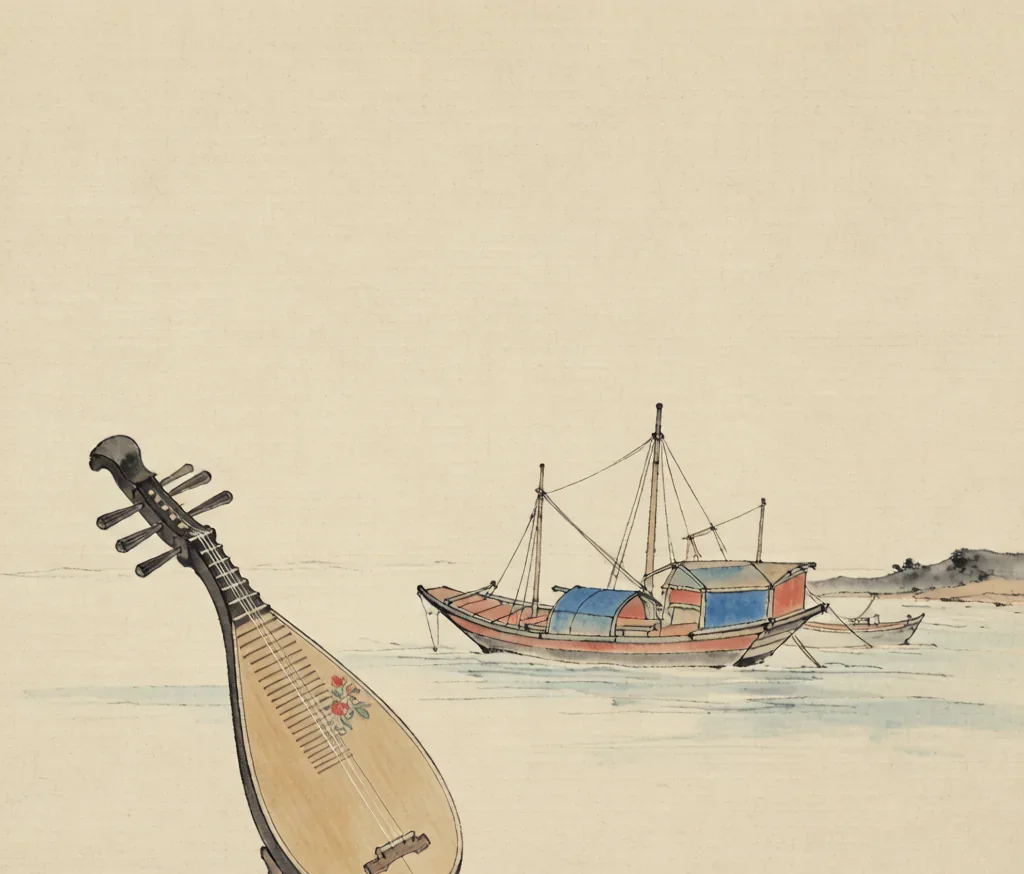
One string, one voice, and a whole sea of feeling: the duxianqin (独弦琴, dú xián qín) is the one-string zither of the Jing people, an ethnic minority of China's southern coast. Its name says everything and nothing at once, for "one string" hardly suggests the liquid, singing, endlessly sliding melodies this instrument produces. Played by the Jing, who live along the Beibu Gulf near the border with Vietnam, the duxianqin is a close cousin of the Vietnamese đàn bầu, and like that instrument it makes a single string sound like many. To hear it is to hear the voice of a small coastal community that has sung to the tide for generations, and to discover how much music a single stretched string can hold.
One String, Endless Voice
At first glance the duxianqin looks almost too simple to be a real instrument. A long, narrow wooden soundboard, sometimes with a shallow trough, carries a single string from a fixed end to a tuning peg at the other. Yet what looks minimal is in fact ingeniously designed. Near the playing end the string is attached not directly to the board but to a flexible rod or a slender strip of bamboo that the player can push and pull. When the player presses or releases this rod, the tension of the single string changes, and the pitch bends and slides in the smooth, vocal way that defines the instrument's sound.
This tension-bending mechanism is the heart of the duxianqin. A normal stringed instrument changes pitch by shortening the vibrating length with a finger; the duxianqin instead changes pitch by tightening and loosening the whole string. The effect is a continuous, glassy glissando rather than a series of stepped notes, so even a single pluck can swell into a phrase that seems to breathe. The result is haunting, like a human voice caught mid-sigh, and it is why the instrument can be so expressive despite having only one string.
How It Is Played
The performer plucks the single string with a small plectrum, often of bamboo, held in the right hand, while the left hand works the flexible rod to bend pitch. By combining plucks with subtle, continuous changes of tension, the player produces melody, vibrato, and long sliding ornaments all from that one source. The left hand's control of the rod is where the art lives: too little pressure and the note is flat and dull, too much and it shrieks; just right, and the string sings.
Because there is only one string, the player thinks in terms of movement rather than position. A phrase becomes a journey of rising and falling tension, and the music tends to be lyrical and contemplative, well suited to evening playing by the water. The duxianqin does not shout. Its natural volume is gentle, intimate, the sound of one person communing with the sea, and amplification is a modern convenience rather than a traditional necessity.
The Jing People and the Coast
The Jing, also known as the Gin, are one of China's smaller recognized ethnic minorities, concentrated in a few fishing villages along the coast of Guangxi near the Vietnamese frontier. Their culture is maritime through and through, built on fishing, boat life, and the rhythms of the gulf. The duxianqin belongs to this world. Historically it was an instrument of the home and the festival, played to relax after fishing, to accompany singing, and to mark the moments of community life. Its close relationship to the Vietnamese đàn bầu reflects the shared cultural currents that flow across this coastal border, a reminder that the sea connects peoples as often as it divides them.
Like many minority traditions, the duxianqin carries more than music; it carries identity. To play it is to take part in a heritage that distinguishes the Jing from their neighbors, a quiet assertion of belonging to a particular place and people. Songs played on the instrument often evoke the sea, the boat, the moon over the water, and the longings of those who live by fishing.
Sound, Technique, and Expression
The tone of the duxianqin is clear and slightly reedy, with a long sustain that lets the sliding ornaments bloom. Skilled players exploit the single string's capacity for microtonal movement, producing intervals and inflections that a fretted instrument could never match. The music often hovers around a central pitch, wandering above and below it in a way that feels improvisatory even when the tune is fixed. This floating quality is emotionally powerful, capable of conveying nostalgia, tenderness, or a calm acceptance of the sea's moods.
Learning the duxianqin demands a fine ear and a patient left hand. The right hand's plucking is straightforward, but the left hand must learn the exact pressure for every pitch and the smooth path between them. There are no frets and no markers; the entire scale lives in the player's memory of tension. For this reason the instrument is often taught by close imitation, master to student, phrase by phrase, until the hand knows the sea's song by feel.
Keeping a Single String Alive
In recent decades the duxianqin has gained new attention as a symbol of Jing culture and as a curiosity in the wider world of Chinese instruments. Cultural agencies have supported its teaching, and some players have brought it to concert stages, where its eerie single-string voice surprises audiences accustomed to louder ensembles. There are also efforts to document the traditional repertoire before the oldest players pass, recording both the tunes and the stories that go with them.
Yet the instrument's future depends on something more personal: young Jing people choosing to pick up the flexible rod and learn the feel of that one string. The duxianqin asks little of the world, materially speaking, but it asks a great deal of attention. In an age of abundance it stands as a small argument for restraint, for the idea that one string, played with care, can say everything that needs saying.
A Closing Reflection
The duxianqin is a lesson in economy. Where other instruments pile on strings and keys, it offers exactly one, and dares the player to find a universe within it. Listening to its sliding, sea-borne voice, you may feel the particular quiet of a coastal night, the creak of a fishing boat, the moon on water. In that single vibrating line, the Jing people have wrapped a whole way of life, and invited the rest of us to listen closely enough to hear it.
❓ Frequently Asked Questions
📝 Chinese Vocabulary
独弦琴 — : The one-string zither; the instrument's name.
京族 — : The Jing people, an ethnic minority of southern China.
独弦 — : "Single string," describing the instrument's defining feature.
北部湾 — : The Beibu Gulf, the coastal region where the Jing people live.
弹拨 — : To pluck, the basic action used to sound the string.
独弦琴 — : The single-string zither of the Jing people
京族 — : The Jing ethnic group, China's coastal Vietnamese-origin minority
泛音 — : Harmonics, the shimmering overtones central to the instrument's sound
🎉 Fun Facts
- The duxianqin has only one string yet can produce flowing melodies through continuous changes of string tension.
- It is a close relative of the Vietnamese đàn bầu, showing the shared musical heritage along China's southern coast.
- The Jing people are among China's smaller ethnic minorities and are centered in fishing communities by the Beibu Gulf.
- Because there are no frets or markers, players learn the entire scale through the feel of string tension, passed down by imitation.
- The duxianqin (独弦琴, dú xián qín) is played with a single string yet produces a haunting range of pitches by pressing a flexible bamboo rod that changes tension against the string.
- Although it has only one string, a skilled player coaxes dozens of harmonics (泛音, fàn yīn), giving the instrument its signature ethereal, singing tone.
- The duxianqin is most closely associated with the Jing (京族, Jīng zú) people of coastal Dongxing in Guangxi, near the Vietnam border.