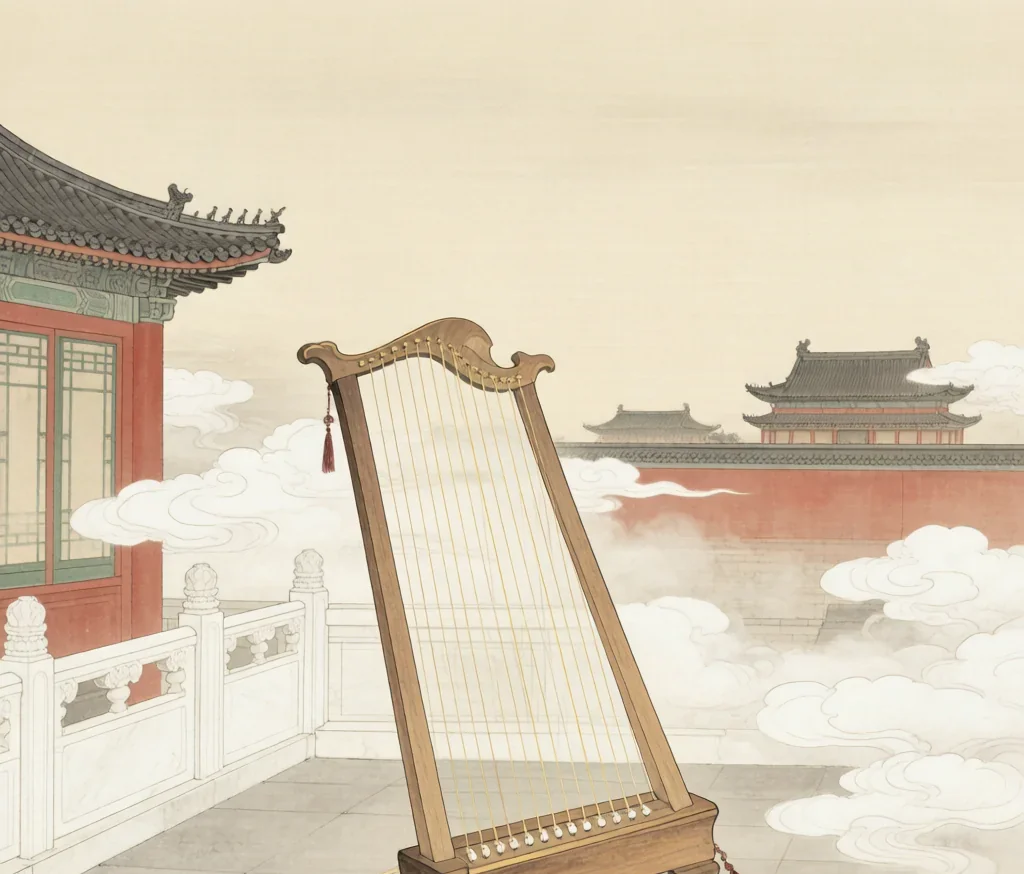
The 箜篌 () is China's harp, an instrument with a long and curious history of disappearance and rediscovery. In ancient times a harp-like instrument entered China from the west, was played at court and in poetry for centuries, and then faded from use so completely that for a long stretch no one in China played a native harp at all. In the twentieth century makers rebuilt the konghou from historical hints and foreign models, creating a revived instrument that now graces the modern Chinese orchestra with a shimmering, celestial sound. This article tells the story of the ancient harp, its loss, its modern rebirth, how the new konghou is built and played, and why its story captures the imagination.
The Ancient Harp of Court and Poetry
The earliest konghou was a foreign-derived harp that reached China along the trade routes, most likely from West or Central Asia, during the Han period or earlier. Historical texts and tomb figurines show a vertical harp with a curved neck and a row of strings, and it was played in the entertainments of the court as well as in regional music. Poets of the Tang dynasty wrote movingly of the konghou, and one famous line compares its sound to the weeping of a goddess, evidence that the instrument moved listeners deeply and belonged to the refined soundscape of the age.
There were in fact a few forms. Sources distinguish a horizontal version and a vertical version, and accounts mention the instrument among the music of border regions as well as the capital. Whatever the exact shape, the konghou was clearly valued for a sound unlike that of the zithers and lutes around it: the open, ringing voice of plucked strings under tension, capable of sweeping glissandos. For centuries it was part of Chinese musical life, celebrated in verse and depicted in art.
How the Harp Was Lost
Then, puzzlingly, the konghou vanished. By the late imperial period the native harp was no longer in use in China, and the craft of making and playing it was lost. Scholars point to shifts in musical taste, the rise of other plucked instruments, and the disruption of the very trade routes that had first brought the harp east. Whatever the cause, the instrument survived mainly in old poems and in a handful of stone carvings and paintings, a remembered sound with no living player.
This long silence is what makes the konghou unusual among Chinese instruments. Many traditional instruments evolved continuously into the present, but the konghou dropped out of practice entirely, becoming a historical name rather than a played thing. For a time, if a Chinese musician wanted a harp, the only option was a Western one. The idea of a distinctively Chinese harp awaited a deliberate act of revival.
The Modern Rebirth
That revival came in the twentieth century, as Chinese instrument makers sought to reconstruct a national harp for the modern orchestra. Drawing on ancient descriptions, archaeological finds, and the example of Western and other Asian harps, they designed a new konghou with a full set of pedals or levers and a chromatic range. The goal was an instrument that could sound like the harp of the poems yet meet the demands of contemporary composition, with all the keys and techniques a modern piece might require.
The rebuilt konghou is essentially a vertical harp with a curved neck and a pillar, strung with many strings that the player plucks with both hands. Unlike the ancient version, it is fully chromatic and built for the concert hall, and it quickly found a place in the national orchestra as the harp voice that Chinese music had lacked for centuries. The revival is a striking case of cultural memory turned into a working instrument: a sound lost for hundreds of years brought back by research and craft.
Construction and the New Design
The modern konghou stands on a frame with a soundbox, a tall neck curving away from the strings, and a pillar on the other side that bears the tension. The strings run from the neck down to the soundboard, and the player uses levers or pedals to change their pitch by a half step, giving access to every key. A typical concert konghou carries several dozen strings, enough for a wide range that overlaps much of the orchestra's middle and high registers.
The use of both hands to pluck is central. Unlike a zither played with one hand while the other damps, the harp invites two-handed playing, with the left hand taking the bass and inner voices and the right hand the melody and upper chords. The soundboard of wood amplifies the strings into a clear, singing tone, and the whole instrument is built to be both beautiful to look at and reliable under concert conditions. Its shape, with the curved neck, clearly echoes the ancient depictions that inspired it.
Sound, Technique, and Repertoire
The konghou's tone is bright, clear, and harp-like, with the signature ability to sweep a glissando across all the strings at once, a shimmering cascade that no lute or zither can quite match. Players pluck with the fingers of both hands, using arpeggios, chords, and flowing melodic lines, and they exploit the pedals to shift key without retuning. In the orchestra it supplies a celestial color, often used for tranquil, imaginary, or decorative passages where a touch of brightness is wanted.
Repertoire includes rearranged older melodies and many new works written since the revival, from solo showpieces to concertos with Chinese orchestra. Composers like the konghou for its ability to evoke antiquity and fantasy at once, fitting the instrument's own backstory of something remembered from the deep past. A slow konghou solo can sound like water or like wind across strings, and a fast one sparkles with the same brilliance as any Western harp.
Why the Konghou Matters
The konghou matters because it shows that tradition is not only preserved but can be rebuilt. Where some instruments survived by steady use, the konghou survived as a memory and was then remade by modern hands, a blend of archaeology and invention. For audiences it offers a sound that feels both foreign and deeply Chinese, a harp that belongs to the same poetic world as the Tang poets who first praised it. Its presence rounds out the modern orchestra, giving Chinese music a harp voice of its own at last.
For listeners encountering the konghou, the best approach is to let its glissandos do their work: hear a single sweep and notice how a whole scale seems to bloom in the air. Then listen to a sustained chord and the quiet after-ring that follows. The instrument's story, from westward arrival to eastward loss to modern return, is a small parable of how cultures borrow, forget, and rediscover. The harp of the poems sings again, and its second life may prove as long as its first.
❓ Frequently Asked Questions
📝 Chinese Vocabulary
箜篌 — : the Chinese harp.
竖箜篌 — : the vertical form of the harp.
卧箜篌 — : the horizontal form mentioned in old texts.
弦 — : string.
凤首箜篌 — : the phoenix-headed form of the harp associated with the Western Regions
竖琴 — : harp, the broader family of instruments the konghou belongs to
踏板 — : pedal, used to change a string's pitch by a half step
共鸣箱 — : the resonating soundbox of the instrument
🎉 Fun Facts
- Tang poets wrote of the konghou's sound as the weeping of a goddess, showing how moved listeners were by it.
- The native Chinese harp dropped out of use entirely for centuries before being rebuilt in the twentieth century.
- The modern konghou was reconstructed from poems, carvings, and other harps rather than from a living tradition.
- Its full glissando across every string produces a shimmering cascade unique among Chinese plucked instruments.
- The konghou appears in Tang-dynasty murals and Buddhist cave paintings, so its shape is known from art long after the living tradition ended.
- Because the revived instrument is fully chromatic, it can move through any key without retuning, which suits modern orchestral writing.