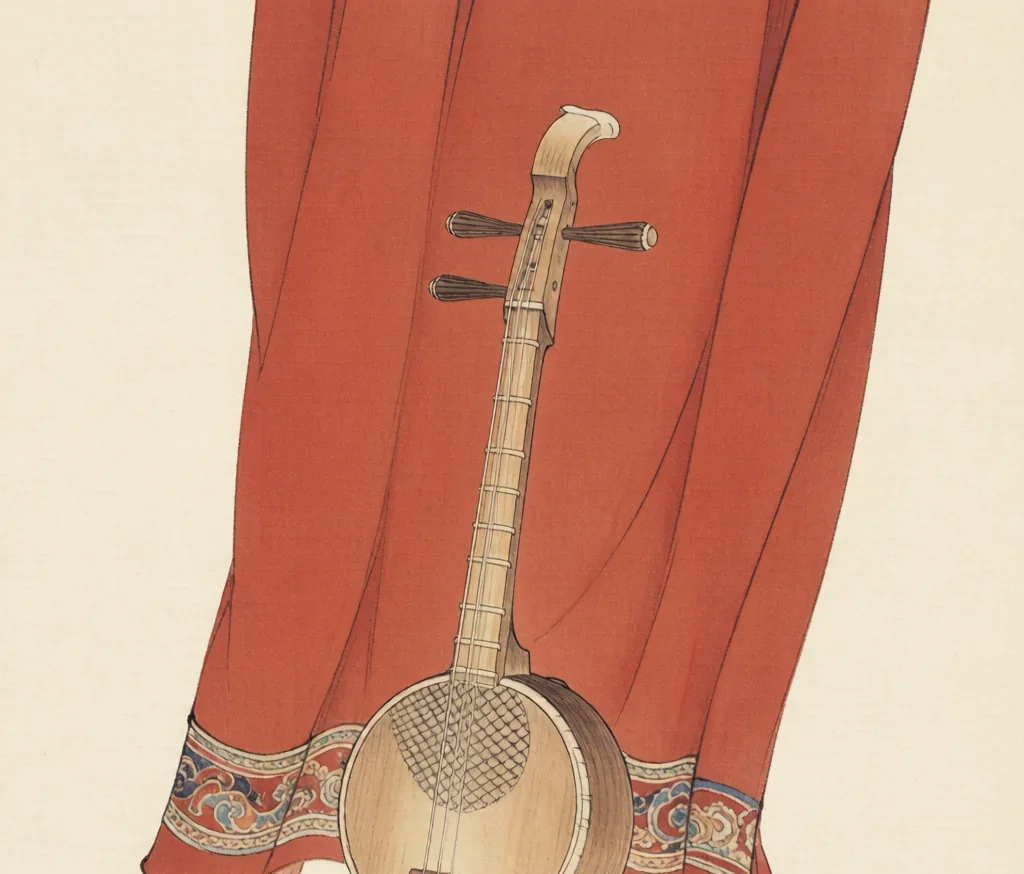
High, bright, and impossible to ignore, the jinghu (京胡, jīng hú) is the small fiddle that leads the music of Beijing opera. Its name tells you both where it belongs and what it is: "jing" points to the capital, Beijing, and "hu" is the short form of huqin, the great family of Chinese bowed string instruments. If you have ever heard the piercing, singing cry that rides above a Peking opera performance, you have heard the jinghu. Though it is tiny, barely the length of a forearm, it carries the entire melodic line of the opera on its two strings, telling the audience when a character is angry, grieving, or in love. To meet the jinghu is to meet the beating heart of one of the world's most elaborate theatrical traditions.
A Tiny Fiddle with a Loud Voice
The jinghu is the smallest and highest-pitched member of the huqin family. Its body is a small resonating drum, usually made of bamboo, with a soundboard of thin python skin stretched across the front. Two strings run from the top of a slender bamboo neck down to a bridge resting on that snakeskin head. The instrument is held vertically on the player's lap or against the leg, and it is bowed with a bow whose hair passes between the two strings rather than across them. This between-the-strings bowing is a hallmark of the huqin family and gives the player extraordinary control over which string sounds and how the notes connect.
Because the jinghu is so small, its pitch is naturally high and its tone naturally bright, even sharp. In the close, amplified-by-architecture world of the traditional opera stage, that penetrating quality is exactly what is needed. The jinghu must be heard over the singer's voice, the percussion, and the other strings, and it is. A single jinghu can dominate a small ensemble, which is why the player is treated as a kind of deputy conductor, setting tempo and shaping emotion in real time.
The Leader of the Beijing Opera Ensemble
In a Peking opera band, the jinghu sits at the center of the melodic group. The music of jingju is built from a set of stock melodic frameworks called banqiang, which the instrumentalists and singers elaborate together. The jinghu plays the leading melodic line, often shadowing or anticipating the singer's vocal line, while instruments such as the yueqin (a round lute) and the sanxian fill in rhythmic and harmonic support. The percussion, led by drums and clappers, sets the strict rhythmic framework, but the melodic shape and the feeling come largely from the fiddle.
The relationship between jinghu player and singer is one of the great partnerships in performance. The two must breathe together. If the singer takes a phrase in a slightly different way, the jinghu follows; if the fiddle pushes the tempo, the singer answers. Master players develop such intimacy with particular singers that their performances feel like a single voice split into two bodies. This is why the jinghu is not merely an accompaniment but a collaborator in the drama itself.
Tuning, Strings, and the Art of the Bow
The jinghu is tuned in fifths, with the two strings pitched quite high, often around the range that suits the high, strained vocal style of jingju. Traditionally the strings were of silk, but modern instruments frequently use metal or wound strings to project better in larger theaters. The bridge sits on the delicate snakeskin, and the slightest change in weather can alter the tension and the sound, so players must tune constantly and handle the instrument with care.
Technique on the jinghu demands a light, fast left hand and a precise bow. Because the bow hair runs between the strings, the player uses pressure and angle to choose whether the upper or lower string speaks. Ornaments such as quick slides, trills, and vibrato imitate the twists of the human voice, which is the whole point in opera music where the instrument must seem to sing like a person. The best jinghu passages do not sound like a violin at all; they sound like another actor on stage, whispering or shouting in tune.
Bright Sound, Deep Feeling
To a first-time listener the jinghu can seem shrill. That first impression misses the point. The brightness is functional: it cuts through a dense theatrical texture so the melody survives. But within that brightness lies a wide emotional range. A slow, sustained line on the jinghu can ache with longing; a rapid, staccato passage can bristle with combat energy; a quiet descending phrase can signal defeat or death. The opera's famous "paint-face" heroes and "young maiden" leads each have musical styles the jinghu knows by heart.
Different roles in Beijing opera call for different melodic treatments, and the jinghu player must master them all. The laosheng (older male) style is dignified and resonant; the dan (female) style is graceful and flowing; the jing (painted-face) style is bold and declamatory. Learning the jinghu is therefore also learning the grammar of the entire opera, a lifetime of studycompressed into two thin strings.
The Jinghu Beyond the Opera House
Although born for the opera, the jinghu has also stepped onto the concert stage. Solo and chamber arrangements let audiences appreciate its color without the full theatrical spectacle, and recordings have carried its sound far beyond China. Still, its soul remains in the opera house, where the player sits just behind the actors and, with a few strokes of the bow, turns a story into something that sings.
Today the instrument faces the familiar challenge of all traditional arts: how to keep its masters and its audience. Conservatories teach it, opera troupes still tour with it, and enthusiasts gather to play for their own pleasure. The jinghu endures because its voice is unique, a sound that no other instrument can counterfeit, and because Beijing opera, for all its changes, still needs that bright thread of melody to hold the show together.
A Closing Reflection
The next time you glimpse a Beijing opera performance, let your ear find the jinghu. Behind the costumes and the stylized movement, there is a small bamboo fiddle doing quiet, relentless work: leading the tune, feeling the singer's breath, and carrying the audience from one emotion to the next. In two strings and a drum of snakeskin, the jinghu holds the whole emotional world of the opera, proof that the smallest instruments often speak the loudest truths.
❓ Frequently Asked Questions
📝 Chinese Vocabulary
京胡 — : The fiddle of Beijing opera; the lead melodic instrument.
胡琴 — : The broad family of Chinese bowed string instruments.
京戏 — : Beijing opera, also called jingju.
板腔 — : The stock melodic-rhythmic frameworks used in opera music.
蛇皮 — : Snake skin, used for the instrument's resonant soundboard.
西皮 — : xipi, one of the two principal melodic modes in Beijing opera music
二黄 — : erhuang, the second principal melodic mode of Beijing opera
琴师 — : the lead instrumentalist, or jinghu player, who guides the opera ensemble
🎉 Fun Facts
- The jinghu is so small that it is the highest and brightest member of the entire huqin family of Chinese fiddles.
- Its bow hair passes between the two strings, a feature shared with the erhu and other relatives that lets the player choose each string with subtle pressure.
- A jinghu player often acts like a deputy conductor, setting the tempo and following the singer's breath in the same instant.
- Different opera role types, from painted-face generals to young maidens, each have their own melodic style that the jinghu player must master.
- The jinghu's snakeskin soundboard is highly sensitive to humidity and temperature, so players protect it from drafts and tune it constantly during a performance.
- A jinghu is often chosen and tuned to suit a particular singer's vocal range, and different instruments may be used for different role types within one opera.