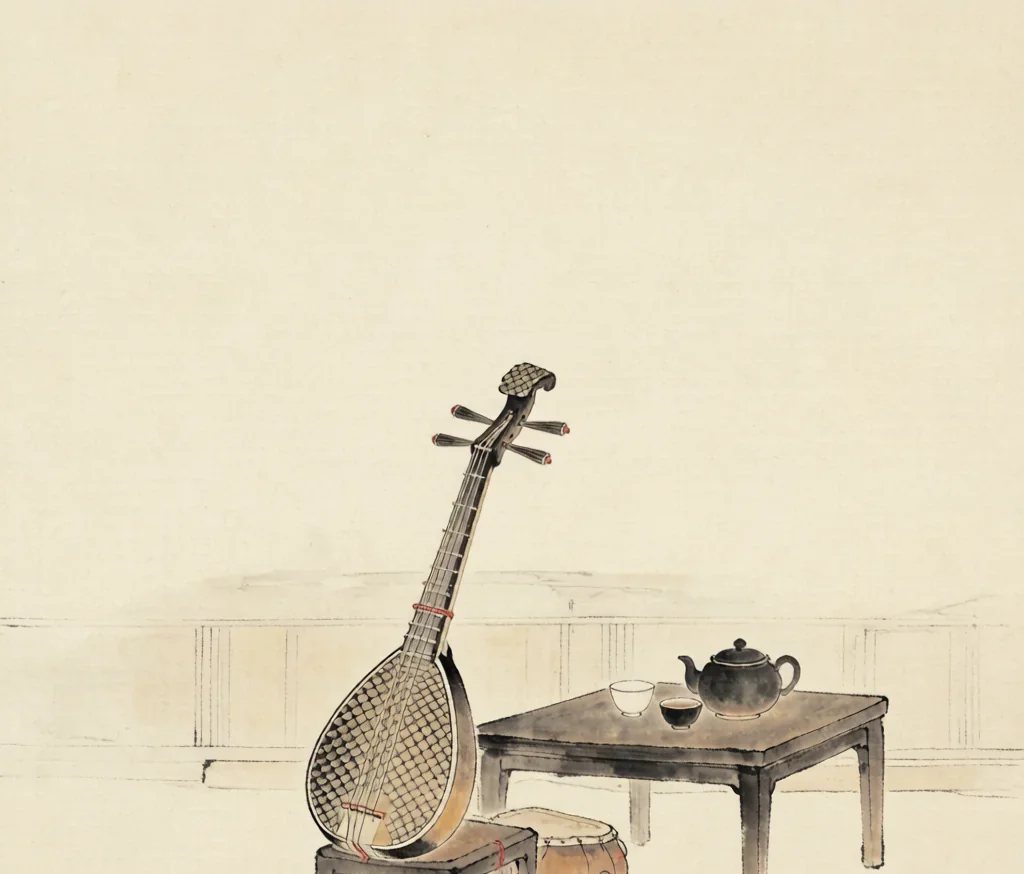
Imagine a long-necked lute with only three strings and no frets at all, its round soundbox wrapped not in wood but in the patterned skin of a snake. This is the sanxian (三弦, sān xián), a plucked string instrument whose very name announces its defining feature: "three strings." For centuries it has been the rhythmic and melodic backbone of northern Chinese storytelling, the bright percussive voice in regional opera ensembles, and a solo instrument capable of astonishing expressiveness. Though less famous abroad than the pear-shaped pipa, the sanxian carries a sound that is unmistakably Chinese, dry and sparkling, full of the snap of the plectrum against open strings. To understand the sanxian is to understand a whole tradition of music built around the spoken word, the tale well told, and the pulse that keeps an audience leaning forward in the lamplight.
A Long Neck and a Snakeskin Drum
The sanxian looks unlike most of its relatives in the Chinese lute family. Its soundboard is a flat, often round or hexagonal wooden frame stretched with python skin, which gives the instrument the appearance of a small hand-drum mounted on a very long, slender neck. That neck, sometimes reaching nearly a meter in length, is completely fretless. The absence of frets means the player can glide between pitches with total freedom, bending notes and sliding with a vocal quality that fretted instruments cannot match. Three strings run the length of the neck to a bridge resting on the snakeskin, and the instrument is ordinarily played with a stiff plectrum made of tortoiseshell, horn, or modern plastic, rather than with the fingernails alone.
Two main sizes exist. The larger northern sanxian, sometimes called the da sanxian, has a deeper, louder voice suited to accompanying storytellers in teahouses and open markets. A smaller southern variant, the xiao sanxian, is lighter and brighter and is favored in the chamber music of the Jiangnan region. The python-skin soundboard is not merely decorative; it is the secret of the sanxian's tone. Because the membrane is thin, the instrument speaks with a crisp, dry attack and a quick decay, more like a percussion instrument that also sings than like the sustained, singing tone of a silk-strung zither. Players tune the three strings in various intervals depending on the repertoire, and the open strings themselves become a rhythmic resource, struck and damped to mark time.
The Voice of the Storyteller
If one role defines the sanxian, it is accompaniment to narrative song. In the quyi traditions of northern China, a solo performer or a small ensemble sings long tales of heroes, ghosts, and lovers while the sanxian marks the beat, fills the spaces, and underscores moments of drama. Forms such as gushu, dasi kuai shu, and the many regional "drum songs" all lean on the instrument. The performer's art lies in the dialogue between voice and string: a patter of syllables might be answered by a的快速 run of plucked notes, a moment of silence broken by a single struck open string like a knock at a door.
What makes the sanxian ideal for this work is its rhythmic clarity. Where a softer instrument might be lost beneath a storyteller's voice, the sanxian cuts through. Its dry, snappy tone functions almost like a woodblock that happens to be tuneful. Generations of northern audiences learned their history and their laughter from sanxian-led performances, and many of the melodies associated with the instrument are themselves centuries old, passed from teacher to apprentice rather than written in fixed notation. The instrument thus preserves a living oral tradition, a library of tunes carried in the hands and memory of performers.
On the Opera Stage
Beyond the teahouse, the sanxian finds a home in the orchestras of several Chinese operas. In northern genres especially, it reinforces the rhythmic foundation and adds a tangy color to the ensemble. It appears in the accompaniment of kunqu and in various local operas where a bright plucked voice is wanted to punctuate a singer's phrases. The player must listen constantly to the vocalist, entering on the offbeats, dropping out for a high note, and returning to drive the scene forward. This responsive, conversational style of playing is one of the hardest skills to learn, and it marks the difference between a technician and a true accompanist.
In the southern string ensemble repertoire of Jiangnan sizhu, the smaller sanxian weaves in and out of a texture of flutes, fiddles, and dulcimers. Here its role is more decorative, supplying crisp interjections and rapid filigree. The same instrument that pounds out a storyteller's rhythm in Beijing can, a thousand miles south, flicker like a蜻蜓 above a gentle melody. That versatility is part of why the sanxian has survived so many changes in musical fashion while more specialized instruments faded.
Technique and the Art of the Plectrum
Playing the sanxian demands a particular right-hand discipline. The plectrum is held firmly and used for downstrokes and upstrokes that must land with even force, because the snakeskin rewards a clean strike and punishes a sloppy one with a dull thud. The left hand, meanwhile, does all the pitch work: pressing the strings at any point along the long neck to produce exact notes, sliding for expressive portamentos, and pressing lightly or firmly to bend pitch. Because there are no frets, intonation is entirely the player's responsibility, and the best performers make this freedom sound effortless.
The left hand also controls the all-important damping. By lifting or pressing a string against the neck a player can stop a note instantly, creating the staccato, speech-like articulation that gives sanxian music its urgency. Advanced players combine plucking, sliding, and damping so fluently that a single phrase can seem to laugh, sigh, and snap to attention in the space of a breath. To hear a master is to understand that the sanxian is far from a simple folk toy; it is a complete musical language in three strings.
Why the Sanxian Matters Today
The sanxian entered the modern Chinese orchestra as a member of the plucked-string section, where its loud, bright voice helps the ensemble project in large concert halls. Composers have written new solo and concerto works that explore its percussive side and its capacity for drama. At the same time, folk performers continue to use it in teahouses and at temple fairs, keeping the older repertoire alive. This double life, as both a concert-hall instrument and a people's instrument, is rare and precious.
For listeners new to Chinese music, the sanxian is a wonderful place to start, because its sound is so direct. There is no veil of sustain or reverb; you hear the plectrum, the skin, and the string as plain facts. In that honesty lies its charm. The sanxian reminds us that Chinese music is not only about gentle, flowing melodies but also about rhythm, wit, and the pleasure of a well-told story told in sound.
A Closing Reflection
To sit with a sanxian is to sit with centuries of northern Chinese life: the market storyteller, the opera pit, the family gathering where someone picked up the long-necked lute and made the room laugh. Three strings and a drum of snakeskin have carried an enormous amount of human feeling. The next time you hear its dry, bright chatter, listen for the voice behind the voice, the tale being told one plucked note at a time.
❓ Frequently Asked Questions
📝 Chinese Vocabulary
三弦 — : The three-string lute; the instrument's name.
弹词 — : A southern narrative-singing tradition accompanied by plucked strings.
鼓书 — : Northern "drum singing," a storytelling genre often led by the sanxian.
蛇皮 — : Snake skin, used for the instrument's resonant soundboard.
拨子 — : The plectrum used to pluck the strings.
大三弦 — : The large northern sanxian, with a deep, loud voice for teahouses and markets.
小三弦 — : The small southern sanxian, lighter and brighter for chamber music.
书场 — : A storytelling house or teahouse venue where the sanxian accompanies tales.
🎉 Fun Facts
- The sanxian's neck is so long and its soundbox so small that the instrument can look almost like a key mounted on a stick, yet it produces a surprisingly loud tone.
- Because it is fretless, skilled players can imitate the pitch slides and cries of the human voice, making it a favorite for dramatic storytelling.
- A southern version of the sanxian is small enough to be held comfortably on the lap during intimate chamber performances in the Jiangnan region.
- The dry, drumlike snap of the sanxian comes from the python-skin head, which vibrates like a tiny drum each time a string is struck.
- In the traditional eight-material (bayin) classification of Chinese instruments, the sanxian belongs to the 'silk' (丝, sī) group because its strings were historically made of twisted silk thread.
- The Japanese shamisen and the Ryukyuan sanshin are descendants of the sanxian, carried to the islands centuries ago and reworked with strings over a wooden body.