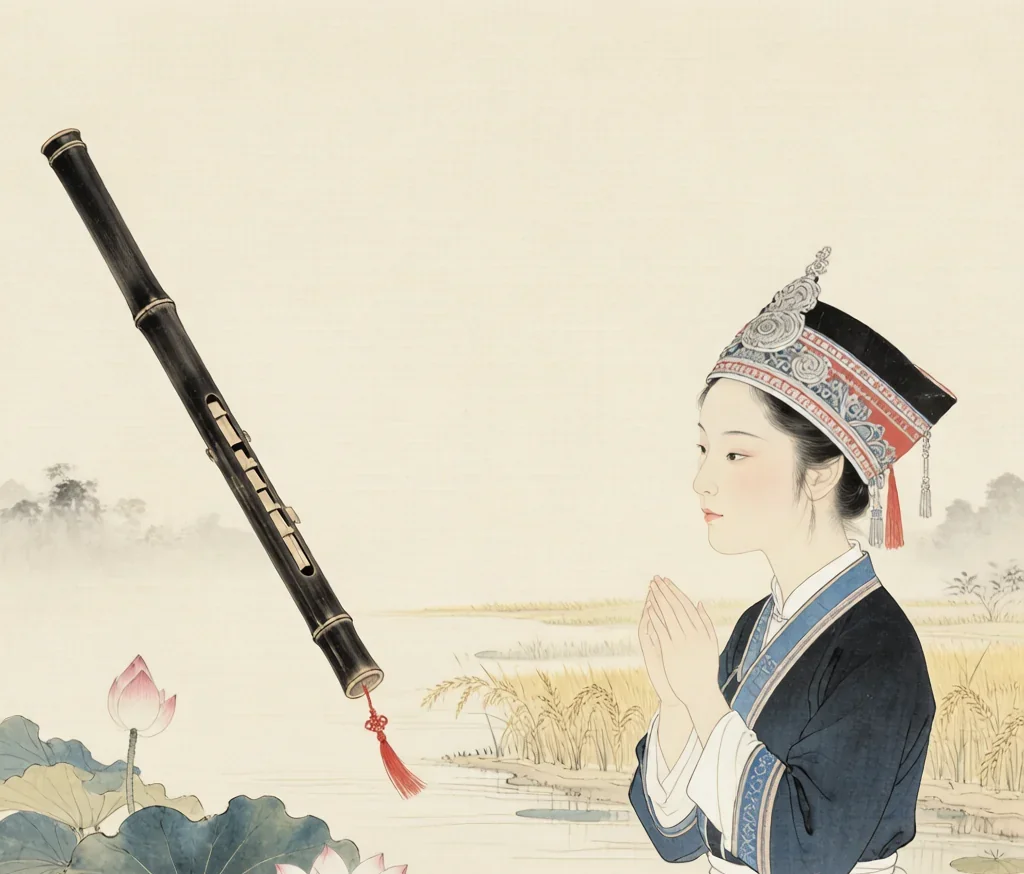
The 巴乌 () is a free-reed flute of the south, a bamboo tube with a reed at the mouthpiece that gives it a soft, reedy, almost vocal tone somewhere between a flute and an oboe. Unlike the airy xiao or the bright dizi, the bawu sings with a gentle buzz that Southern Chinese and several ethnic-minority peoples have cherished for generations. Long a folk instrument of Yunnan and neighboring regions, the bawu has in recent decades joined the modern Chinese orchestra and won listeners well beyond its homeland. This article looks at its southern roots, its clever free-reed construction, its sound and playing, its cultural role among minority peoples, and its place in music today.
A Flute of the Southern Hills
The bawu comes from the southwest of China, especially Yunnan, and is closely tied to the musical life of several ethnic-minority groups there, including the Yi, Hani, Miao, and Dai. In these communities it has long been an instrument of courtship and feeling, played by young people to express longing or to accompany singing in the fields and villages. Its mellow, speaking tone suits intimate outdoor music where a louder flute would feel out of place, and its folk character sets it apart from the courtly instruments of the north.
What makes the bawu special among Chinese flutes is its reed. Most Chinese flutes are edge-blown, meaning the player splits air against a sharp rim, but the bawu is a free-reed instrument: a thin tongue of reed or metal at the mouthpiece vibrates to set the air column moving. This gives it a fundamentally different, more vocal and reedy sound, and it places the bawu in the same family as the sheng mouth organ, though it is played like a flute. The bawu thus bridges two worlds of Chinese wind sound.
Construction of the Reed Flute
A bawu is made from a length of bamboo with a row of finger holes, much like a simple flute, but near the mouthpiece it carries a small rectangular opening in which a thin reed tongue is set. The player blows into a mouthpiece at the end, and the reed vibrates to drive the air column inside the tube, which is then pitched by opening and closing the finger holes. The body is usually broader and shorter than a xiao, and the reed is the heart of the instrument: its size and cut determine the tone and responsiveness.
Traditionally the reed was a sliver of bamboo or grass, but modern bawu may use a delicately shaved reed of copper or other metal for stability. The finger holes are arranged for the local scale, and some modern versions add keys to extend the range and ease playing. Because the reed is small and can be damaged by moisture or rough breath, players treat it with care, but the basic instrument remains a humble tube of bamboo with one magical vibrating tongue.
The Sound and How It Is Played
The bawu's tone is soft, reedy, and expressive, with a gentle vibrato-like waver that comes from the free reed and from the player's breath. It cannot be blown very loudly, which keeps it an intimate instrument, but within its range it sings with a warmth that flutes lack. Players cover the finger holes to change pitch and use breath pressure and embouchure to shape the tone, and the reed's natural buzz gives even slow notes a living, human quality.
Technique is close to that of a simple flute, though the breath must be controlled so the reed speaks cleanly without choking. The bawu's limited dynamic range means expression comes from nuance rather than volume: subtle swelling, slight pitch bends, and a singing legato. Folk players often use it for slow, lyrical tunes that sound like a voice telling a story, and the instrument's ease of melody-making made it a natural partner for singing and for quiet evening music.
Cultural Life Among the Minorities
Among the peoples of Yunnan the bawu is more than an instrument; it is a social and emotional voice. In several traditions young men play the bawu to signal affection or to accompany their own singing, and its sound is bound up with ideas of love, home, and the mountain landscape. Because these communities maintain rich oral music traditions, the bawu carries tunes and feelings that are not written down but passed from player to player, making it a living archive of local song.
The instrument also reflects the broader cultural mosaic of southwest China, where many languages and musics meet. The bawu's free-reed idea is shared with other regional instruments, and its presence across several ethnic groups shows how a single clever design can belong to many communities at once. In this sense the bawu is a small example of the diversity within Chinese culture, a reminder that "Chinese music" is a family of many local voices rather than one uniform sound.
From Folk Instrument to Concert Stage
In the twentieth century the bawu was adopted into the modern Chinese orchestra and concert repertoire, much as other regional instruments were standardized and elevated. Makers added keys and refined the reeds so the instrument could handle composed pieces in any key, and composers wrote solo and ensemble works that show off its lyrical side. Its soft color fills a gap between the flutes and the reeds, and it pairs beautifully with strings and with the gentler plucked instruments.
The bawu's move to the stage has also carried the music of China's southwest to national and international audiences who might never visit Yunnan. A bawu solo can evoke mist over terraced fields and the quiet of a village at dusk, and listeners often remark on how unexpectedly "singing" a flute can be. Its success shows that a humble folk instrument, given care and a wider stage, can speak to people far from its homeland without losing its local soul.
Learning and Appreciating the Bawu
For a newcomer the bawu is welcoming because its finger holes work like a simple flute and the reed does much of the tonal work. The main lessons are gentle, steady breath and care for the reed, which should be kept dry and protected. A beginner can soon play slow tunes and enjoy the instrument's vocal quality, though clean attacks and even tone take a little practice, as with any reed instrument.
To appreciate the bawu, hear a slow solo where the reed's waver makes a single line feel like a person singing, then notice how different it is from the bright dizi or the airy xiao. Its story, from the hills of Yunnan to the concert hall, is a hopeful one: that the music of a small community can find a large audience while keeping its character. The bawu asks little more than breath and feeling, and in return it gives one of the most human voices in all of Chinese wind music.
The Bawu and the Sheng Family
Although played like a flute, the bawu belongs acoustically to the free-reed family, related to the sheng mouth organ and to regional pipes such as the lusheng (芦笙). All of these use a vibrating tongue of reed or metal rather than an air-splitting edge, giving them a buzzy, vocal color that sets them apart from the dizi and xiao.
Notable Bawu Repertoire
Since entering the concert hall, the bawu has gained a growing body of solo and ensemble works written by Chinese composers, often drawing on Yunnan folk tunes. Pieces such as 'The Happy Farmer' (欢乐的泼水节-style themes) and lyrical solo arrangements let the instrument's singing tone shine, and it is frequently paired with plucked strings in the modern Chinese orchestra.
❓ Frequently Asked Questions
📝 Chinese Vocabulary
巴乌 — : the free-reed flute of the south.
簧 — : reed, the vibrating tongue.
竹 — : bamboo, the tube.
吹 — : to blow.
芦笙 — : The lusheng, a related free-reed mouth pipe of southwest minorities
笛子 — : The dizi, the bright edge-blown Chinese flute
箫 — : The xiao, the airy vertical bamboo flute
彝族 — : The Yi people, among the bawu's traditional players
🎉 Fun Facts
- The bawu is a free-reed instrument, giving it a reedy, vocal tone unlike the airy dizi or xiao flutes.
- It is closely tied to the courtship and folk music of Yunnan's ethnic-minority peoples such as the Yi and Hani.
- Though quiet, the bawu joined the modern Chinese orchestra in the twentieth century and gained a concert repertoire.
- Its humble body is just bamboo with one small reed, yet that reed is what gives the instrument its human, singing voice.
- Because the bawu is a free-reed instrument, the player's breath must stay gentle and even; blowing too hard can choke the small reed and stop the tone.
- The bawu's reedy buzz is often likened to a human voice, which is why folk players use it to 'sing' wordless melodies that feel like quiet storytelling.