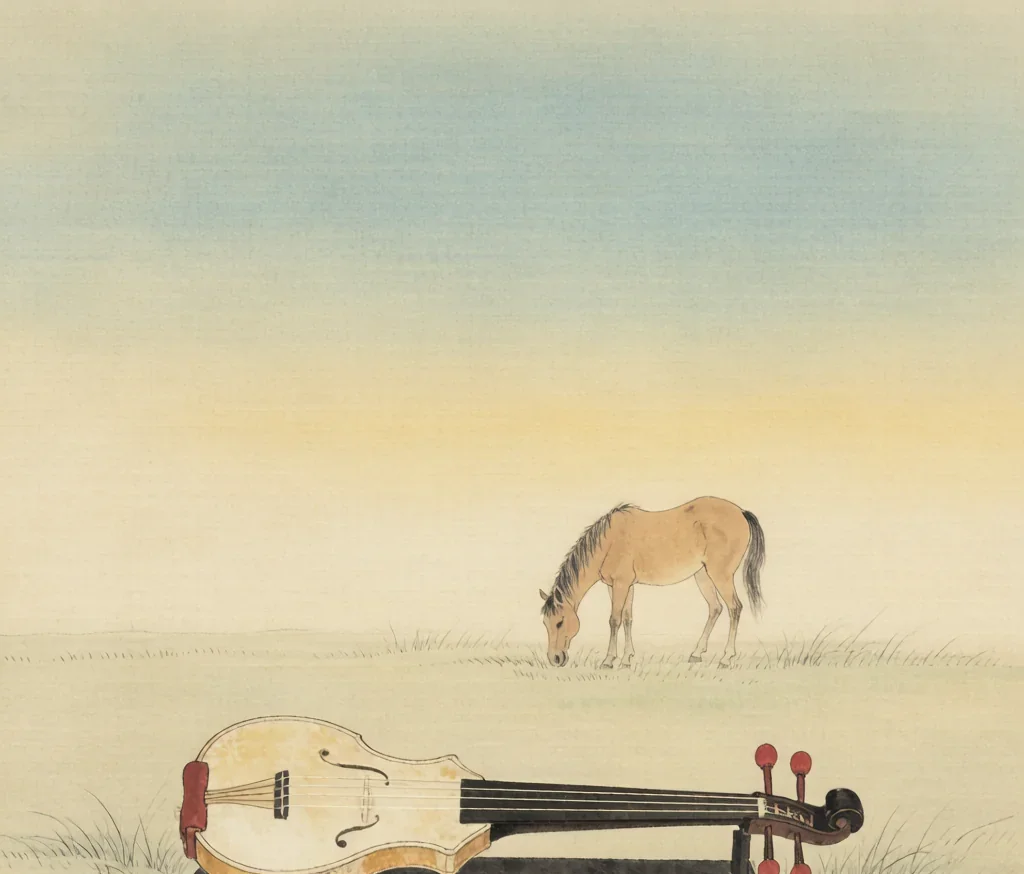
Made from the leg bone of a horse and speaking in a bright, reedy voice, the maguhu (马骨胡, mǎ gǔ hú) is one of the most distinctive fiddles in China. Its name is almost a complete description: "ma" means horse, "gu" means bone, and "hu" is the familiar short form of huqin, the family of Chinese bowed strings. This is the horse-bone fiddle of the Zhuang people, the largest ethnic minority of Guangxi in southern China. Small, piercing, and full of character, the maguhu has led Zhuang folk music and opera for generations, carrying the sound of village festivals and riverside evenings on two strings and a resonator once part of a living animal. To hear it is to hear a culture that turns the ordinary remains of daily life into something that sings.
A Fiddle Built from a Horse's Bone
The most famous feature of the maguhu is its soundbox, traditionally carved from the hollow shin bone of a horse. A horse's lower leg bone is naturally tubular and strong, and when hollowed and covered at the playing end with a thin soundboard, often of wood or snakeskin, it becomes a small, bright-sounding resonance chamber. The neck, usually of hardwood, carries two strings up to tuning pegs, and the instrument is bowed like others of the huqin family, with the bow hair passing between the strings. The overall impression is of a compact spike fiddle, modest in size but confident in voice.
Using bone was not merely symbolic; it was practical. In rural Guangxi, where horses were working animals, their bones were a readily available material, and the dense, thin-walled bone produced a particularly crisp tone. Today some makers use alternative materials for the body while keeping the name and the shape, but the traditional bone version remains the ideal that players revere. The maguhu thus embodies a kind of folk ingenuity, making fine music from what the land and the animals provide.
The Sound of Zhuang Country
The maguhu is the leading melodic instrument of Zhuang music, and its bright, slightly nasal timbre is instantly recognizable in the ensembles of Guangxi. It commonly appears in the Zhuang "bayin" folk ensemble, a mixed group of winds, strings, and percussion that performs at weddings, temple fairs, and New Year celebrations. In that context the maguhu carries the tune, weaving rapid, ornamented lines above the steady pulse of gongs and drums. Its penetrating voice is perfectly suited to open-air village performance, where it must be heard over a bustling crowd.
Beyond the ensemble, the maguhu is central to Zhuang opera, where it functions much as the jinghu does in Beijing opera, leading the singers and shaping the emotional line of a scene. The player must be both musician and dramatist, knowing when to surge with a hero's entrance and when to fall quiet for a lament. This dual role, in both folk ensembles and the opera house, has made the maguhu the spiritual instrument of Zhuang musical life.
How the Maguhu Is Played
Like its huqin relatives, the maguhu is held vertically and bowed with the hair between the two strings. The left hand stops the strings along the neck to produce pitches, and the player adds the slides, trills, and vibrato that give Zhuang fiddle music its vocal, speech-like quality. The small bone body responds quickly, so notes attack sharply and decay fast, contributing to the instrument's alert, lively character. A good player can make the maguhu laugh, weep, or gallop, and the resemblance of its bright cry to the energy of a horse has not been lost on those who named it.
Technique rewards a light, nimble left hand and a controlled bow. Because the body is small, the string length is short, which pushes the pitch upward and demands precise fingering. Ornamentation is rich, drawing on the melodic turns of Zhuang song. Players often learn by ear within family and community settings, absorbing not just notes but the proper "feel" of Zhuang phrasing, which differs from the styles of Han Chinese fiddles to the north.
Culture, Identity, and the Horse
The horse has long mattered to the peoples of Guangxi and neighboring regions, as a mount, a draft animal, and a partner in daily labor. To build an instrument from a horse's bone is to honor that relationship, transforming the animal's remains into continuing life in the form of song. For the Zhuang, the maguhu is therefore more than a folk fiddle; it is a token of identity, a sound that says "this is our music, our land, our way." At festivals the instrument's cry can summon a sense of belonging as strongly as any flag or costume.
The Zhuang are far from alone in China in treasuring a distinctive bowed instrument, and the maguhu sits within a wider southern tradition of minority fiddles, each shaped by local materials and taste. Studying it reveals how musical instruments map the country's cultural diversity: the same basic idea, a string and a bow, blossoms into dozens of local voices, of which the horse-bone fiddle is one of the most evocative.
Preserving a Bone-Box Fiddle
As with many minority instruments, the maguhu faces the twin challenges of modernization and diminished rural practice. Younger generations migrate to cities, and the bone-bodied fiddle can seem a relic of village life. Yet there are strong efforts to keep it alive: cultural bureaus support teaching programs, Zhuang opera troupes continue to tour, and makers preserve the craft of hollowing bone into a singing resonator. Some conservatories now include the maguhu in their curriculum, bringing it to stages far from Guangxi.
The instrument's unusual origin gives it a natural appeal as a symbol of living heritage. Audiences are charmed by the idea of a fiddle made from a horse's leg, and that curiosity opens a door to the deeper music behind it. If the maguhu can keep attracting both scholars and listeners, the horse's bone will go on singing for a long time yet.
A Closing Reflection
There is something quietly profound in the maguhu's story. A working animal gives its strength to a village, and when its life ends, a part of it is reshaped into an instrument that gives the village its voice back in song. Two strings stretched over a horse's bone carry the joys and sorrows of the Zhuang people, proving that music is, in the end, a way of keeping life alive in new forms. Listen for the maguhu at a Guangxi festival, and you will hear the echo of hoofbeats turned to melody.
❓ Frequently Asked Questions
📝 Chinese Vocabulary
马骨胡 — : The horse-bone fiddle; the instrument's name.
壮族 — : The Zhuang people, the largest ethnic minority of Guangxi.
八音 — : The traditional "eight tones" folk ensemble that features the maguhu.
壮剧 — : Zhuang opera, in which the maguhu leads the music.
胡琴 — : The broad family of Chinese bowed string instruments.
骨胡 — : bone fiddle, a short name for the maguhu
琴杆 — : the neck of the fiddle
马骨 — : horse bone, the traditional material of its soundbox
🎉 Fun Facts
- The maguhu's soundbox is traditionally hollowed from a horse's lower leg bone, giving the instrument both its name and its crisp tone.
- It is the leading melodic voice of Zhuang folk ensembles and Zhuang opera in Guangxi, much as the jinghu leads Beijing opera.
- The Zhuang are China's largest ethnic minority, and the maguhu is one of their most recognizable cultural symbols.
- Making one requires turning an animal's bone into a singing resonator, a folk craft that blends practicality with respect for the animal.
- The maguhu's bright, reedy tone lets it lead an open-air ensemble, so it is often the first instrument heard at a Zhuang village celebration.
- In southern China several minority groups have their own bone or wood fiddles, making the maguhu part of a wider family of regional spike fiddles.