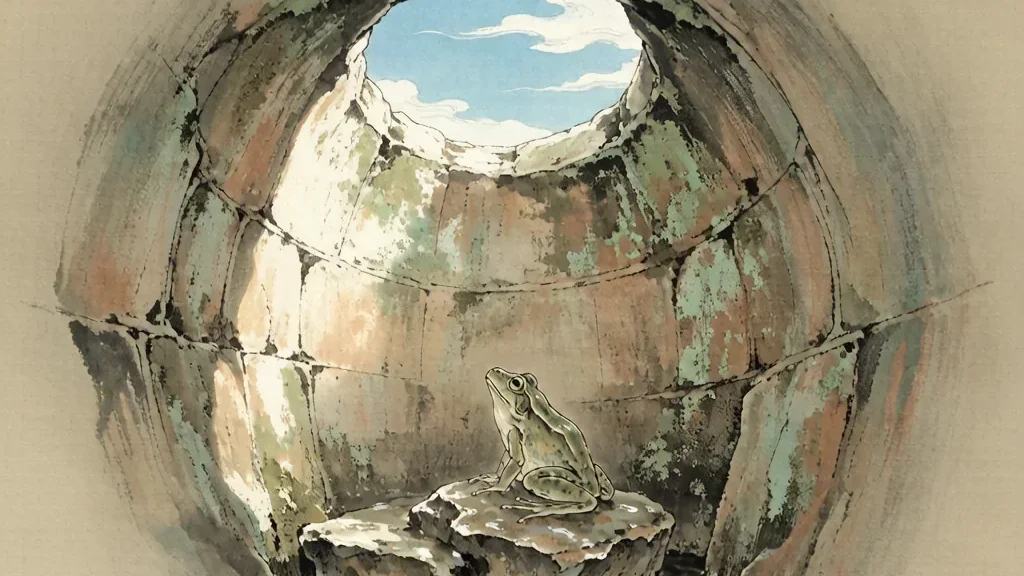
Among the many forms contentment that comes from knowing very little. It is not the contentment of the wise, who have seen the world and made peace with it. It is the contentment of those who have not seen the world at all — and who, because they have not, are perfectly convinced that the small corner they inhabit is the whole of existence. The Chinese idiom 井底之蛙 (jǐng dǐ zhī wā), "the frog at the bottom of a well," describes this contentment with a mixture of amusement and sorrow, and the story behind it is one of the most beloved in the entire classical tradition.
The tale comes from the "Zhuangzi" (庄子), the foundational Daoist text attributed to the philosopher Zhuang Zhou, who lived in the fourth century BCE during the Warring States period. Zhuangzi was a master of parable, and his work is full of talking animals, improbable sages, and jokes whose punchlines are also philosophical arguments. The story of the frog in the well is one of his most quoted, and its gentle satire has made it a favorite of Chinese educators, parents, and anyone who has ever had to gently explain to someone that the world is larger than they think.
The Frog Who Owned a World
In an old well, deep and narrow, there lived a frog. The well was his whole world. Its mossy walls were his walls. Its small circle of sky, visible far above, was his sky. The few inches of water at the bottom were his ocean. The crevices in the stone were his countryside, his mountains, his cities. He had lived there his entire life, and he had never climbed out, and he had never wanted to. He was, in his own estimation, a great success — a lord of all he surveyed, even if all he surveyed was a circle of damp stone no wider than his body was long.
One day, so the story goes, a great sea turtle arrived at the edge of the well. The turtle had come from the Eastern Sea, hundreds of miles away, and was traveling inland when he happened upon the well and looked down into its depths. The frog, delighted to have a visitor, puffed himself up and called out a welcome. "Come down, come down!" he cried. "You must see my splendid home. I am master here. When I feel like it, I hop onto the well wall and survey my domain. When I am tired, I rest in the little hollow in the stone. I paddle in the water, and it is just deep enough to cover my belly and dip my chin. The tiny insects that gather at the edge are mine to eat. The crabs and tadpoles cannot compare with me. I am the greatest creature in this whole world. Come down, friend turtle, and let me show you the wonders of my kingdom."
The Turtle at the Edge
The sea turtle looked down at the frog's "kingdom" — a small patch of damp stone, a puddle of murky water, a circle of sky no larger than a plate. He wanted to descend and visit, the story tells us, but he was too large. His shell was wider than the mouth of the well. He tried, and could not fit. So instead, he spoke to the frog from above.
"Have you ever seen the sea?" the turtle asked. The frog blinked. The sea? He had heard the word, perhaps, but he had no image to attach to it. The turtle went on. "The Eastern Sea is more than a thousand miles across. At its deepest, it is more than a thousand fathoms down. In the time of the great sage-kings, the floods came and the sea did not swell. In the long droughts, the sea did not shrink. It does not change with the seasons. It does not care about the rains. It is vast beyond measure, and it has been there since before the world had a name. To live in that sea — that is what it means to be truly at home."
The frog said nothing. The "Zhuangzi" tells us that his eyes went wide, his mouth opened slightly, and he felt, for the first time in his life, small. The little kingdom he had been so proud of — the puddle, the moss, the circle of sky — collapsed in his imagination. He had thought he was the lord of a world. He had not even been the lord of a puddle. He was a frog, in a well, and the world he had missed was wider than he could have conceived.
The Philosophy of the Small Sky
Zhuangzi's purpose in telling this story was philosophical, not merely moral. He was arguing against the Confucians and the Legalists and the Mohists — all the rival schools of his day who claimed to have grasped the truth about the world and laid it down in their doctrines. To Zhuangzi, every philosophical system was a well. Each one had its frog — the scholar who had memorized the texts, mastered the arguments, and concluded from this that he understood the world. The sea turtle was Zhuangzi's own ideal: the mind that had glimpsed the vast, undogmatic, ungraspable Dao and knew that no doctrine could contain it.
The story's enduring appeal, though, goes far beyond its original philosophical context. It speaks to a universal human experience: the moment when a person who has been perfectly confident in their understanding of the world encounters evidence that their understanding is, in fact, a small circle of sky seen from the bottom of a stone shaft. This happens to everyone. The child who thinks their town is the whole world, and then sees a map. The student who thinks their school is the whole world, and then meets people from another country. The expert who thinks their discipline is the whole world, and then encounters a question their discipline cannot answer. The older person who thinks their era is the whole world, and then watches a younger generation arrive with assumptions they cannot recognize.
Why the Idiom Endures
井底之蛙 is used in modern Chinese to describe anyone whose perspective is limited by their circumstances — particularly someone who does not know that their perspective is limited. It is spoken with affection when applied to children, who cannot help being small. It is spoken with sharper edge when applied to adults, who should know better. The successful businessman who has never left his industry and believes he understands all industries. The city-dweller who has never spent a night in a village and believes rural life is simple. The citizen of a powerful country who has never traveled and believes the world is a reflection of their own concerns. In each case, the well is not a place. It is a habit of mind.
The idiom's gentle wisdom is that the cure for frog-hood is not shame but encounter. The frog did not become smaller when the turtle spoke. He became aware of how small he had always been. That awareness — painful, humbling, and ultimately liberating — is the beginning of any real education. The sea is always there, vast and indifferent, waiting beyond whatever well we happen to inhabit. The turtle is always passing by. The only question is whether we will listen when he describes what he has seen, or whether we will puff ourselves up, declare our puddle a kingdom, and go on croaking in contentment at the bottom of our stone.
Perhaps the deepest lesson of the story is that the frog was not wrong to love his well. The well was real. The moss was real. The small circle of sky was real. What was wrong was the conclusion he drew from them — that they were the whole of the world. Zhuangzi does not ask the frog to despise his puddle. He asks him to remember that his puddle is not the sea. And that distinction, simple as it sounds, may be the most important one a mind can learn to make.
Zhuangzi Against the Schools
The frog appears in the Autumn Floods chapter as part of Zhuangzi's broader argument with the rival philosophers of his age. Each school — Confucian, Mohist, Legalist — claimed to possess the full truth, and Zhuangzi answers by showing a frog convinced its well is the universe. The well, in this reading, is any closed doctrine, and the frog is the confident master who has never met the sea. The parable is therefore less about geography than about intellectual humility: no system, however elegant, contains the whole Dao. Readers who know the philosophical context hear in the frog's pride a direct jab at the certainty of rival teachers, and in the sea turtle's vastness an image of the ungraspable reality no single school can hold.
The Frog in Modern Learning
Chinese educators still reach for 井底之蛙 when urging students to read widely and travel, because the frog's error is exactly the error of the unread mind: mistaking one textbook, one town, or one opinion for the whole of things. The idiom has become a gentle prod toward curiosity, used by parents and teachers who want children to know there is a sea beyond the well. Unlike harsher warnings about stupidity, it seldom shames; it invites. A student told they are a frog in a well is being handed an exit, not an insult. That softness helps explain why the story survives in classrooms: it motivates expansion without humiliation, turning a philosophical point into a daily encouragement to keep looking outward.
Tales of the Limited View
The frog belongs to a worldwide family of 'limited view' tales, and Chinese literature holds several cousins. There is the blind man describing the elephant, each feeling one part and declaring the whole; there is the villager who thinks his hamlet is the empire. What makes the frog distinctive is its quiet contentment — the frog is not arguing, only assuming. That passive certainty is the sharper lesson, because most narrowness is not argued but simply lived. The idiom thus pairs naturally with warnings against overconfidence and against trusting any single source. Told together, these tales form a curriculum in epistemic humility, teaching that the first step toward wisdom is noticing the well's mouth above you and wondering what lies past the small blue square.
The Virtue of Knowing Smallness
A subtler reading defends a kind of wisdom in the frog. Zhuangzi does not urge the frog to despise its well, only to remember it is not the sea. There is a calm virtue in knowing one's own smallness and living well within it, without pretending to cosmic scope. The danger is not the well but the claim that the well is all. Modern readers under pressure to be everywhere and know everything may find relief in this: to be a frog who knows the well is finite is healthier than to be a frog who denies the sea. The idiom, pushed gently, becomes a permission to be limited and honest about it, which is itself a form of clear sight the frog briefly achieves the moment the turtle speaks.
❓ Frequently Asked Questions
📝 Chinese Vocabulary
井底之蛙 — : "A frog at the bottom of a well" — a person with a narrow worldview, ignorant of the larger world beyond their limited experience.
庄子 — : The foundational Daoist philosopher (c. 369–286 BCE) whose work preserves this parable in the chapter "Autumn Floods."
东海 — : "The Eastern Sea" — the vast ocean described by the sea turtle, contrasted with the frog's puddle at the bottom of the well.
海鳖 — : "Sea turtle" — the visitor from the Eastern Sea whose description shatters the frog's complacency.
坐井观天 — : "Sitting in a well watching the sky" — a closely related idiom that describes the same narrow perspective from a slightly different image.
井 — : Well — the narrow shaft that forms the frog's entire world and the measure of his ignorance.
蛙 — : Frog — the small creature content in its limited view, the idiom's symbol of a narrow mind.
秋水 — : Autumn Floods — the Zhuangzi chapter that preserves the frog's parable as a meditation on size and knowledge.
🎉 Fun Facts
- The frog's parable appears in the "Autumn Floods" (秋水) chapter of the "Zhuangzi," one of the most celebrated passages in all of Daoist literature, where it serves as an extended meditation on the relativity of size and knowledge.
- The story has parallels in Buddhist scriptures — the Buddha is recorded telling a nearly identical parable — and scholars debate whether Zhuangzi's version influenced the Buddhist telling or vice versa, or whether both drew on a shared older tradition.
- A common Chinese extension of the idiom is "井底之蛙,不知大海" (jǐng dǐ zhī wā, bù zhī dà hǎi) — "the frog in the well knows not the great sea" — used as a direct warning to the overconfident.
- The image is so beloved in Chinese education that illustrations of the frog looking up at his small circle of sky are a standard feature of primary school textbooks, often the first idiom story many Chinese children learn.
- The frog's small circle of sky is a standard image in Chinese primary-school readers, often a child's very first encounter with the idea that perspective can be limited.
- Painters love the composition of a frog tilted upward at a postage-stamp of blue, because it turns an abstract lesson about ignorance into a single, comic picture.