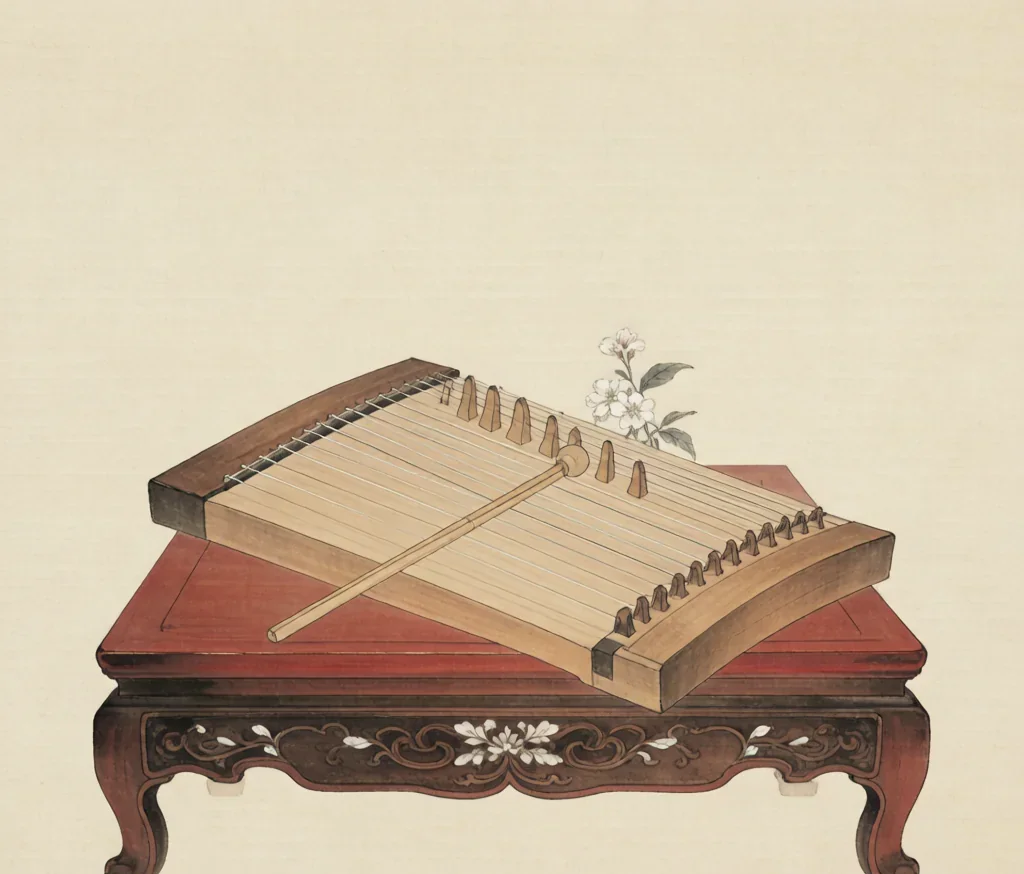
The 扬琴 (), known in English as the Chinese hammered dulcimer, is the bright, ringing heart of many Chinese instrumental ensembles. Played by striking rows of metal strings with a pair of light bamboo hammers, it produces a brilliant, bell-like cascade of notes that can sparkle like rain or roll like a distant thunder of strings. Unlike most Chinese instruments, the yangqin is a relative newcomer with foreign roots: it arrived from the west along the trade routes and was adopted, transformed, and made thoroughly Chinese over the past few centuries. This article traces the yangqin's journey into China, explains how its trapezoidal body and many strings are built, describes its tuning and technique, and shows why it became so central to the modern Chinese orchestra.
A Traveler from the West
The ancestor of the yangqin is the santur, a hammered dulcimer played across the Middle East and Central Asia for centuries. Through the overland and maritime trade networks that linked Persia, India, and China, an instrument of this family reached the south China coast, most likely during the Ming dynasty, around the sixteenth or seventeenth century. Historical accounts point to ports such as Guangzhou and the wider Lingnan region as the place where the new instrument first took hold among local musicians, who were quick to appreciate its loud, clear, and decorative sound.
Once in China, the instrument did not remain a foreign curiosity. Craftsmen reshaped its body, adapted its tuning to Chinese scales, and folded it into regional ensemble traditions such as the narrative-singing and teahouse music of the south. By the Qing dynasty it had spread through much of the country and acquired its Chinese name, in which the first character signals something foreign or brought from afar. The yangqin is therefore a living example of how Chinese music has always absorbed outside influences and reworked them into something unmistakably its own.
Construction of the Trapezoid
The yangqin has a flat, wing-shaped or trapezoidal soundboard of paulownia wood set into a wooden frame, with two curved bridges that support the strings across its face. Beneath the soundboard lie several more bridges transmitting vibration, and the whole instrument sits on a stand so the player can reach the strings from above. The strings themselves are usually of steel, often with a winding of another metal on the lower courses to add weight and richness, and a full concert yangqin may carry more than a hundred strings grouped in courses of two to five that are struck together to sound one note.
Tuning is done by tightening or loosening the strings at the side, and the layout is designed so that the two hands can move independently across different registers. The player holds a hammer in each hand, traditionally a slender strip of bamboo with a flexible tip, though modern players may use rubber-tipped or weighted sticks for different colors of attack. Because the strings run in parallel courses, the player learns a map of bridges and positions rather than fretted fingerings, rather like a small horizontal harp struck from above.
Tuning and the Chinese Scale
The early yangqin was tuned to the pentatonic scale that underlies most traditional Chinese melody, with the bridges arranged so the player could sweep up and down the five core notes with both hammers. As the instrument matured, makers added strings and bridges to provide extra notes, including the half steps needed for the seven-note scale and for the different modal systems used in regional music. A modern concert yangqin is essentially chromatic across a wide range, which lets it play both old tunes and newly composed pieces in any key.
This flexibility is a large part of the yangqin's value. Where a fixed-pitch instrument might struggle to move between the distinct modes of northern and southern repertoires, the yangqin can be retuned between pieces and can realize almost any scale a composer asks for. The trade-off is that the player must remember a fairly complex layout, and must retune with care before a performance, since a single loose string can throw off an entire passage. Good tuning is therefore as much a part of the art as good striking.
Technique and the Voice of Hammers
The basic stroke is a gentle tap with the side of the bamboo hammer, but the technique is far richer than that suggests. Players use single strokes, rapid alternation of the two hammers for fast runs, rolls that shimmer like a tremolo, and dampening touches of the left hand to cut notes short for a crisp, percussive effect. By striking near the bridge the tone is bright and penetrating, while striking nearer the center gives a softer, rounder voice. Skilled players can make the yangqin sing a sustained melodic line or erupt in a storm of decorative notes.
A distinctive feature is the brushing or glissando, where a hammer is drawn across a row of courses to produce a waterfall of sound, an effect unique to struck string instruments. The yangqin also excels at accompaniment, providing a steady, glittering rhythmic foundation under a singer or a melodic soloist. Its percussive yet pitched nature lets it sit comfortably between the drum and the strings, which is why ensembles value it as both a solo and a supporting voice.
The Yangqin in the Chinese Orchestra
When reformers in the twentieth century organized the scattered traditions of Chinese music into the modern Chinese orchestra, the yangqin found a natural home. Its wide range, bright tone, and ability to play chords and fast figuration made it an ideal counterpart to the plucked strings and the bowed strings, and it often serves the role that the piano or harpsichord might in a Western ensemble. In the full orchestra it anchors the plucked-string section and frequently carries the accompaniment or the sparkling ornamental lines.
The yangqin also keeps a strong solo life. Composers have written showpieces that exploit its speed and brilliance, and conservatory training now treats it as a serious classical instrument with graded examination repertoires. Regional styles survive too, especially in the south, where the older, smaller yangqin still accompanies narrative singing and local ensemble music. The instrument thus lives in two worlds at once: deeply traditional in its regional roots and thoroughly modern in the concert hall.
Learning and Listening Today
For a newcomer the yangqin is less mysterious than it looks. The hammers are easy to hold, and because the notes are laid out in a clear spatial pattern, a beginner can soon play simple tunes and enjoy the immediate, satisfying ring of the strings. The main difficulties are evenness of touch, clean fast passages, and the discipline of retuning accurately. A good teacher will stress relaxed wrists and a light, bouncing stroke rather than force, since the instrument speaks best when struck with finesse.
Listeners curious about the yangqin should seek both classic solo repertoire and modern ensemble works, where its glittering runs contrast beautifully with the darker colors of the erhu or the ruan. Recordings that place the yangqin forward in the mix reveal just how piano-like it can be, capable of both thunder and whisper. More than most instruments, the yangqin tells the story of Chinese music as a whole: open to the world, eager to adopt, and endlessly creative in turning a borrowed idea into a treasured national voice.
❓ Frequently Asked Questions
📝 Chinese Vocabulary
扬琴 — : the Chinese hammered dulcimer.
琴竹 — : the bamboo hammers used to strike the strings.
弦 — : string.
码 — : the bridge that supports the strings.
蝴蝶琴 — : The 'butterfly qin,' a folk name for the yangqin inspired by its wing-like shape.
梧桐 — : Paulownia wood, the light wood used for the yangqin's soundboard.
铜丝 — : Brass or copper wire, used for the yangqin's strings.
击弦乐器 — : A struck-string instrument, the family the yangqin belongs to.
🎉 Fun Facts
- The yangqin reached China only a few centuries ago, making it one of the youngest members of the traditional Chinese orchestra.
- Its name uses a character that can signal something brought from afar, a hint at the instrument's foreign origin.
- A concert yangqin can carry more than a hundred strings grouped into courses, yet each course sounds as a single note.
- The yangqin's glissando, a hammer swept across many strings, produces a waterfall of sound found in almost no other Chinese instrument.
- The yangqin is struck rather than bowed or plucked, which places it among the struck-string family alongside the hammered dulcimer of other cultures.
- In the modern Chinese orchestra the yangqin often plays the role a piano would, supplying chords and bright accompaniment behind soloists.