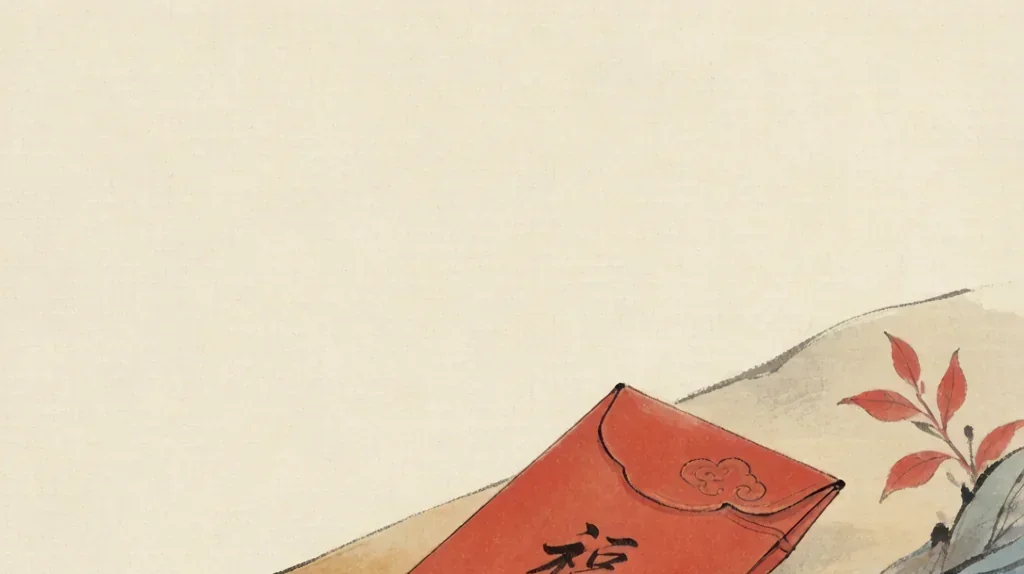
Few objects carry as much meaning in Chinese culture as the humble red envelope — a small crimson paper packet that holds money and a world of significance. Known in Mandarin as 红包 (hóng bāo), literally "red packet," it appears at nearly every major life event: births, birthdays, weddings, New Year celebrations, graduations, and business openings. But the red envelope is far more than a financial gift. It is a vessel of blessing, a shield against misfortune, a marker of relationships, and — in the age of smartphones — a daily social ritual shared by hundreds of millions of people.
To understand why a simple red packet carries such weight, we have to look back over a thousand years, to a time when the color red was believed to ward off demons and the gift inside was meant not to enrich, but to protect.
The Origins: Coins, Demons, and Protective Charms
The earliest ancestor of the red envelope is the 压岁钱 (yā suì qián) — "money to suppress the evil spirit." Folklore from the Han Dynasty (206 BCE – 220 CE) tells of a demon called Sui (祟), a small shadowy creature that appeared on New Year's Eve to pat the foreheads of sleeping children. A child touched by Sui would develop a high fever and could be left simple-minded or worse. To keep the demon away, parents began placing coins under their children' pillows or beside their beds. The coins were believed to emit a faint glow that frightened Sui off.
Over the centuries, this protective custom evolved. During the Tang Dynasty (618–907), courtiers gave children New Year coins wrapped in red silk threads, a tradition associated with the empress handing out "opening of the year" money to grandchildren in the palace. By the Qing Dynasty (1644–1912), the practice had spread to common households, and the wrapping shifted from cloth to the now-iconic red paper. The character 祟 (suì), meaning "evil spirit," sounds identical to 岁 (suì), meaning "year" or "age." So yā suì qián came to mean both "money to suppress the demon Sui" and "money to anchor the passing year" — a beautiful linguistic pun that survives today.
Red itself was chosen for a reason. In Chinese cosmology, red is the color of fire, vitality, and the sun. It is the color that, according to legend, frightened away the beast Nian on New Year's Eve. Wrapping money in red paper transforms a mundane object into a talisman — a small burst of yang energy that protects the recipient from harm and invites good fortune.
Modern Usage: When and to Whom
Today, the red envelope flows through nearly every chapter of Chinese life. The most familiar occasion is Chinese New Year, when married adults and elders give yasuiqian to children, unmarried relatives, and younger family members. The envelopes are typically handed out after the reunion dinner on New Year's Eve or on the first morning of the new year, often accompanied by the greeting "过年好" (guò nián hǎo) — "Happy New Year."
At weddings, guests present red envelopes to the newlyweds to help them start their life together and to share in the joy. The amounts are carefully calibrated to cover the cost of the guest's seat at the banquet, plus a little extra — a custom known as 凑份子 (còu fèn zi), "chipping in for the share." Birthdays, especially for babies, elders celebrating longevity milestones (the 60th, 70th, or 80th), and the one-month celebration of a newborn (满月, mǎn yuè), all call for red envelopes. They are given when a young person enters university, when a business opens, when a friend moves into a new home, and even, increasingly, as a tip or thank-you to service workers during festivals.
The unifying logic is simple: the red envelope is given by someone with more stability, seniority, or good fortune to someone beginning a new stage or in need of blessing. It is a one-way gift of goodwill, never an exchange.
How Much to Give: The Etiquette of Amounts
If you are invited to a Chinese celebration, the question of how much to put in the envelope will inevitably arise. The short answer: it depends — on the relationship, the occasion, your region, and your own financial situation. But there are clear cultural rules that guide the decision.
The most important rule is to favor even numbers and, above all, the number 8. The digit 8 (八, bā) sounds like 发 (fā), meaning "to prosper" or "to get rich," so amounts like 88, 288, 588, and 888 are universally welcomed. The number 6 (六, liù) is also auspicious, as the phrase 六六大顺 (liù liù dà shùn) means "everything goes smoothly." Amounts such as 600 or 666 convey wishes for an easy, unobstructed path.
The number 4 (四, sì), by contrast, must be avoided at all costs. It sounds nearly identical to 死 (sǐ), "death." A red envelope containing 40, 400, or 4,000 yuan is a serious faux pas. Similarly, odd numbers are generally reserved for funerals (white envelopes, not red), so they should not appear in celebratory gifts. The one famous exception is 9, which sounds like 久 (jiǔ), "long-lasting," making 999 a popular wedding gift symbolizing a love that lasts forever.
For Chinese New Year, small amounts are perfectly acceptable — 50 to 200 yuan for a child, more for close family. For weddings, the local custom reigns: in many cities, the minimum is 600 to 1,000 yuan, with close friends giving 1,500 to 3,000 or more. Always use new, crisp bills if possible — many banks even offer fresh notes specifically for the holiday season. Wrinkled or torn money is considered inauspicious.
Red Envelope Etiquette: The Unspoken Rules
Beyond the amount, a subtle code of conduct surrounds the giving and receiving of red envelopes. Following these rules shows respect for the culture and consideration for the recipient.
First, always give and receive with both hands. This gesture conveys sincerity and respect, the same way you would offer or accept a business card in formal settings. Second, never open the envelope in front of the giver. Tearing into a red packet to inspect the amount is considered greedy and thankless. Quietly pocket it and express gratitude; you may check the contents later in private. Third, when you receive a red envelope, it is polite to offer a small verbal blessing in return — wishing an elder good health, a newlywed couple lasting happiness, or a child success in school.
If you are the giver, never hand over an empty envelope (a sign of bad luck), never seal it so tightly that the recipient cannot open it without tearing, and never recycle an envelope that bears someone else's name or the wrong year. The envelope itself, with its gold characters and auspicious motifs, is part of the gift. Choosing one that matches the occasion — a wedding envelope for a wedding, a New Year envelope for the Spring Festival — is a small but meaningful detail.
The Digital Revolution: WeChat and the 抢红包 Craze
In 2014, WeChat introduced a feature that would transform an ancient custom: the ability to send digital red envelopes through a chat app. Within a few years, sending 微信红包 (Wēixìn hóng bāo) had become a national pastime. During Chinese New Year alone, tens of billions of digital envelopes now change hands, far surpassing the physical kind.
The most beloved innovation is the 抢红包 (qiǎng hóng bāo) — "grabbing the red envelope" — a group chat feature where the sender posts a single envelope to be split randomly among whoever taps fastest. The amounts vary wildly: one person might receive 0.01 yuan, another 50 yuan. The thrill is not in the money but in the chase. Families, friend groups, and even company departments hold hour-long grabbing sessions, fingers hovering over screens, laughter erupting at the absurd variance. It has become a new form of social bonding that bridges the gap between grandparents in rural villages and grandchildren in distant cities.
Alipay, QQ, and other platforms have followed suit, and the digital red envelope has spread to employee bonuses, marketing campaigns, and even street performers' tip jars via QR code. Yet despite the technology, the underlying meaning is unchanged. Whether the envelope is paper or pixel, what travels inside it is a wish: may you be safe, may you prosper, may the year ahead be kind.
More Than Money
The red envelope endures because it is so much more than currency. It is a language of care that needs no words — a way of saying "I am thinking of you" without the awkwardness of direct sentiment. It encodes hierarchy and affection in equal measure, telling children they are protected, elders they are respected, newlyweds they are supported, and friends they are remembered. In a culture that often expresses love through action rather than speech, the red envelope is the perfect vessel: small enough to fit in a palm, heavy with meaning, and as red as a wish for good fortune.
Red Envelopes Around the World
Where Chinese communities settled, the red envelope traveled with them. In Southeast Asia it is called ang pao, in Cantonese-speaking regions li shi, and in Chinatowns from London to New York it appears each spring on shop counters and dinner tables. Overseas families use the envelope to keep a tangible tie to their heritage, teaching children the greetings and the two-handed courtesy even when the surrounding culture differs. The digital version has only widened this reach, letting grandparents abroad send a blessing to grandchildren on another continent in seconds. Across all these places the meaning stays constant: a small red packet is a wish for safety and good fortune, carried far from its village origins.
❓ Frequently Asked Questions
📝 Chinese Vocabulary
红包 — : red envelope or red packet; a small red paper (or digital) wrapper containing money, given as a gift at celebrations to convey blessing and good fortune.
压岁钱 — : New Year's money given to children; literally "money to suppress the evil spirit (Sui)," a tradition dating back over two thousand years.
抢红包 — : "grabbing the red envelope"; the modern practice of competing in a group chat to claim a share of a randomly split digital red packet.
利是 — : The Cantonese name for auspicious red envelopes given in southern China, often to children and service workers in the new year.
礼簿 — : The gift register kept at a wedding or major event to record who gave how much, so the favor can be returned later.
满月 — : The full-month celebration of a newborn, a key occasion for giving red envelopes to the baby and parents.
祟 — : The demon Sui of folklore, whose touch harmed children and whom the red envelope was meant to frighten away.
凑份子 — : To chip in for the share, the custom of calibrating a wedding envelope to cover one's seat plus a little extra.
🎉 Fun Facts
- The character 祟 (suì, "evil spirit") and 岁 (suì, "year") are homophones, which is why New Year money is called yasuiqian — it both wards off demons and "anchors" the passing year.
- During the 2024 Spring Festival, WeChat users sent over 80 billion digital red envelopes on New Year's Eve alone — more than ten for every person on Earth.
- Wedding red envelope amounts are often recorded in a 礼簿 (lǐ bù, "gift register") so the couple can reciprocate in kind when the giver's own wedding or child's birthday comes around.
- In southern China, married adults give red envelopes called 利是 (lì shì) — Cantonese for "auspicious" — not only to children but to service workers, security guards, and even strangers during the first weeks of the new year.
- The number 999 is a popular wedding gift because 9 (九) sounds like 久 (jiǔ), meaning "long-lasting" — symbolizing a marriage that will endure forever.
- In many workplaces the boss hands out red envelopes on the first working day after the holiday as a wish for a prosperous year, a small ritual that blends business with blessing.