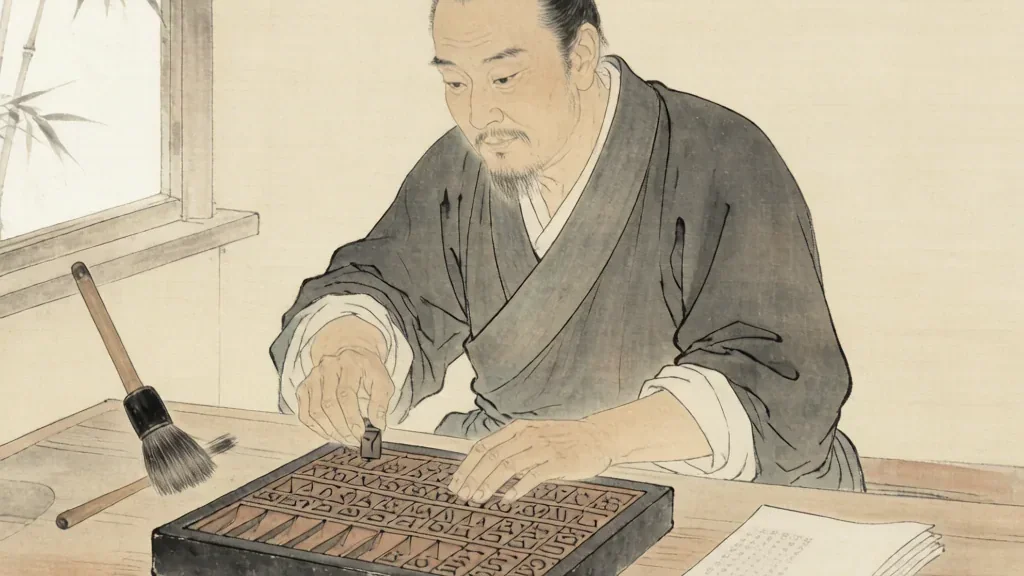
In the middle of the eleventh century, a common artisan working in the workshops of the Song dynasty found a way to print books that would change the world. His name was Bi Sheng, written 毕昇 and pronounced . Using fired clay, he created individual movable type characters that could be arranged, inked, and reused—four centuries before Johannes Gutenberg's press appeared in Europe. For English readers, Bi Sheng is a pivotal but often overlooked figure in the history of communication. This article tells the story of the inventor whose clay characters seeded the printed word.
An Artisan of the Song
Bi Sheng lived during the Northern Song dynasty, roughly between 970 and 1051 CE, and almost nothing is known of his personal life. He was not a court official or a famous poet but a craftsman employed in the imperial printing establishments, where woodblock printing was already a mature industry. Block printing had spread rapidly in China, but it was slow and wasteful: each page required a separately carved wooden block, and a single mistake could ruin the whole plate.
Bi Sheng's genius was to break the page into its smallest reusable unit—the single character. By making each character a separate piece, he turned printing from a carving of whole pages into a system of composition, exactly the principle that defines movable type everywhere it has appeared. His social obscurity is precisely why his achievement is so striking: it came not from a scholar's study but from a workingman's bench.
The Invention of Movable Type
The method is recorded in detail by the scholar Shen Kuo in his Dream Pool Essays, our only source for Bi Sheng's work. Bi Sheng made characters from sticky clay, carving each one in reverse on a small block and then baking it hard in a kiln. He kept the thousands of type pieces in a grid, sorted by rhyme for easy retrieval, and for each page he pressed the needed characters into a frame coated with a mixture of resin, wax, and paper ash.
When the frame was heated, the backing melted and held the type firmly in place for inking and pressing. After printing, gentle heat released the characters so they could be returned to their compartments and used again. The system was fast to set for large runs and economical, because a single character could serve in countless different pages. Shen Kuo noted that Bi Sheng's heirs still kept the type, preserving the inventor's tools after his death.
Why Clay, and Not Metal?
A natural question is why Bi Sheng used clay rather than metal. Clay was cheap, easy to carve, and could be fired in any kiln; it also took ink well and resisted the warping that early metal type suffered. Bi Sheng experimented with wood type too, but found that wooden pieces swelled with moisture and stuck unevenly, making them hard to remove. Clay gave him uniform, durable characters at low cost.
Metal movable type did appear later in China, Korea, and eventually Europe, but Bi Sheng's clay version was the first working system of its kind. The choice of material was a practical judgment, not a limitation of vision. The crucial insight—that type should be individual, reusable, and recombinable—was fully present in his clay characters.
Why the Idea Spread Slowly in China
Paradoxically, movable type did not immediately replace block printing in China. Chinese has thousands of characters rather than a small alphabet, so setting type required a huge store of pieces and careful sorting. For many books, especially those with large character sets, carving a woodblock remained competitive in cost and speed. Block printing therefore remained dominant in China for centuries even after Bi Sheng's invention.
The idea traveled, however. Movable type spread to neighboring Korea, where metal type was developed extensively by the Choe family and the Goryeo and Joseon courts, producing some of the world's earliest metal-type printed books. The principle also reached the Islamic world and, much later, Europe, where Gutenberg's alloy type realized the same dream in a phonetic alphabet that made the system especially efficient.
Recognition Through a Single Account
Bi Sheng's fame rests almost entirely on a few paragraphs written by Shen Kuo, a polymath who admired the invention and recorded it carefully. Without that account, Bi Sheng might have vanished entirely from history, a reminder of how fragile the record of ordinary inventors can be. Shen Kuo's description is specific enough that modern scholars have been able to reconstruct and test the method, confirming that it worked as described.
This dependence on one witness also shows the value of good documentation. Shen Kuo, who wrote on everything from magnetism to mathematics, understood that Bi Sheng's clay characters were a turning point. His brief, precise report is the thread by which we know the name of the man who first printed with movable type.
Legacy in the Age of Print
Bi Sheng's legacy is the printed world we inhabit. Every book, newspaper, and page produced by rearrangeable type descends from the principle he pioneered. Though Gutenberg is the name most Westerners associate with movable type, the technique's first realization belongs to a Chinese artisan four centuries earlier. Recognizing Bi Sheng does not diminish Gutenberg; it enlarges our sense of how a single practical idea can arise in one civilization and flower in another.
For readers today, Bi Sheng stands for the quiet inventor whose work outruns his fame. His clay characters, baked in a Song-dynasty kiln, were the first movable type in human history, and they set in motion the long revolution that made the written word cheap enough for everyone. He is a fitting hero for an age still grappling with how technology spreads knowledge.
How a Page Was Printed
Bi Sheng's method was practical and repeatable. He carved each character in reverse on a small block of sticky clay and baked it hard in a kiln, keeping thousands of type pieces in a grid sorted by rhyme for quick retrieval. For each page he pressed the needed characters into a frame coated with a mixture of resin, wax, and paper ash; when heated, the backing melted and held the type firmly for inking and pressing. After printing, gentle heat released the characters so they could be returned to their compartments and reused. The system was fast for large runs and economical because a single character could serve in countless different pages, turning printing from whole-page carving into reusable composition.
From Clay to the Modern Press
Bi Sheng's clay characters were the first working movable type in human history, but the idea did not stay in China. Because Chinese uses thousands of characters, type-setting remained laborious and woodblock printing stayed competitive at home, yet the principle traveled to Korea, where metal type was developed extensively and produced some of the world's earliest metal-type books, and later reached the Islamic world and Europe. Gutenberg's alloy type realized the same dream in a phonetic alphabet that made the system especially efficient for Western languages. Every book, newspaper, and page produced by rearrangeable type descends from the principle Bi Sheng pioneered, making the printed world we inhabit his lasting legacy. His humble clay characters thus set in motion the long revolution that made the written word cheap enough for everyone.
❓ Frequently Asked Questions
📝 Chinese Vocabulary
毕昇 — : Bi Sheng, the inventor of movable type.
活字印刷 — : movable-type printing, his invention.
北宋 — : the Northern Song dynasty, his era.
泥活字 — : clay movable type, the material he used.
梦溪笔谈 — : the Dream Pool Essays by Shen Kuo that records his work.
沈括 — : Shen Kuo, the polymath whose Dream Pool Essays records Bi Sheng's invention.
雕版印刷 — : Woodblock printing, the mature technique that movable type improved upon.
胶泥 — : The sticky clay from which Bi Sheng carved each reusable type character.
🎉 Fun Facts
- Bi Sheng's type was made of baked clay, not metal, yet it was the world's first reusable movable type.
- We know about him almost entirely from one account by the scholar Shen Kuo.
- He sorted thousands of clay characters in a grid by rhyme to speed up typesetting.
- Korea later developed metal movable type based on the same principle, producing very early printed books.
- Before Bi Sheng, a whole page had to be carved on one wooden block, so a single carving error could ruin an entire plate.
- Gutenberg's European press came about four centuries later and realized the same idea using a phonetic alphabet, which suited Western languages well.