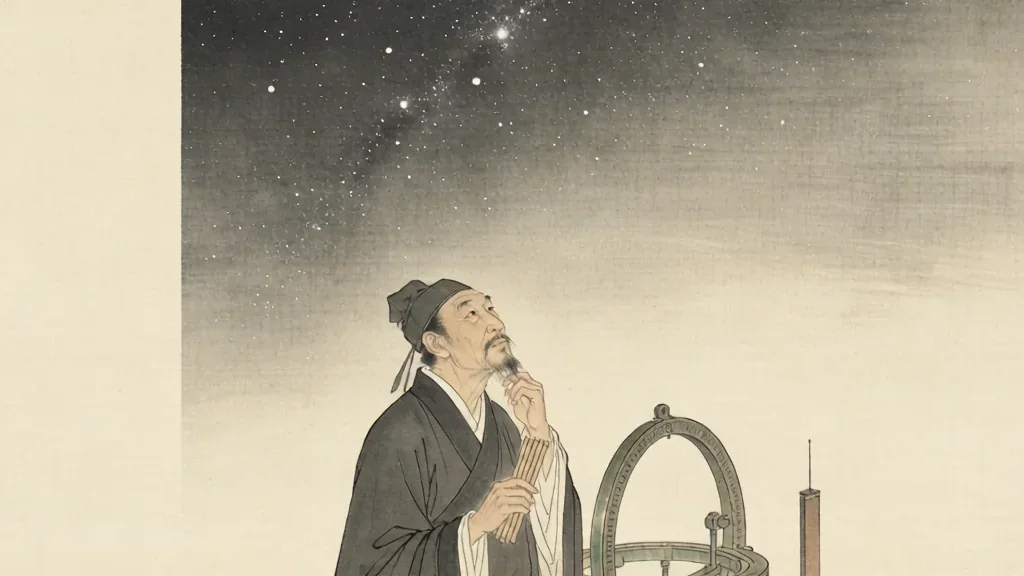
At the height of the Mongol Yuan dynasty, a Chinese scientist undertook the most ambitious survey of the heavens and the land that his civilization had ever attempted. His name was Guo Shoujing, written 郭守敬 and pronounced . An astronomer, mathematician, hydraulic engineer, and instrument-maker, Guo measured the length of the solar year with an accuracy not surpassed in the West until the sixteenth century, and he built observatories and canals that served the empire. For English readers, Guo is a doorway into a sophisticated tradition of state-supported science. This article follows the career of a man who quite literally measured the sky.
Early Promise and Patronage
Guo Shoujing was born in 1231, near the end of the Mongol conquest of China, and he came of age as the Yuan dynasty was being consolidated under Kublai Khan. He was raised in part by a grandfather who shared an interest in mathematics and water engineering, and as a young man Guo displayed a gift for designing instruments and solving practical problems. His talent reached the attention of the court, and Kublai Khan—keen to legitimize Yuan rule with proper calendars and public works—gave him significant responsibility.
What distinguished Guo's career was the scale of official support behind it. The Yuan state funded a nationwide network of observatories and survey stations, something no private scholar could attempt. Guo was placed in charge of both the astronomical reform and major hydraulic projects, a combination of roles that let him apply the same quantitative discipline to the stars and to rivers.
Reforming the Calendar
The centerpiece of Guo's astronomical work was a new calendar, the Shoushi calendar, or "Calendar of Established Order," completed in 1281. To build it, he first needed accurate measurements of the heavens. He organized observations across the empire, from sites as far apart as the northern steppes and the southern coasts, recording the positions of the sun, moon, and planets with unprecedented care.
The result was a solar year length of 365.2425 days—identical to the value used by the Gregorian calendar introduced in Europe three centuries later. For its time this was astonishingly precise. The Shoushi calendar remained the official Chinese calendar for centuries and was celebrated as the most accurate of the imperial era. Guo achieved this not by genius alone but by systematic observation, better instruments, and rigorous calculation.
Instruments and Observatories
Guo Shoujing was above all a master instrument-maker. He designed and built a new generation of astronomical devices at the principal observatory in Dadu, the Yuan capital (near modern Beijing). Among his inventions was an improved gnomon—a tall, precisely graded shadow-casting pillar—and the "simplified instrument," a streamlined armillary sphere that reduced complex rings to a more usable form. He also constructed a large celestial globe and a water-powered armillary driven by an escapement.
Beyond the capital, he established more than two dozen observation posts stretching across the realm, each staffed to record data under a common method. This network was, in effect, the world's first coordinated geodesic and astronomical survey. The precision of his equipment and the discipline of his observers together made the Shoushi calendar possible.
The Geodetic Survey
Guo's survey was not limited to the sky. He directed a nationwide measurement of the earth's surface intended to fix the relationship between latitude and the length of the solar day, and more practically to support taxation and administration. Teams traveled the empire measuring distances, heights, and the timing of the noon shadow at different latitudes, producing a grid of data unprecedented in scope.
This work blurred the line between astronomy and geography. By linking local observations to a single coordinate system, Guo helped give the Yuan state a unified picture of its territory. The survey stands as one of the great administrative-scientific enterprises of the medieval world, comparable in ambition to later European mapping projects but separated from them by centuries.
Engineer of Rivers and Canals
Guo Shoujing was equally famous as a hydraulic engineer. He repaired and extended the canal systems around the capital so that grain and goods could be moved efficiently to feed Dadu's population. His most noted project was the expansion of the waterway linking the city to the network of northern rivers, including work that became part of what is now the Grand Canal system.
He applied his surveyor's eye to water, calculating gradients and sluices so that boats could pass and fields could be irrigated. The canals he improved kept the Yuan capital supplied and demonstrated how science could serve the state's most basic needs. For Guo, there was no contradiction between reading the stars and digging a channel: both were problems of measurement and order.
Legacy of a Measured Empire
Guo Shoujing died around 1316, leaving a record of achievement that marked the high point of traditional Chinese astronomy. His calendar governed Chinese timekeeping for generations, and his instruments influenced observatory design for centuries. In modern times, his memory is honored by the naming of a lunar crater and a near-Earth asteroid after him, joining Zu Chongzhi in the sky he loved to measure.
For the English-speaking reader, Guo Shoujing reshapes the story of science. He shows that large-scale, state-funded, data-driven research existed in fourteenth-century China, and that the divide between "East" and "West" in scientific accomplishment is a matter of timing and record-keeping, not of capability. The astronomer who measured the sky reminds us that curiosity, properly supported, can chart the heavens in any age.
Measuring the Seasons for Farmers
The Shoushi calendar was not an abstract achievement; it governed daily life. Its accurate determination of solstices and the solar year set the dates of planting, harvest, and the great festivals, so that farmers, tax collectors, and ritual officials all kept time by Guo's reckoning. A reliable calendar also confirmed the ruler's mandate, since correct rites depended on correct days. By tying the heavens to the agricultural year, Guo's work reached from the observatory down to the village field. The precision that matched the Gregorian value three centuries later was, in practice, a tool for feeding and ordering a vast realm through the rhythm of the seasons.
Science as Statecraft in the Yuan
Guo Shoujing's career shows how the Mongol Yuan used science to legitimize rule. Kublai Khan funded observatories, surveys, and canals not merely from curiosity but to present Mongol governance as civilized and cosmic, aligned with the heavens and attentive to the people's welfare. A new calendar and a well-fed capital proclaimed a settled, legitimate dynasty rather than a conqueror's camp. Guo's hydraulic works further bound the realm together by moving grain to Dadu. In this light, astronomy and engineering were instruments of state, and the Yuan's willingness to sponsor large, data-driven projects marks one of the boldest marriages of science and power in medieval history.
❓ Frequently Asked Questions
📝 Chinese Vocabulary
郭守敬 — : Guo Shoujing, astronomer and engineer of the Yuan dynasty.
授时历 — : the Shoushi or "Calendar of Established Order" that he created.
元朝 — : the Yuan dynasty founded by the Mongols, his era.
天文台 — : observatory, the institutions he built and ran.
水利 — : waterworks or hydraulic engineering, his other great field.
简仪 — : The simplified armillary, an instrument Guo Shoujing designed by removing redundant rings.
圭表 — : The gnomon, a graduated shadow pillar for measuring solstices and the sun's path.
四海测验 — : The nationwide survey of the four quarters that Guo directed for the Shoushi calendar.
🎉 Fun Facts
- Guo's solar year value of 365.2425 days is exactly the same as the Gregorian calendar adopted in Europe in 1582.
- He set up more than twenty observation stations across the empire, an early form of coordinated scientific survey.
- A crater on the Moon and an asteroid bear his name.
- He improved the canals that fed the Yuan capital, linking astronomy to the practical problem of feeding a city.
- Guo Shoujing's simplified instrument removed many overlapping rings of the traditional armillary, making sky measurement far easier and more accurate.
- His survey measured the length of the sun's noon shadow from the far north to the southern coast, an early form of latitude mapping.