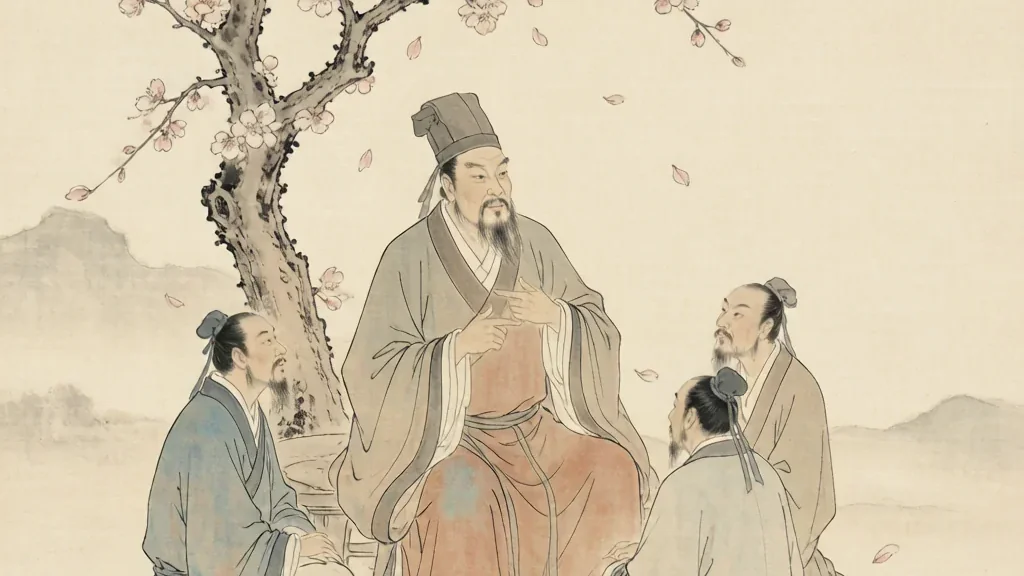
Of all the thinkers who carried forward the teachings of Confucius, none shaped them more warmly or more lastingly than the man later honored as the "Second Sage." His name was Mencius, written 孟子 and pronounced . Living about two centuries after Confucius, in the violence of the Warring States period, Mencius argued that human nature is fundamentally good and that rulers govern by the consent and welfare of the people. For English readers, Mencius is the optimistic heart of Confucianism—a philosopher who believed in the better angels of our nature. This article follows his life and his enduring faith in humanity.
Life of a Wandering Teacher
Mencius was born around 372 BCE in the state of Zou, in present-day Shandong, the homeland region of Confucius. According to tradition he was raised by his mother, a figure so associated with devoted child-rearing that Chinese culture still references "the mother of Mencius" as a model parent. He studied the Confucian classics and absorbed the conviction that virtuous leadership could restore order to a fractured world.
Like Confucius, Mencius spent his life traveling among the warring states, offering advice to kings who often listened politely and acted not at all. He served for a time in Qi and debated rivals such as the Daoists and the followers of Mozi. Though he never held the transforming office he sought, he gathered disciples and left a recorded body of conversations and arguments that became one of the Four Books at the core of later Confucian education.
The Goodness of Human Nature
Mencius's signature doctrine is that human nature is good. He did not mean that people are always virtuous, but that they are born with sprouts—the tendencies toward compassion, shame, courtesy, and a sense of right and wrong. Even a stranger will feel alarm at a child about to fall into a well, he argued; that spontaneous pity proves the seed of goodness is native to us all.
This optimism set him against thinkers such as Xunzi, who taught that nature is selfish and must be disciplined by training. For Mencius, education and good government should nurture the innate sprouts rather than impose an alien order. His view gave Confucianism a humane and hopeful cast, insisting that moral improvement is the fulfillment of who we already are, not a fight against our essence.
The People as the Foundation
Mencius carried Confucius's political concern to a striking conclusion: the people are the most important element of a state, the altars of soil and grain next, and the ruler lightest of all. He taught that a king who neglected the people forfeited the "Mandate of Heaven" and could rightfully be removed. In a famous exchange, he told a ruler that killing a tyrant was not regicide but the execution of a criminal.
These were bold words in an age of absolute princes. Mencius grounded them in consequences: a government that oppresses its subjects breeds rebellion and ruin, while one that relieves famine and lightens taxes earns loyal support. His "well-field" ideal envisioned farmers holding land that let them feed their families and thus remain morally decent—a linkage of economics and virtue typical of his practical compassion.
Debating the Age's Schools
Mencius was a fierce polemicist who saw himself as defending Confucius against rivals. He attacked the followers of Mozi for eroding family devotion through universal love, and he ridiculed the Daoists for withdrawing from public duty. He also opposed the "profiteers" who measured policy only by gain, insisting that a state must be guided by righteousness, not mere advantage.
Yet his debates reveal a pluralistic intellectual world. The very fact that Mencius had to argue so vigorously shows how contested the Confucian project was. His victories were rhetorical and pedagogical rather than political, but they helped define what orthodoxy would later mean. By the time Confucianism became state doctrine, Mencius's interpretations were treated almost as scripture.
The Book and Its Legacy
The Mencius, a book of dialogues and speeches compiled by his disciples, became one of the Four Books that dominated Chinese education for nearly a thousand years, from the Song dynasty onward. Generations of students memorized his arguments, and the imperial examination system sealed his influence over the governing class. His phrases entered everyday language, and his image joined Confucius in temples of Confucian worship.
His optimism also softened Confucianism's hierarchical edge. By asserting innate goodness, he gave ordinary people dignity and gave rulers a moral standard they ignored at their peril. The "Second Sage" thus did more than comment on Confucius; he made the tradition livable and humane for the vast majority who would never be kings.
Why Mencius Still Speaks
Mencius still speaks because his two claims—that people are naturally inclined to good, and that power must serve the people—remain the foundations of any decent politics. His faith in human potential encourages education and self-cultivation, while his limits on rulers anticipate modern ideas of accountability. For English readers, he is an accessible entry to Confucian thought: less ceremonial than Confucius, more hopeful than Xunzi.
In a world still wrestling with how to balance authority and dignity, Mencius offers a steady voice: nurture the good that is already there, and judge every government by whether it feeds and frees the common person. The philosopher of the goodness of human nature remains, after two thousand years, a teacher worth hearing.
Nurturing the Sprouts
Mencius taught that goodness is innate, but he was equally clear that it must be tended. The compassionate sprout in every person can be smothered by hardship or neglect, or it can be strengthened through reflection, learning, and the right surroundings. He compared the mind to a garden that needs regular care, and he warned that a life spent chasing profit or pleasure dries up the natural shoots of virtue. This is why education and good company matter so much in his thought: they feed what is already there instead of imposing a foreign order. The practical lesson is hopeful and demanding at once, that anyone can become better, but only through steady, daily effort to notice and act on the good they already feel.
Mencius on War and Economy
Mencius was no dreamy moralist; he had concrete views on how a state should be run. He condemned pointless warfare and the exploitation of subjects, arguing that a ruler who overtaxes farmers or drags them into campaigns forges his own downfall. His well-field ideal divided land into nine squares worked cooperatively, so each family could feed itself and still contribute to the common good. This linking of economics and ethics was central to his thought: a person who is hungry and frightened cannot be expected to be virtuous. By tying the people's welfare to the ruler's legitimacy, he turned Confucian care into a program of taxation, land, and peace, a vision of government measured by whether ordinary lives were fed and free.
❓ Frequently Asked Questions
📝 Chinese Vocabulary
孟子 — : Mencius, the Confucian "Second Sage."
性善 — : the goodness of human nature, his key doctrine.
仁政 — : humane government, rule oriented to the people's welfare.
战国 — : the Warring States period, his era.
四书 — : the Four Books, the corpus in which his work was enshrined.
浩然之气 — : Flood-like qi, the great moral energy Mencius said grows from accumulated right conduct.
义 — : Righteousness or duty, the moral claim that should guide action alongside benevolence.
井田 — : The well-field system, Mencius's ideal of landholding that linked economic security to virtue.
🎉 Fun Facts
- Mencius's mother is a Chinese symbol of devoted parenting; the phrase "Mencius's mother moves three times" refers to choosing a good environment for a child.
- He said the people matter more than the ruler—a radical claim in his age of absolute princes.
- His book became one of the Four Books memorized by exam candidates for nearly a millennium.
- He debated followers of Mozi and the Daoists, helping define Confucian orthodoxy.
- The term hao ran zhi qi, his 'flood-like qi,' is now everyday Chinese for an upright, unyielding spirit.
- Mencius spent years moving between rival courts, in Qi, Liang, and Teng, usually honored as a guest yet rarely followed, mirroring Confucius's own frustrated travels.