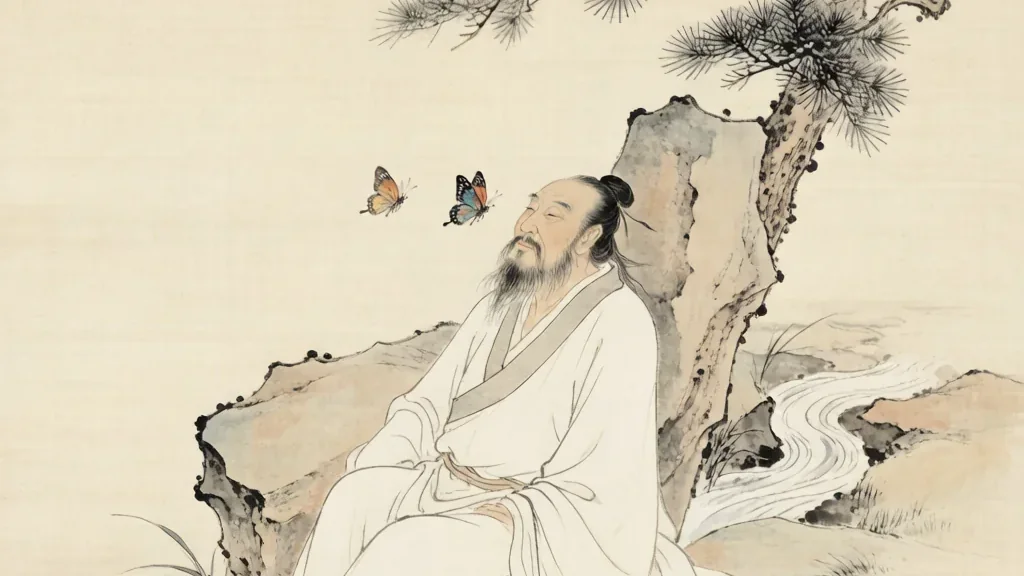
Among the voices of ancient China, none is stranger or more delightful than the philosopher who wondered whether he was a man who had dreamed of being a butterfly, or a butterfly now dreaming he was a man. His name was Zhuangzi, written 庄子 and pronounced . A Daoist thinker of the Warring States period, he wrote in dazzling parables that嘲笑 the pretensions of power, learning, and even philosophy itself. For English readers, Zhuangzi is the playful, liberating side of Chinese thought—a writer who still feels startlingly modern. This article wanders through his life and his boundless freedom.
A Poor Sage Who Refused Office
Zhuangzi is traditionally said to have lived around 369 to 286 BCE in the state of Song. Unlike Confucius or Mencius, who sought to advise kings, Zhuangzi reportedly declined high office when it was offered, preferring the freedom of a modest life. A famous story has him turning down an invitation to become a minister, comparing the court to a sacrificial ox fattened for slaughter and himself to a free turtle dragging its tail in the mud.
He is said to have earned a simple living weaving sandals or doing small work, and to have been on easy, witty terms with fellow thinkers. The little we know of his life comes largely from the book that bears his name, a text as much literary as philosophical. What emerges is a man who valued liberty above rank and laughter above doctrine—a rarity in any age.
The Butterfly and the Dream
The most famous passage in all Chinese philosophy is Zhuangzi's butterfly dream. He wrote that once, dreaming he was a butterfly flitting happily about, he did not know he was Zhuangzi; then waking, he wondered whether he was Zhuangzi who had dreamed of a butterfly, or a butterfly now dreaming he was Zhuangzi. The boundary between dream and waking, he concluded, is blurred.
This is not mere whimsy. It is a probe into the limits of what we can know and the rigidity of the self. By unsettling the certainty that "I" am fixed and real, Zhuangzi loosens our grip on the labels we use to divide the world. The butterfly becomes a doorway to his larger theme: that our confident distinctions—life and death, right and wrong, big and small—may be far less solid than they seem.
The Relativity of Things
Zhuangzi delighted in showing that judgments depend on where one stands. What is useful to one creature is useless to another; what is beautiful to a human may mean nothing to a fish. He tells of a giant tree so gnarled it cannot be cut for lumber, and so is never felled—its "uselessness" is precisely its salvation. The point is not that nothing matters, but that fixed rankings are arbitrary.
His "equalizing of things" teaches that we should not force one standard on all. A frog in a well thinks the well is the whole world; a summer insect cannot conceive of ice. These stories warn against mistaking our narrow perspective for universal truth. For Zhuangzi, wisdom lies in recognizing the vastness beyond our little pond.
Freedom Through the Dao
Like other Daoists, Zhuangzi taught harmony with the Dao, the ever-changing flow of nature. But where the Daodejing is terse and oracular, Zhuangzi is conversational and comic. He pictures the sage as one who "roams" beyond conventional bounds, responding to each moment without clinging to fixed plans or fears. Such a person is free because nothing external can shatter an identity rooted in the Dao.
He also reworked the Confucian ideal of skill. In the tale of Cook Ding carving an ox, the cook moves with effortless grace because he has forgotten the distinction between knife and ox and follows the natural gaps. Mastery, for Zhuangzi, is not effort piled on effort but action so attuned to reality that it becomes spontaneous. This is the freedom he most prized.
Death, Laughter, and Acceptance
Zhuangzi's attitude toward death is among his most consoling teachings. When his wife died, he was found drumming and singing; he explained that she had returned to the vast transformational process of nature, and to wail would be to deny the inevitability of change. At his own death, asked how he wished to be buried, he is said to have welcomed being left to the birds and beasts, indifferent to where his body came to rest.
This equanimity is not coldness but a deep acceptance of life's mutability. By seeing death as part of the endless transformation of things, Zhuangzi dissolves the terror that fixes us in anxiety. His laughter at the grave is an invitation to live without the weight of pretending the self is permanent. It is a profoundly liberating vision.
Why Zhuangzi Still Delights
Zhuangzi still delights because he refuses to be a sage in the ordinary sense. He mocks the search for fixed answers and instead offers stories that free the mind. In an age anxious for certainty and status, his humor and humility are tonic. He teaches that the fullest life may be the one least concerned with proving itself right.
For English readers, Zhuangzi bridges literature and philosophy in a way that anticipates modern irony and existential play. The Daoist who dreamed he was a butterfly remains a companion for anyone who suspects that the world is larger, stranger, and more joyful than the rules allow. He is, quite simply, one of the great liberating writers of humanity.
The Zhuangzi as Literature
The Zhuangzi is not a dry treatise but one of the most imaginative works in Chinese letters. Tradition ascribes it to the man himself, though later hands added chapters, and it now stands as thirty-three sections of parables, dialogues, and nonsense rhymes. Its style delights precisely because it refuses a single voice: sages argue with Confucians, a skull gives a lecture on death, and logicians are gently mocked for taking names too seriously. For English readers the book feels strikingly modern, closer to a surreal essay than to a scripture. What makes it enduring is that its playfulness carries a serious point, that fixed doctrines imprison the mind, and that freedom begins with laughing at our own certainty. Modern translators still argue over whether the parables are philosophy or fiction, a debate the text seems to invite by never settling down into a single doctrine.
Influence on Art and Thought
Zhuangzi's laugh echoed far beyond philosophy. His stress on spontaneity and the limits of convention fed directly into Chan Buddhism, where sudden insight matters more than rigid study, and into the ideals of Chinese landscape painting, where the scholar-artist prizes an untroubled, natural brush. Poets from the Tang onward quoted him to justify withdrawal from court and a life attuned to rivers and mountains. In daily speech, Chinese still use phrases drawn from his pages to praise someone who takes life lightly or sees through pomposity. Few ancient writers have shaped the emotional temper of a civilization as much as this reluctant sage, whose refusal to be a teacher became his greatest teaching. Centuries later his tales still surface in novels, films, and political essays, proof that a writer who wanted followers least has gained them most enduringly.
❓ Frequently Asked Questions
📝 Chinese Vocabulary
庄子 — : Zhuangzi, the Daoist philosopher and writer.
道 — : the Dao, the natural way or flow of the universe.
蝴蝶梦 — : the butterfly dream, his most famous parable.
逍遥 — : free and easy wandering, his ideal of liberty.
战国 — : the Warring States period, his era.
齐物论 — : Equalizing Things, the Zhuangzi chapter on the relativity of all distinctions
坐忘 — : sitting and forgetting, a meditative state of emptying the self
鲲鹏 — : the giant fish-bird of Zhuangzi's opening parable on vast transformation
🎉 Fun Facts
- When Zhuangzi's wife died, he drummed on a basin and sang instead of weeping.
- He turned down a minister's post, saying he would rather be a free turtle dragging its tail in the mud.
- His butterfly dream is one of the most quoted passages in all of Chinese literature.
- The tale of Cook Ding carving an ox illustrates effortless skill through harmony with nature.
- The Zhuangzi survives as a book of thirty-three chapters mixing prose and verse, and together with the Daodejing it forms the core of Daoist philosophy.
- In one fable a giant bird called the peng transforms from a fish and soars vast distances, an image Zhuangzi uses to mock small-minded creatures content in their little pond.