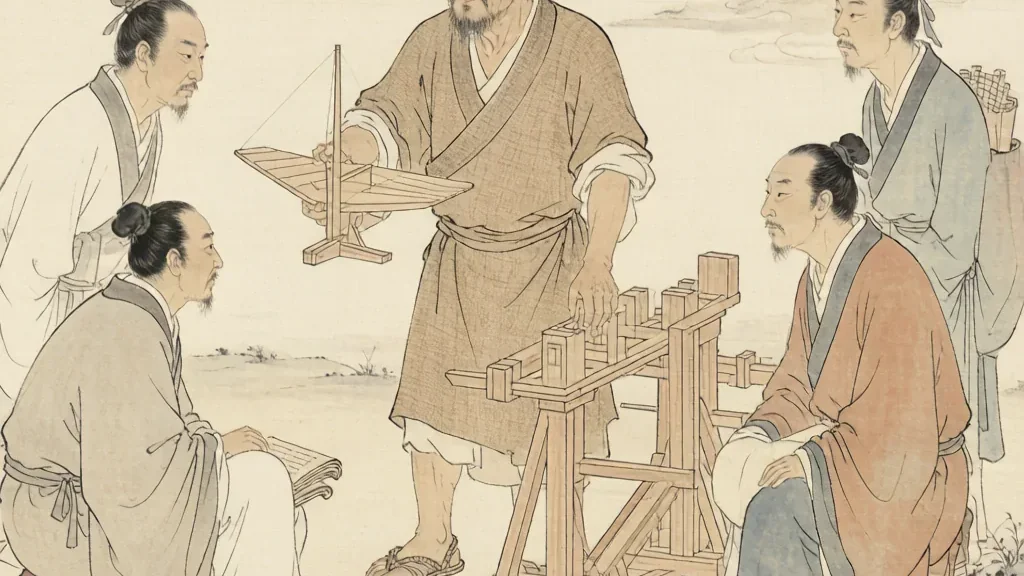
In an age when China's thinkers debated how society should be ordered, one philosopher stood out for a radical and generous idea: that we should care for the welfare of others as we care for our own. His name was Mozi, written 墨子 and pronounced . Living in the turbulent centuries of the Spring and Autumn and Warring States periods, Mozi founded a school that preached "universal love," opposed aggressive war, and prized usefulness over ceremony. For English readers, Mozi is a fascinating counterweight to Confucius—a pragmatic, almost utilitarian voice in ancient Chinese thought. This article explores his life, his doctrine, and his strange disappearance from the mainstream.
The Man and His School
Mozi is traditionally said to have lived from about 470 to 391 BCE. His background is unclear; some later accounts describe him as a craftsman or engineer, possibly of humble origin, which may explain his school's practical, labor-respecting spirit. He may have begun as a follower of Confucian teachings before breaking away to found his own movement, the Mohists, who became the chief rivals of the Confucians for centuries.
The Mohist school was unusual in being highly organized. It functioned almost like a disciplined order, with a leader called the "Great Master" and members who traveled to defend states against aggression and to serve as administrators. Mohists prized frugality, plain living, and collective discipline, and they maintained a reputation for technical skill in fortifications and mechanics. This combination of philosophy and practical engineering made them both thinkers and defenders of cities.
Universal Love
Mozi's central ethical teaching was jian'ai, usually translated as "universal love" or "impartial care." He argued that the world's troubles came from people caring only for themselves and their own families while harming others. The remedy was to extend the same concern to everyone regardless of kinship or distance. A person should, Mozi said, care for another's state as for his own, and for another's family as for his own family.
This was a direct challenge to the Confucian emphasis on graded love—care that naturally begins with parents and widens outward. Mozi thought graded love inevitably produced partiality and conflict. His universal love was not sentimental but a principle of social coordination: if everyone benefited others, everyone would be secure. It is one of the earliest statements of impartial benevolence in world philosophy, strikingly close in spirit to later Western utilitarianism.
Opposition to Aggressive War
Mozi was the ancient world's most forceful critic of offensive warfare. He distinguished between just defense and aggressive conquest, and he devoted enormous energy to dissuading rulers from attacking their neighbors. Traveling from state to state, he would debate warmaking kings, showing that the gains of a campaign never matched its ruinous cost in lives and resources.
In one famous episode, Mozi is said to have rushed to a threatened city and, through a simulated defense using模型和 mathematical reasoning, convinced a attacking lord that his siege would fail, thereby averting the war. Whether literal or not, the story captures the Mohist commitment to practical peacemaking backed by engineering skill. For Mozi, the condemnation of war was not mere preaching but a program of technical and moral resistance.
Utility, Frugality, and Anti-Fatalism
Mohism judged institutions by their usefulness. Mozi attacked lavish funerals, extended mourning, and expensive music and rites, arguing that such practices drained resources without benefiting the people. This put him at odds with Confucians, who treasured ritual as the glue of society. Mozi wanted a lean, functional state that fed, clothed, and defended its subjects.
He also insisted on human effort over destiny. Against the "fatalists" who said outcomes were fixed, Mozi argued that diligence and good government changed the world—a stance that empowered action. His "three standards" for testing a belief asked whether it rested on the deeds of ancient sage kings, the evidence of the senses, and the benefit to the people. These standards read like an early method of empirical and pragmatic verification.
The Mohist Canon and Decline
After Mozi's death, his followers produced a remarkable body of texts, including the Mohist Canon, a set of terse, technical passages on logic, optics, mechanics, and definition. These writings show a school fascinated by argument, geometry, and the behavior of light and levers—an early Chinese engagement with what we would call science and formal logic. The Canon is one of the most intellectually daring texts of ancient China.
Yet Mohism faded after the unification of China under the Qin and the triumph of Confucianism under the Han. Its strict discipline, its celibate and ascetic tone, and its challenge to family-centered values made it hard to sustain as a mass tradition. By the early imperial era it had largely vanished as an organized school, preserved only in a few chapters of the received text. Its disappearance is one of the great "what ifs" of Chinese intellectual history.
Why Mozi Matters Now
Mozi matters because he represents a road not taken—a Chinese tradition of impartial benevolence, anti-war pragmatism, and empirical inquiry that was sidelined but never erased. Modern readers, especially those concerned with global justice and the ethics of conflict, find in him a surprisingly contemporary voice. His universal love prefigures modern cosmopolitanism, and his "three standards" anticipate scientific testing.
For the English-speaking world, Mozi is also a useful correction to the idea that "Chinese philosophy" means only Confucianism and Daoism. He shows the richness and disagreement of ancient Chinese thought, and he invites us to ask why some ideas win and others fade. The philosopher of universal love still has much to teach a divided world.
Mozi on Heaven and the Spirits
Mozi grounded his ethics in a religious frame that Confucians largely avoided. He taught that Heaven has a will, an impartial concern for all people, and that a ruler who ignores it loses legitimacy. To back this up he affirmed the existence of ghosts and spirits, not as folklore but as moral agents who reward the good and punish the wicked. For Mozi these beliefs were not superstition but a useful check on selfish power: if rulers and commoners alike feared spiritual witnesses, they would behave better. This cosmic morality gave his plain, utilitarian program a higher sanction, and it shows how different his school was from the ritual-centered Confucians, who preferred human example to divine oversight.
Mozi's Ideal of the Worthy Ruler
Politics for Mozi meant organizing society around usefulness and fairness. He wanted offices filled by talent through the standard of shang xian, so that a capable commoner could rise and a useless noble could fall. He also pressed for unified standards of right and wrong across the realm, arguing that divided opinions bred chaos and waste. A good government, in his view, fed its people, defended them against attack, and measured every custom by whether it benefited the many. Though austere and suspicious of ceremony, his program was deeply practical: a lean state, honest officials, and a clear test for every policy. That combination of meritocracy and utilitarianism makes him a strikingly modern voice in ancient thought.
❓ Frequently Asked Questions
📝 Chinese Vocabulary
墨子 — : Mozi, founder of the Mohist school.
兼爱 — : universal love, his central ethical principle.
非攻 — : "oppose aggression," his anti-war doctrine.
墨家 — : the Mohist school, his followers and movement.
战国 — : the Warring States period, his era.
尚贤 — : Exalting the worthy, Mozi's principle that offices should go to the able regardless of birth.
天志 — : The Will of Heaven, Mozi's standard that rulers should follow heaven's impartial care.
明鬼 — : Affirming ghosts, Mozi's belief that spirits watch and reward good while punishing evil.
🎉 Fun Facts
- Mozi's followers were organized like a disciplined order with a single leader, the "Great Master."
- The Mohist Canon contains early Chinese writings on optics, levers, and logic.
- Mozi condemned expensive music and funerals as wasteful, angering the ritual-loving Confucians.
- His "three standards" for truth look surprisingly like modern empirical testing.
- Mozi taught that offices should go to the able regardless of family, a rare meritocratic stance in an age organized around hereditary privilege.
- He held that spirits and ghosts served as moral watchers who rewarded the good and punished the wicked, a belief he used to urge people toward right conduct.