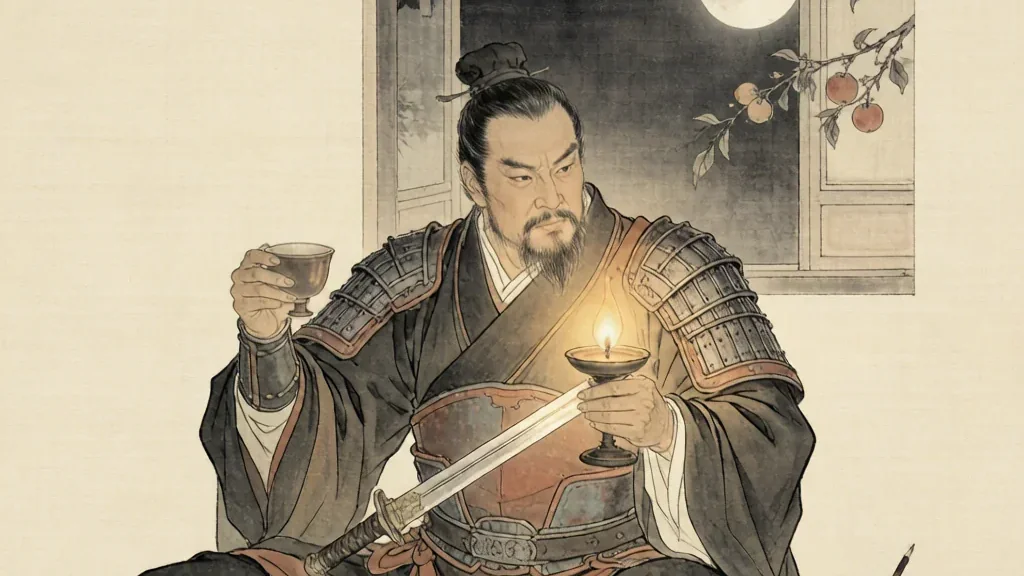
History rarely produces a man who was both a battlefield commander and one of the finest lyric poets who ever lived. Xin Qiji (辛弃疾, Xīn Qìjí) was exactly that rare fusion. Born in 1140 in territory occupied by the Jurchen Jin dynasty, he grew up dreaming of reclaiming the lost north for the Song empire. As a young man he led a daring raid behind enemy lines; as an old man he poured his unspent patriotism into stirring ci lyrics of iron and grief. No Chinese poet wrote with more muscular energy, and few carried a heavier heart. To read Xin Qiji is to hear a soldier's rage singing through a scholar's brush.
Xin lived in the Southern Song, an age when the Chinese court had retreated south of the Yangtze and resigned itself to half a kingdom. He spent his life urging reconquest and being sidelined by cautious officials. His poetry turns that frustration into some of the most powerful verse in the language. This article follows the warrior who became a poet, and the undying longing that gave his words their fire.
A Youth in Occupied Lands
Xin Qiji was born in Licheng (near modern Jinan, Shandong), then under the rule of the Jurchen Jin, who had seized northern China in 1127 and driven the Song court south. Like many Han Chinese living under foreign rule, his family kept alive the hope of restoration. From boyhood Xin was trained in martial arts and horsemanship as well as the classics, and he absorbed a burning determination to return the north to Song hands.
At the age of twenty-one, Xin organized a band of two thousand volunteers and joined a larger anti-Jin uprising led by a commander named Geng Jing. He proved himself bold and resourceful. When a fellow officer defected to the Jin and murdered Geng Jing, Xin led a troop of fifty horsemen deep into the enemy camp, seized the traitor, and delivered him to the Song executioner — a feat of pure daring that made him famous overnight.
This early heroism established the pattern of his life: spectacular courage followed by institutional suspicion. The Southern Song court welcomed his defection but never fully trusted a rough northern man of action, and they channeled his energy into minor civilian posts rather than the military command he craved.
The Frustrated General
For the next two decades Xin served in various regional appointments, mostly in the south and along the frontier. He was an able administrator — suppressing banditry, improving agriculture, and strengthening defenses — and he repeatedly submitted memorials proposing grand strategies to recover the north. His plans were detailed and realistic, but the pacifist-leaning court, wary of both war and of ambitious generals, ignored or shelved them.
His temperament did not help his career. Xin was outspoken, proud, and impatient with corruption and timidity, which earned him enemies among the entrenched literati. Periods of favor were followed by demotions and long stretches of forced retirement. He watched from the sidelines as half-measures and court intrigue squandered whatever chance the Song had to strike north.
Yet even in retirement he trained local militias and studied military science, never giving up the hope that he might one day be summoned to lead the reconquest. The gap between his capacity and his recognition is the wound at the center of his poetry — a man built for war, confined to gardens and wine.
The Ci Lyric as a Weapon
Xin Qiji is counted among the greatest masters of the ci, a song-lyric form set to existing tunes with strict tonal patterns. Where many ci poets wrote of love and longing in delicate language, Xin brought a broad, masculine, and often colloquial vigor to the form. He could be boisterous, ironic, philosophical, or desolate within a single poem, and he expanded the ci's range to carry public themes of statecraft and war.
His best-known poems dramatize the patriot's plight. In "Recalling the Past at Beigu Pavilion," he summons the heroes of the Three Kingdoms to lament the absence of leaders in his own time. In many lyrics he mocks his own white hair and idle sword, or conjures the lost north in vivid, aching images. Unlike the refined allusions of courtly verse, his lines often feel spoken aloud — urgent, argumentative, alive.
Scholars divide his style into two streams: the "heroic" mode of outrage and ambition, and a softer mode of village scenes, drinking songs, and quiet nature. Both reveal the same restless intelligence. Alongside Su Shi, he is considered a founder of the "Hao Fang" or "heroic and uninhibited" school of ci, which broke the form free from its earlier narrow confines.
Historical Context: The Southern Song
Xin lived under the Southern Song (1127–1279), the diminished successor to the great Northern Song that had been destroyed when the Jurchen captured the capital and the emperor. The new court rebuilt itself at Hangzhou, enjoying commercial prosperity and cultural brilliance while formally accepting the loss of the north. This compromise bred a divided national mood: a cultured, pleasure-loving society shadowed by shame and a recurring itch for revenge.
The Jin to the north were a constant threat, and later the even more dangerous Mongols. Xin's calls for military preparedness were not paranoia; the Song would indeed fall to the Mongols within a century of his death. Read in this light, his poetry is not mere melancholy but a warning unheeded — the voice of a patriot who saw the danger clearly and was punished for saying so.
Later Life and Unfinished Longing
In his final years Xin was briefly recalled to a military post during a short-lived and disastrous war policy, but he was soon dismissed again. He spent his last decades at a lakeside retreat he called "The Cottage of Pleasing Noise," drinking, writing, and receiving friends. He died in 1207 at about sixty-seven, his dream of a restored north unfulfilled and the north still in foreign hands.
Even in these quiet years the old fire flickered. Poems from this period alternate between self-mocking ease and sudden bursts of indignation, as if the warrior inside could not be wholly domesticated. The tension between acceptance and resistance gives his late work a poignant depth: he had made peace with his circumstances but never with his country's humiliation.
Legacy of the Warrior-Poet
Xin Qiji left some six hundred ci lyrics, a substantial and enormously influential body of work. Later poets admired his ability to fuse feeling and force, and reformers and nationalists in the nineteenth and twentieth centuries adopted him as a patron saint of resistance. His lines about recovering the north were quoted by patriots facing modern invasions, proving how a Song-dynasty soldier's grief could still stir a modern crowd.
Today Xin Qiji stands as proof that tenderness and toughness can share one breast. He wanted to be a liberator and became instead a liberator of the Chinese lyric, widening what poetry could say and feel. For readers who know the ache of talents unused by their times, his voice remains consoling and fierce — a reminder that even defeat, honestly sung, can be a kind of victory.
The Sound and Craft of His Lyrics
The ci lyric that Xin Qiji mastered was not free verse but a song form: each poem had to fit an existing tune, with fixed line lengths and strict tonal patterns that earlier poets had used mostly for love and leisure. Xin broke that mold by pouring public themes of war, statecraft, and indignation into the form. He freely used colloquial speech, abrupt shifts of tone, and even comic language, lending his lines a spoken, argumentative energy that courtly verse avoided. Within a single lyric he could move from boisterous irony to quiet melancholy, a range that challenged the form's gentle conventions. Scholars often contrast his vigorous diction with the refined allusions of his contemporaries, noting that his best work feels overheard rather than composed. This stylistic daring is a large part of why later poets ranked him beside Su Shi as a founder of the bold school.
From Song to the Present: A Living Voice
Xin Qiji's reputation has only grown since the Song. Ming and Qing anthologists placed him among the very greatest ci poets, and reformers of the nineteenth and twentieth centuries adopted his north-longing verses as patriotic scripture during foreign invasions. Today his lyrics appear in Chinese school textbooks, and lines such as his wish to recover the lost rivers and mountains are quoted in films, television, and speech. His life also nourishes popular culture: operas, novels, and historical dramas retell the young raider who became a grieving poet. Scholars continue to debate the two currents of his style, the heroic and the serene, and new editions of his six hundred surviving lyrics appear regularly. In this sense the warrior who was denied a battlefield found a larger one in language, and his voice remains current nearly nine centuries after his death.
❓ Frequently Asked Questions
📝 Chinese Vocabulary
辛弃疾 — : The Southern Song warrior and master of the ci lyric.
南宋 — : The Southern Song dynasty that retreated south of the Yangtze.
词 — : The tonal song-lyric form in which Xin excelled.
豪放派 — : The "heroic and uninhibited" school of ci poetry.
金 — : The Jurchen Jin dynasty that occupied northern China.
稼轩 — : Xin Qiji's literary name (hao), under which many of his works are collected.
破阵子 — : A ci tune title meaning Breaking the Enemy Formation, used for one of his best-known patriotic lyrics.
美芹十论 — : Ten Treatises Presented with Celery, Xin's memorial of military strategy urging reconquest of the north.
🎉 Fun Facts
- At twenty-one Xin led just fifty riders into an enemy camp to seize a traitor and bring him to justice.
- He is, with Su Shi, considered a founder of the bold "heroic" style of ci poetry.
- Modern Chinese nationalists quoted his poems about recovering the north during twentieth-century wars.
- He named his retirement home "The Cottage of Pleasing Noise" despite his lifelong frustration.
- Xin Qiji once single-handedly suppressed a mutiny among his own troops and later rebuilt flood defenses as a regional official, showing he was a capable administrator, not only a poet.
- Though born in the north under Jin rule, Xin Qiji spent most of his life in the south and is buried near Shangrao in Jiangxi, where his former lakeside retreat still draws visitors.