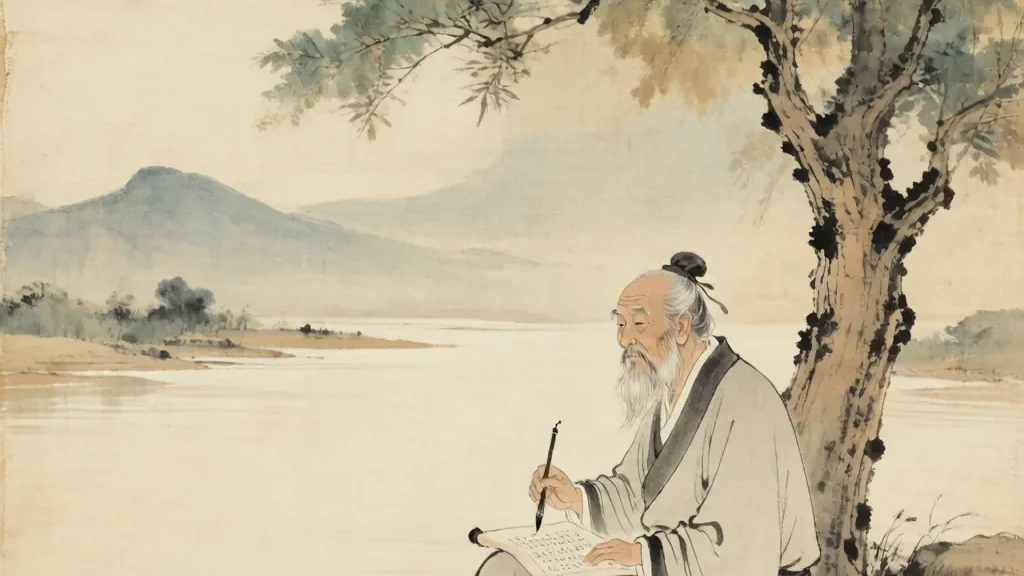
Among the poets of China's golden Tang dynasty, one name has always been loved by ordinary readers as much as by scholars. That name is Bai Juyi (白居易, Bái Jūyì), a poet of the ninth century who made it his lifelong mission to write verse that a village woman or a toothless farmer could understand and feel. While many Tang masters prized obscurity and refined allusion, Bai Juyi pursued clarity, compassion, and direct speech. He is remembered today not only for beautiful lines but for a conscience that ran through his poetry like a spine. To read Bai Juyi is to meet a writer who believed that literature should serve people, not merely impress them.
Born in 772 CE during the Tang dynasty's long, slowly fraying afternoon, Bai Juyi lived through court intrigue, war on the frontiers, personal exile, and the consolations of friendship and wine. He held high office, fell from favor, and spent his later years as a devout Buddhist gentleman of leisure. Across all these changes, he kept writing — more than 2,800 poems survive — and he kept revising them until even a child could follow. This article follows his life, his art, and the warm, humane legacy that has kept him popular for twelve hundred years.
Early Life and the Making of a Poet
Bai Juyi was born in Xinzheng, in present-day Henan province, to a family of modest official rank that had fallen on hard times. Legend holds that as a child he wore his writing fingers to the bone and that early poverty sharpened his sympathy for the suffering poor. What is certain is that he was brilliantly diligent: he passed the prestigious imperial examinations in 800 and quickly won a reputation at the capital for both his learning and his outspokenness.
His early success brought him into the circle of the great poet and statesman Yuan Zhen, with whom he formed one of the most famous friendships in Chinese literary history. The two men exchanged hundreds of poems, criticized each other's drafts, and developed a shared style of plain, emotionally direct verse later called the "New Yuefu" movement. Bai Juyi believed poetry should be a mirror held up to society and a voice for those who had none.
Even in youth, Bai Juyi showed the independence that would define him. He refused to write merely decorative court verse while the empire suffered, and he used his pen to dramatize the hardships of soldiers, women, and taxpayers. This moral seriousness, unusual in a young courtier, marked him as a poet who would not be content with fame alone.
A Career of Principle and Exile
In 806 Bai Juyi received a junior post and soon became a remonstrating official — a role charged with criticizing government policy. He took this duty seriously, submitting memorials that condemned corruption, wasteful wars, and the oppression of common people. His candor offended powerful ministers. When his friend Yuan Zhen was demoted and he himself spoke against a military campaign, the court struck back.
In 815, after a political assassination in the capital, Bai Juyi submitted a memorial urging swift justice. His enemies seized the chance to accuse him of overstepping his rank and of impropriety regarding his mother's death, and he was banished to the remote post of prefect of Jiangzhou, far from the centers of power. This exile, though painful, became one of the creative turning points of his life. It was there, by a river at night, that he wrote his most famous long poem, "The Song of the Pipa."
Later he was recalled and served competently in several regional posts, including Hangzhou and Suzhou, where he won lasting local affection by repairing waterways and building a famous causeway on West Lake. Yet he never again trusted the capital's politics, and he increasingly turned toward retirement, friendship, and Buddhist devotion.
The New Yuefu and the Poetry of Compassion
Bai Juyi's most distinctive contribution to Chinese poetry was his theory and practice of the "New Yuefu" — new ballads in the old musical tradition, rewritten to address contemporary social ills. He declared that poetry should "harmonize the passions" and "observe the times," meaning that verse must reflect the real condition of the people. In poems such as "The Old Man with the Broken Arm" and "The Charcoal Seller," he gave voice to the crushed and the forgotten with unsentimental precision.
What set him apart was his deliberate simplicity. He famously tested his drafts on an old servant woman; if she could not understand a line, he rewrote it. This was not a lack of skill but a positive aesthetic choice — a conviction that clarity was a form of respect for the reader. His language is plain, his images concrete, his feelings open. Readers who struggle with the dense allusions of other Tang poets often find Bai Juyi immediately accessible.
His long narrative poems, especially "The Song of Everlasting Sorrow" about the doomed love of Emperor Xuanzong and Lady Yang, and "The Song of the Pipa," combine storytelling, music, and melancholy into works of enormous popularity. These poems circulated by hand throughout the empire and even reached Korea and Japan within his lifetime.
Historical Context: The Tang in Decline
Bai Juyi lived during the aftermath of the An Lushan Rebellion, the cataclysm of the mid-eighth century that shattered the Tang court's confidence and drained its treasury. Although the dynasty survived, the central government never fully recovered its authority, and regional warlords, heavy taxation, and court factionalism plagued the later Tang. It was an age of brilliant culture shadowed by instability.
This context explains the moral urgency of Bai Juyi's writing. He saw talented men exiled, frontier families broken by conscription, and peasants crushed by levies, and he could not treat poetry as a genteel game. His work belongs to a long Confucian tradition that holds the literate elite responsible for speaking truth to power. At the same time, his later poems show the pull of Daoist ease and Buddhist detachment, reflecting the temperament of an age learning to live with disappointment.
Later Years: Retirement, Wine, and Friends
In his fifties Bai Juyi requested retirement and settled in Luoyang, the eastern capital, where he lived comfortably as a wealthy gentleman. He gathered a circle of friends, kept a famous collection of wines, and amused himself with poetry, music, and garden parties. He called himself the "Old Man of Fragrant Mountain" after a nearby monastery and became a lay Buddhist devotee, donating money to carve scriptures in stone.
Even in leisure his pen stayed busy. He wrote playful occasional poems to friends, reflective verses on aging, and gentle celebrations of small pleasures — a cup of wine, a snowfall, a letter arrived from afar. These late works show a man who had made peace with life's losses and found contentment in friendship and the natural world. He died in 846 at the age of seventy-four, honored and mourned across the empire.
Legacy and Lasting Popularity
Bai Juyi's reputation has never dimmed. In China he remained, through a thousand years of anthologies, the poet ordinary people quoted; in Japan, where his name was pronounced Hakurakuten, he was even more adored, influencing court poetry and painting profoundly. His tomb near Luoyang remains a place of pilgrimage, and his causeway on Hangzhou's West Lake is still walked by millions.
Modern scholars value him for proving that profundity and popularity are not opposites. His commitment to clarity, his social conscience, and his unembarrassed warmth made him a model for later vernacular literature and for any writer who would speak plainly to a broad audience. In an age of information overload, Bai Juyi's insistence that good writing must be understood is a lesson that has not aged a day.
Friendship and Wine in Later Life
In his fifties Bai Juyi asked to retire and settled in Luoyang, where he lived as a wealthy gentleman of leisure. He gathered a circle of friends, kept a famous collection of wines, and amused himself with poetry, music, and garden parties. He called himself the Old Man of Fragrant Mountain after a nearby monastery and became a lay Buddhist devotee, donating money to carve scriptures in stone. Even in ease his pen stayed busy: he wrote playful occasional poems to friends, reflective verses on aging, and gentle celebrations of small pleasures, a cup of wine, a snowfall, a letter arrived from afar. These late works show a man who had made peace with life's losses and found contentment in friendship and the natural world.
Bai Juyi's Reception in Japan
Bai Juyi's fame crossed the sea within his own lifetime, and in Japan, where his name was pronounced Hakurakuten, he was adored more than almost any other Chinese poet. Japanese courtiers copied his verses by hand, studied his style, and let his imagery shape their own poetry and painting for centuries. His tomb near Luoyang remains a place of pilgrimage, and his causeway on Hangzhou's West Lake is still walked by millions. Modern scholars value him for proving that profundity and popularity are not opposites, and his commitment to clarity made him a model for later vernacular literature and for any writer who would speak plainly to a broad audience. His popularity across East Asia shows that clarity, not difficulty, is the true measure of a poet who speaks to the common heart.
❓ Frequently Asked Questions
📝 Chinese Vocabulary
白居易 — : The Tang poet famous for clear, compassionate verse.
新乐府 — : "New Yuefu," his socially engaged ballad style.
唐朝 — : The Tang dynasty (618–907), China's poetic golden age.
长恨歌 — : "Song of Everlasting Sorrow," his famous narrative poem.
琵琶行 — : "Song of the Pipa," written during his exile at Jiangzhou.
元稹 — : Yuan Zhen, the poet and statesman who was Bai Juyi's closest friend and literary partner.
香山居士 — : The 'Old Man of Fragrant Mountain,' the Buddhist lay name Bai Juyi took in retirement.
洛阳 — : The eastern capital where Bai Juyi spent his later, leisurely years.
🎉 Fun Facts
- Bai Juyi tested his poems on an uneducated old woman to make sure they were understandable.
- He was more popular in Japan than almost any other Chinese poet and shaped Japanese court culture.
- He built a causeway on Hangzhou's West Lake that tourists still walk today.
- He and his friend Yuan Zhen exchanged hundreds of poems and even used poetry to coordinate meetings.
- His 'Song of Everlasting Sorrow' was so loved that it became a standard subject for later painters and dramatists.
- In his later years he donated money to have Buddhist scriptures carved in stone, merging his faith with his wealth.