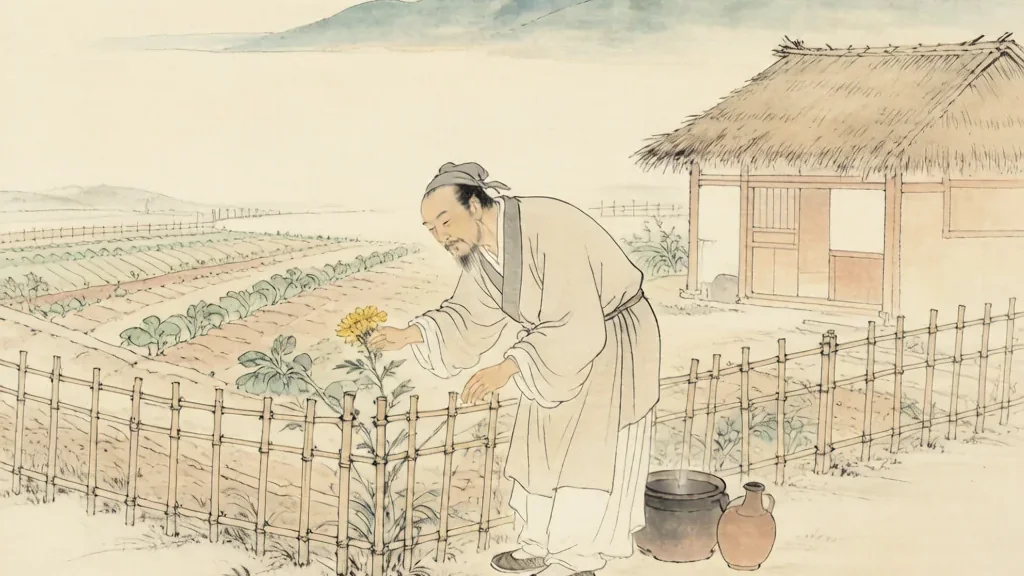
Long before the West invented the "noble savage" or the weekend gardener, a Chinese official named Tao Yuanming (陶渊明, Táo Yuānmíng) quit his job, went home to his farm, and wrote poems about the simple joy of pulling weeds among chrysanthemums. He lived in the troubled fourth and fifth centuries, when China was split among rival states and public life was dangerous and corrupt. His response was to walk away. In a famous preface he said he left office because his temperament could not bend to flattery. That single act made him the patron saint of Chinese retirement and the inventor of the "fields and gardens" poetry that millions have loved since.
Tao Yuanming is more than a recluse. He is the poet who taught China to find paradise not in palaces or immortals but in an ordinary afternoon — a cup of wine, a book, a gentle breeze through the pines. This article follows his brief official career, his decisive homecoming, his vision of the "Peach Blossom Spring," and the long afterlife of a man who chose freedom over rank.
A Reluctant Official
Tao Yuanming was born around 365 into a family that had known better days; he was a distant descendant of a famous general, but by his time the household was poor. Like most educated men, he saw office as both duty and livelihood, and he took a series of minor posts, often as a magistrate's assistant or county magistrate. These jobs were poorly paid and required constant travel and deference to superiors he did not respect.
The era was the Eastern Jin, a southern dynasty during the long division that followed the fall of the Han. The court was dominated by aristocratic families, and real power lay with military strongmen. For a poor gentleman of independent spirit, official life meant compromise after compromise. Tao later admitted he took posts mainly to feed his family, not from conviction.
The turning point came in 405, when he was serving as magistrate of Pengze. Ordered to receive a visiting inspector with full ceremony and flattery, he is said to have declared that he would not bow for the sake of five pecks of rice, and he resigned after only about eighty days in office. He was roughly forty, and he never again held public employment. The story, whether exact or not, captured a truth about the man: he valued his dignity more than his salary.
The Choice to Farm
Back home, Tao threw himself into farming — with, by his own admission, mixed results. He was not a natural agriculturist; poems confess that weeds often outgrew his crops and that harvests were thin. But the failure did not trouble him as it might a professional farmer, because his purpose was not profit but peace. He wrote that he preferred a life of steady poverty to one of anxious wealth.
His days fell into a quiet rhythm: rising early to work the fields, resting in the shade, drinking wine made from his own grain, and reading by lamp-light. He befriended his neighbors, poor farmers like himself, and received guests without ceremony. Poverty brought humiliation at times — he recalls begging for food in a bad year — yet he insisted the freedom was worth it.
This was a radical stance. Confucian teaching honored service to the state, and to withdraw could look like shirking. Tao answered by redefining the good life around personal integrity and natural delight. His example quietly proposed that a man could be principled without being an official, an idea that liberated later literati to value retirement as highly as career.
The Poetry of Fields and Gardens
Tao Yuanming created the "farmstead" or "fields and gardens" (tianyuan) tradition in Chinese poetry, writing in plain, unhurried language about planting, harvesting, drinking, and weather. His famous series "Returning to Dwell in the Country" celebrates his homecoming in calm, concrete images: a fence, chrysanthemums, the smoke from village chimneys at dusk, a dog barking, a cock crowing.
What distinguishes his voice is its lack of artifice. Where many poets strained for elegance, Tao sounds like a man talking to a friend. He admits boredom, loneliness, and the occasional longing for company; he does not pretend the rustic life is always blissful. That honesty is why readers trust him. A poem may open with hard labor and end with a glass of wine and a shrug — the wisdom of someone who has chosen his burden freely.
He also wrote "Drinking Wine" poems, including the justly famous lines about picking chrysanthemums by the eastern fence and, in the distance, seeing the southern mountains — a moment of effortless union with nature that has been quoted forever after. The ease is the point: enlightenment arrives not through striving but through unforced attention.
The Peach Blossom Spring
Tao's most enduring invention is the "Peach Blossom Spring," a prose fable about a fisherman who drifts up a stream past blossoming trees and enters a hidden valley where people live in peace, knowing nothing of dynasties or wars. They had fled turmoil long ago and built a simple, happy community. When the fisherman leaves and tries to return, the place is gone.
The tale is a cornerstone of Chinese imagination — a utopia not of machines or laws but of ordinary village calm, untouched by history's storms. It expressed a deep weariness with the endless wars of the age and a hope for refuge. For fifteen hundred years, "Peach Blossom Spring" has meant any lost haven of innocence, and the phrase still appears in everyday speech and place names across the Chinese world.
Crucially, the spring is unrecoverable. Tao does not promise that such a place exists to be found; he offers it as a consolation and a critique — a measure of what human strife destroys. The poignancy of the story is that paradise is real enough to be imagined and fragile enough to be lost.
Historical Context: An Age of Division
Tao lived during the Eastern Jin and the early Southern Dynasties, part of the long Wei-Jin-Northern-and-Southern period when China was politically fragmented after the Han collapse. It was an era of weak central authority, powerful clans, and constant military upheaval in the north. Intellectual life turned toward Daoism and Buddhism, and many thinkers prized personal cultivation over public service.
This atmosphere made Tao's withdrawal thinkable where it might not have been in a strong, confident empire. The fashion for "pure conversation" and Daoist detachment gave a philosophical frame to his choice, even as his own brand of retirement stayed earthy and practical rather than mystical. He was, in the end, less a philosopher than a farmer who happened to write unforgettable lines about why he farmed.
Legacy of the Hermit Poet
During his lifetime Tao was little known beyond local friends; he even feared his poems would not survive. Within a century or two, though, he was recognized as a master, and by the Tang and Song he was revered. Poets from Wang Wei to Su Shi called him a model, and the "return home" motif became a permanent option in the Chinese literary imagination — something a tired official could invoke to justify retiring with grace.
Modern readers still respond to Tao's core gift: permission to stop, to simplify, to find enough in little. In a culture of relentless achievement, his chrysanthemums and wine and quiet evenings read less like ancient escapism than like sanity. He proved that the richest life might be the one with the fewest possessions, provided it is freely chosen.
Wine, Leisure, and the Pleasure of the Moment
Tao Yuanming's Drinking Wine poems are the heart of his gentler philosophy. In them he picks chrysanthemums by the eastern fence and, looking up, sees the southern mountains; the moment arrives without striving, a quiet union with nature. He insists that wine is not escapism but a way of attending to the present, of loosening the grip of ambition and worry. Many poems admit boredom, loneliness, or the chill of poverty, yet they end in acceptance. This honesty about ordinary feeling is rare in a literature often bent on grandeur. Tao taught that enlightenment need not be earned through hardship or ritual; it can surface in a cup of wine and a sunset. His leisure is active attention, not laziness, and that distinction is why his small pleasures still read as freedom rather than retreat.
Family, Poverty, and the Ethics of Integrity
Tao Yuanming came from a once-prominent family reduced to modest means, and he took office mainly to feed relatives, not from conviction. That tension between duty to family and duty to self runs through his work. He believed a person should not sell their dignity for comfort, yet he felt the pull of supporting those he loved. His poems do not hide the cost: thin harvests, a hard year when he begged for food, the ache of parting from friends. What makes his stance powerful is that he weighed these sacrifices openly and still chose integrity. By reframing retirement not as shirking but as the preservation of conscience, he offered later scholars a moral vocabulary for saying no. His poverty became proof of principle, and his example loosened Confucian service's monopoly on the good life.
❓ Frequently Asked Questions
📝 Chinese Vocabulary
陶渊明 — : The hermit poet who chose farming over office.
归园田居 — : "Returning to Dwell in the Country," his farmstead poem series.
桃花源 — : "Peach Blossom Spring," his utopian fable.
田园诗 — : "Fields and gardens" poetry, the genre he founded.
东晋 — : The Eastern Jin dynasty in which he served briefly.
饮酒 — : Drinking Wine, the famous series of Tao Yuanming's poems on ease, nature, and quiet contentment.
五斗米 — : Five pecks of rice, the salary he said he would not bow for, the phrase that became shorthand for his refusal to compromise.
隐逸 — : Reclusion, the ideal of withdrawing from office that Tao Yuanming made a central theme of Chinese poetry.
🎉 Fun Facts
- Tao Yuanming quit his last post after only about eighty days, saying he would not bow for "five pecks of rice."
- He admitted in his poems that he was a poor farmer whose weeds often outgrew his crops.
- His "Peach Blossom Spring" is still used as a place name and everyday phrase across China.
- He feared his poems might be lost, yet they became foundational to Chinese literature.
- Tao Yuanming is so linked with chrysanthemums that the flower became a lasting emblem of the retired scholar in later Chinese painting.
- His plain, conversational style was once thought too unrefined by some contemporaries, yet it reshaped Chinese poetry's idea of true elegance.