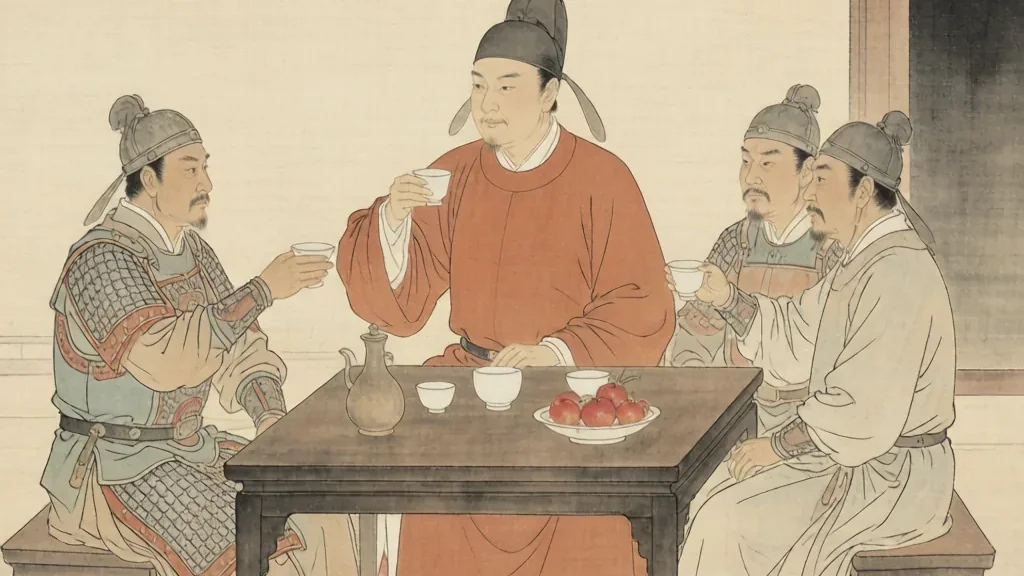
He founded a dynasty that would last three hundred years, yet he never fought a single major battle to do it. Emperor Taizu of Song (宋太祖, Sòng Tàizǔ), born Zhao Kuangyin, came to power in 960 through a bloodless coup, then solved the problem that had haunted China for centuries: how to stop ambitious generals from overthrowing the throne. His answer was elegant and unprecedented — invite the generals to a banquet, hint that they retire, and disarm the military command while rewarding it richly. The Song dynasty he launched became the most culturally brilliant, commercially advanced, and (by design) militarily cautious empire in Chinese history. Taizu is the emperor who chose stability over swagger, and changed China's trajectory.
This article follows Zhao Kuangyin from frontier commander to founding emperor, explains his famous "wine of release from command" strategy, examines the civil-first state he built, and weighs the trade-offs of a peace purchased at the price of military weakness. His story is a case study in how institutions, not just individuals, secure a realm.
From Frontier Commander to Emperor
Zhao Kuangyin was born in 927 into a military family during the chaotic Five Dynasties period, when short-lived warlord states fought over the ruins of the Tang. He rose through the ranks as a skilled cavalry officer and became the trusted commander of the elite palace troops under the Later Zhou dynasty. He was known for personal courage, fairness, and the ability to win men's loyalty.
In 960, as the young Later Zhou emperor lay vulnerable, Zhao's troops marched toward the capital. At a bridge called Chenqiao, his officers allegedly draped a yellow robe — the imperial color — over the sleeping Zhao, hailing him as emperor. Whether staged or spontaneous, the "Chenqiao mutiny" was remarkably peaceful: the boy emperor abdicated, the court was spared bloodshed, and Zhao founded the Song. The near-absence of violence was itself a statement about the kind of ruler he meant to be.
From the start Taizu showed political finesse. He protected the abdicated family, retained capable officials, and moved quickly to consolidate without purges. His self-presentation as a reluctant, mandated ruler helped legitimize a coup that might otherwise have looked like mere mutiny.
The Banquet That Disarmed the Generals
Taizu's defining act came a few years into his reign. Having himself risen by soldier revolt, he feared that other commanders might do the same. In a famous episode, he hosted a feast for his most powerful generals and, over wine, spoke wistfully of how restless he was despite the throne. When they asked why, he said: "Who among you does not wish to be emperor? One day your troops might drape the yellow robe on you too."
Alarmed, the generals begged to be spared. Taizu then suggested the solution: resign your commands, take fine estates and incomes, and enjoy your families in peace. The generals understood and complied. This "wine of release from military command" (杯酒释兵权) stripped the army's top leadership of power without a drop of blood. It is one of the most celebrated examples of political skill in Chinese history.
The move was not cynical cruelty but structural design. Taizu wanted a system where no single general could threaten the center. By removing rivals gently and rewarding them, he bought loyalty and stability at once — a stark contrast to the purges other founders used.
Building a Civil-First State
Having tamed the military, Taizu built a state where civilians led soldiers. He placed civil officials above military ones, centralized finance and personnel in the capital, and strengthened the examination system to recruit talent from across the realm. The ideal Confucian gentleman-official — learned, not martial — became the backbone of government.
He also reorganized the army so that command, training, and deployment were separated, preventing any one officer from building a personal following. Frontier troops rotated frequently, and the best soldiers were kept near the capital as a imperial guard. These measures made rebellion hard but also, critics noted, made the army less effective in the field.
Taizu's famous instruction to his heirs was to "use scholars to govern" and to treat the examination graduates with honor. This set the Song on its distinctive path: a bureaucracy of trained literati, a culture of books and law, and a relative absence of the warlordism that had wrecked the preceding centuries.
Reunifying China Without War
Taizu did not merely secure his own court; he worked to reunite the fragmented realm. Through a mix of diplomacy, intimidation, and limited war, the Song absorbed most of the southern states and the Shu kingdom in the west, often allowing defeated rulers to retire honorably. By his death in 976, most of China south of the Yangtze and much of the north was under Song control.
His strategy was patient: isolate the strongest rival, pick off the weak, and avoid the exhausting total wars that had destroyed earlier dynasties. He left the stubborn Northern Han and the Khitan Liao in the north for his successors, but the core reunification was his achievement. The relative peace of his conquests contrasted with the brutal unifications of the Qin and Sui.
This reunification by degrees laid the foundation for the Song's later flourishing. A realm at peace, with stable administration and revived trade, could pour its energy into economy and culture rather than endless campaigning.
Historical Context: The Five Dynasties
Taizu rose from the Five Dynasties and Ten Kingdoms (907–960), a half-century when northern China saw five short-lived regimes and the south splintered into rival states. It was an age of military disorder, broken oaths, and abrupt dynastic deaths — exactly the instability Taizu was determined to end. The memory of warlord chaos made his civil-first reforms popular with a public weary of soldiers.
His solution — empowering civilians, dividing military power, and using exams — became the Song's defining character and influenced every later dynasty. The Ming and Qing would likewise keep the military subordinate to the civil service, a principle rooted in Taizu's experience of how easily armies made and unmade emperors.
Legacy and the Cost of Peace
Emperor Taizu died in 976 under murky circumstances — later legend claims his brother succeeded after a strange night-time scene — and was posthumously honored as the dynastic founder. The Song he began became one of the most prosperous, populous, and inventive societies in the world: printing, gunpowder, compass navigation, and a commercial revolution all flourished under his institutional heirs.
But the same demilitarization that brought stability also left the Song vulnerable. Later Song struggled against the Liao, Jin, and finally the Mongols, eventually losing the north and then the whole realm. Historians debate whether Taizu's pacifism went too far. What is undisputed is his originality: he solved the warlord problem so well that China would not face it again at scale. For that, he stands as one of the most consequential founders in Chinese history.
Law, Land, and Economic Order
Having ended the warlord chaos, Taizu turned to the quiet work of building a stable society. He promoted a fairer legal code and urged restraint in punishment, wary of the harsh edicts that had helped doom the Sui. To weaken the great landowners' grip, he supported policies that let ordinary farmers hold land and eased the corvée labor owed to the state. He centralized tax collection in the capital so that regional commanders could no longer fund private armies from local wealth. Standardized weights, measures, and coinage encouraged trade across the reunited realm. These measures were unspectacular compared with his bloodless coup, yet they were what made the Song prosperous. By pairing a disarmed military with a well-fed peasantry and a predictable law, Taizu purchased an order sturdy enough to survive his own dynasty's later weakness.
The Murky Succession to His Brother
Taizu's death in 976 produced one of Chinese history's enduring mysteries. He was succeeded not by a son but by his younger brother, Zhao Guangyi, who took the throne as Emperor Taizong. Later legend, captured in the phrase about a lamp-shadow and axe-sound night scene, hints that the handover was irregular, though no firm evidence survives. What is certain is that Taizu had earlier bound his brothers by oath to pass the realm among them before returning it to the next generation, a compact born of the fragile new dynasty's need for unity. The episode matters because it shows how a founder who solved the warlord problem through family trust also left a question of legitimacy that later critics would exploit. The brotherly succession remained a shadow over the Song's claim to rightful rule.
❓ Frequently Asked Questions
📝 Chinese Vocabulary
宋太祖 — : The founding emperor of the Song (r. 960–976).
赵匡胤 — : Taizu's personal name before he took the throne.
杯酒释兵权 — : "Releasing command over a cup of wine."
陈桥兵变 — : The Chenqiao mutiny that made him emperor.
宋朝 — : The Song dynasty he founded.
黄袍 — : The yellow robe, the imperial color that Taizu's troops draped over him at the Chenqiao mutiny to signal his claim to the throne.
禁军 — : The imperial guard, the elite troops kept near the capital under Taizu's direct control to balance the regional armies.
文官 — : Civil officials, whom Taizu placed above military officers as the backbone of his peace-first state.
🎉 Fun Facts
- Taizu disarmed his most powerful generals at a banquet by hinting they should retire — no blood was shed.
- He rose to the throne when his troops draped him in a yellow robe while he was asleep at Chenqiao.
- He kept the deposed boy-emperor's family safe, avoiding the usual post-coup massacres.
- His civil-first policy made the Song the most commercially and culturally advanced society of its age.
- Folklore credits the martial-arts-trained emperor with founding a style of boxing, often called Taizu Changquan, that influenced later Chinese martial arts.
- He reigned sixteen years, from 960 to 976, and at his death the throne passed not to his own son but to his younger brother, a transition later clouded by legend.