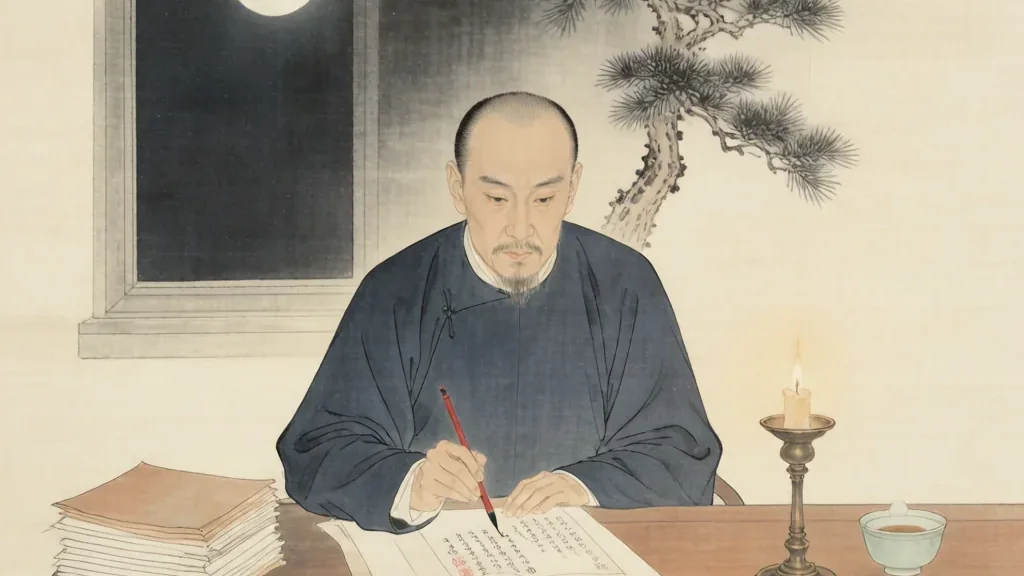
He ruled for only thirteen years, but he may have done more work than emperors who reigned for decades. The Yongzheng Emperor (雍正, Yōngzhèng), who sat on the Qing throne from 1722 to 1735, is the dynasty's great reformer and its great mystery. Surrounded by rumors that he stole the throne from his brother, he governed with relentless energy: reviewing memorials late into the night, overhauling the tax system, tightening the bureaucracy, and building the secret memorial network that let him rule directly. Where his son Qianlong dazzled, Yongzheng drilled. Historians increasingly rank him as the most effective of the Qing rulers — the indispensable link between his father Kangxi's conquests and his son's glittering peace.
This article examines the disputed succession, Yongzheng's administrative revolution, his fiscal and legal reforms, his austere piety, and the darker rumors that still cling to his name. It argues that behind the whispered legends was a ruler who genuinely tried to make the state work.
The Disputed Succession
Yongzheng was born in 1678 as Yinzhen, the fourth son of the Kangxi Emperor. Kangxi's long reign ended in a succession crisis: the designated heir had been deposed, and several princes maneuvered for the throne. When Kangxi died in 1722, Yinzhen emerged as emperor, backed by a will whose authenticity later critics questioned. Rumors — spread partly by his defeated brothers' faction — claimed he had forged the will or poisoned his father.
Modern scholars largely reject the conspiracy tales; the succession, though contested, had a plausible legal basis. But the rumors mattered: they made Yongzheng insecure and drove him to prove his legitimacy through performance and results. He moved decisively against rival princes, some of whom were imprisoned or pressured, consolidating control within months.
This fraught start shaped his reign. A ruler who felt he had to justify his title often governs hardest, and Yongzheng did exactly that — turning suspicion into administrative zeal.
The Workaholic Reformer
Yongzheng's defining trait was industriousness. He read and annotated an enormous volume of official documents, often writing long comments in red ink on the secret memorials his officials sent directly to him. The "secret memorial" system, expanded under him, let provincial officials report frankly and confidentially, bypassing normal channels and giving the emperor an unvarnished view of the realm.
He hunted corruption aggressively, punished negligent officials, and rewarded competence. He tightened the chain of command so that responsibility was clear and evasion harder. The effect was a more responsive, less leaky government — though also a more feared one, since officials never knew when a secret report might land on the throne.
His style was blunt and practical, impatient with ceremony for its own sake. He wanted the machine of state to run, and he personally oiled its parts. Later Qing administrators looked back on his reign as a model of efficient, hands-on rule.
Fiscal and Legal Reforms
Yongzheng's most lasting reform was the "fusion of tax and corvée" (摊丁入亩), which folded the head-based poll tax into the land tax. This shifted the burden from poor households toward landowners, easing the load on the landless and stabilizing revenue. It was a genuinely progressive fiscal change that improved equity and administration at once.
He also tried to curb the power of local elites who shielded themselves from taxes and law, promoted the "self-government" (baojia) surveillance system, and standardized judicial procedures. In education and ritual he supported Confucian orthodoxy while also patronizing Tibetan Buddhism — a Manchu imperial tradition — presenting himself as a universal ruler bridging cultures.
These reforms strengthened the state's fiscal base and prepared the surplus that his son Qianlong would later spend on wars, gardens, and tours. Yongzheng built the treasury; Qianlong emptied parts of it.
Piety, Austerity, and Image
Unlike Qianlong's later opulence, Yongzheng projected austerity. He discouraged extravagance at court, cut unnecessary expenditure, and presented himself as a diligent, frugal sage. He was sincerely devout, sponsoring Buddhist temples and sometimes depicted in art as a Chan meditator — an unusual, intimate imperial image that humanized him.
He also cultivated a particular persona through edicts and collected "sacred instructions," teaching officials how to behave and think. This moralistic governance aimed to refashion the bureaucratic culture from the top, instilling discipline and loyalty. His famous "Sacred Edict" commentaries extended Kangxi's earlier moral injunctions into a tool of social indoctrination.
The combination of Buddhist devotion and Confucian rigor was characteristically Qing: Manchu rulers legitimated themselves through multiple traditions at once. Yongzheng was a master of this balancing act.
Historical Context: The Qing at Its Apex
Yongzheng ruled in the Qing's "High Qing" phase, between Kangxi's long consolidation and Qianlong's expansion. The dynasty had secured China proper and the steppe; the task now was to govern well rather than conquer. Yongzheng's reforms were the domestic counterpart to his father's military unification.
His reign also faced real challenges: floods, fiscal strain from Kangxi's generous later years, and the ever-present risk of factional intrigue. That he met them with reform rather than repression marks him as a statesman, not merely a survivor. The administrative scaffolding he left underpins the eighteenth-century Qing's famed prosperity.
Legacy and the Whispered Myths
Yongzheng died suddenly in 1735, reportedly while working, and was succeeded by his son Qianlong. Popular legends — novels and operas — spun wild tales about him: that he was an impostor, that he was murdered, that a woman avenged his crimes. Most are fiction, but they show how a secretive, severe ruler invites myth.
Serious history judges him kindly. He stabilized the treasury, purified administration, and reformed taxation in ways that helped ordinary people. Without his thirteen hard years, the Qianlong golden age could not have happened. For the modern reader, Yongzheng is the reminder that unglamorous competence — the emperor who simply did the work — may matter more than the one everyone remembers.
Purging the Rival Princes
Yongzheng's first years on the throne were shadowed by his brothers. Several princes had competed for the succession, and once he won, the new emperor moved quickly to neutralize them. The most capable, the eighth and fourteenth princes, were stripped of rank, renamed with insulting words, and in some cases imprisoned. These acts were brutal, but they also ended a decade of factional warfare that had paralyzed the late Kangxi court. By removing rivals rather than fighting them openly, Yongzheng secured a stable base for reform. Later novelists turned this into tales of murder and disguise, yet the documented result was containment, not massacre on the scale of later reigns. The episode shows the hard logic of his rule: loyalty could not be assumed, so it had to be enforced before anything else could be built.
Between Two Long Reigns
Yongzheng sits between the two longest reigns in Qing history, his father Kangxi's sixty-one years and his son Qianlong's sixty. Measured only in time, his thirteen years look small, yet historians often rank him the most effective of the three. Kangxi won the empire, Qianlong spent its surplus in glory and war, and Yongzheng did the unglamorous middle work of making the state function. His tax, legal, and administrative changes outlasted the disputes over his title and made the later prosperity possible. Where Kangxi projected majesty and Qianlong displayed taste, Yongzheng projected diligence, and that diligence is why the dynasty held together. For students of government, his reign is the proof that a short, strenuous rule can matter more than a long, celebrated one.