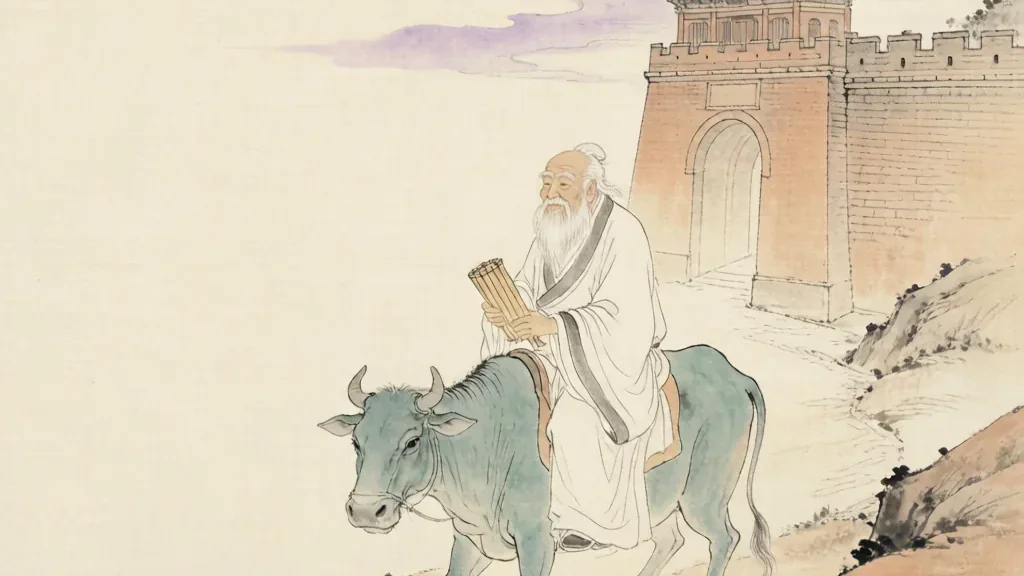
Some books whisper; the Daodejing speaks in paradoxes that have echoed for more than two thousand years. Known in Chinese as the Daodejing, "the classic of the way and its power," this slender text of about five thousand characters is the foundational scripture of Daoism and one of the most translated works in all of world literature. Traditionally attributed to a sage called Laozi, it offers no commandments and no gods to obey. Instead it invites the reader to notice how water wins by yielding, how the empty space of a wheel makes the cart useful, and how the softest things outlast the hard. For an English-speaking reader, the Daodejing is both a philosophical puzzle and a practical manual for living with less friction — a manual for the Way, the dao that cannot be named.
The Voice Behind the Text: Who Was Laozi?
The historical Laozi is wrapped in legend. His name means "Old Master," and the standard story places him as a contemporary, perhaps an elder, of Confucius in the sixth century BCE, working as the keeper of the archives at the Zhou royal court. According to the historian Sima Qian, when Laozi grew weary of the corruption of his age he rode west on a water buffalo toward the pass at Hangu. There a gatekeeper recognized his wisdom and refused to let him leave until he wrote down his teachings. The result was the Daodejing, after which the old master vanished into the wilderness and was never seen again.
Most modern scholars doubt the neat legend. They point out that the text we have shows layers of composition and probably took shape over several centuries, perhaps reaching something like its final form around the third century BCE. Whether one person wrote it or many, the voice is remarkably consistent: ironic, gentle, and suspicious of power, learning, and cleverness. That consistency is part of why readers still feel they are hearing a single temperament — a mind that prefers the valley over the peak.
Structure and Style: Eighty-One Short Chapters
The received text is divided into eighty-one chapters, a number chosen for its auspicious associations rather than by the author. The first thirty-seven chapters are usually called the Daojing, the "classic of the way," while the remaining forty-four make up the Dejing, the "classic of virtue or power." Each chapter is short, often under a hundred characters, built from rhymed, parallel lines that read like poetry and argue like proverbs. The compression is deliberate. The text wants to be memorized and turned over in the mind, not read once and filed away.
Because the language is so compact and so fond of reversal — "the way that can be spoken is not the constant way" — translators have produced wildly different English versions. Some render it as mystical chant, others as political advice for rulers. Both readings are faithful, because the Daodejing itself refuses to stay in one category. A single chapter can be read as cosmology, statecraft, and meditation at once, which is precisely the point: the small and the large obey the same pattern.
Core Ideas: The Way, Non-Action, and Softness
The central figure is the dao, the "way," the flowing process by which all things arise and return. The Daodejing insists the true dao cannot be captured in words; naming it already limits it. Human beings, it warns, cover the world with labels and then mistake the labels for reality. To live well is to return to directness, to the uncarved block, the unshaped wood before it becomes a thing with a use and a name.
From this follows wuwei, often translated "non-action" but better understood as "effortless action" or "not forcing." The sage acts without grasping, teaches without lecturing, and completes great things by never competing for credit. The text repeatedly praises the weak over the strong: water, which conquers by flowing around resistance; the flexible reed that survives the wind while the rigid oak snaps; the empty bowl that alone can be filled. These are not mere metaphors. They are a whole stance toward ambition, conflict, and the self.
Governance and the Sage Ruler
A surprising amount of the Daodejing is addressed to rulers. A good king, it says, is like the darkness of the north star: everything turns around him, yet he hardly moves. He keeps the people simple and well fed, gives them few laws, and hides his own cleverness. "Govern a great state as you would cook a small fish" — gently, and rarely turning it, lest it fall apart. The ideal government is one the people scarcely notice, crediting themselves when all goes well.
This quietist politics stands in sharp contrast to the Legalist and Confucian programs of the same era, which trusted rites, laws, and vigorous administration. The Daodejing suspects that the more a state displays its laws and punishments, the more thieves it produces. Order, it argues, grows from the bottom up when people are left to their natural rhythms. It is a radical, almost anarchist, current that has surfaced again and again in Chinese history whenever thinkers grew tired of heavy-handed rule.
Reception Through the Centuries
The Daodejing became the heartbeat of philosophical Daoism, and later it was woven into religious Daoism as a revealed scripture chanted in temples. Its influence spread far beyond religion. Chinese landscape painters learned its lesson that emptiness is as expressive as ink; poets learned to leave room for silence; generals and statesmen quoted it for its cunning patience. The Tang imperial family claimed descent from Laozi and gave the text official honor.
Outside China, the book arrived in the West in the nineteenth century and exploded in popularity during the 1960s, when its anti-materialist tone fit a counterculture hungry for alternatives to industrial progress. Today it appears on shelves beside self-help guides and business manuals alike, sometimes trivialized, often genuinely consoling. Whatever the framing, its central wager survives: that by doing less, by yielding, by trusting the larger pattern, a person may accomplish more than by straining against the world.
Why the Daodejing Still Matters
More than twenty-five centuries after it was set down, the Daodejing speaks to a world drowning in noise, speed, and certainty. Its counsel to stop, to simplify, to let things be, is harder and more necessary than ever. It does not promise success in the ordinary sense. It promises something stranger: that the soft, the empty, and the unpretentious have a power the ambitious never suspect. For a reader new to Chinese thought, there is no better doorway than this small, slippery, endlessly generous book.
The Rhetoric of Paradox
The Daodejing teaches by contradiction. Its famous opening line says the dao that can be spoken is not the constant dao, and it repeatedly pairs opposites, being and non-being, hard and soft, gain and loss, to show that each defines the other. This is not confusion but method: by refusing fixed answers, the text pushes the reader toward direct experience rather than doctrine. A good ruler is described as barely visible; the greatest skill looks clumsy; the fullest vessel seems empty. These reversals train a habit of mind that questions surface appearances. Later Chinese thinkers, from Zhuangzi to Chan Buddhists, adopted the same taste for paradox as a path to insight.
A Book for Daily Living
Although it speaks of cosmic patterns, the Daodejing is intensely practical. Its advice maps onto ordinary life: step back from constant striving, listen before speaking, do the small task well, and do not cling to outcomes. In East Asia these ideas shaped etiquette, martial arts, and medicine, where balance and softness are prized over force. In the modern West the book is quoted in business, therapy, and sport, often stripped of context but still pointing to the same wager: that yielding can be stronger than pushing. Read lightly, it is a manual for reducing friction; read closely, it is a sustained argument that the most effective action is the least forced.
❓ Frequently Asked Questions
📝 Chinese Vocabulary
道德经 — : The Classic of the Way and Its Power, the foundational Daoist text.
道 — : The Way; the underlying pattern and process of the cosmos.
德 — : Virtue or power; the capacity to act in harmony with the Way.
无为 — : Non-forcing, effortless action, or acting without grasping.
老子 — : "Old Master," the traditional author of the Daodejing.
名 — : Name; the labeling that the Daodejing warns limits and distorts reality.
自然 — : Self-so or spontaneity, the natural state the sage follows rather than forcing.
上善若水 — : Highest good is like water, the book's key image of softness overcoming hardness.
🎉 Fun Facts
- The entire Daodejing is only about five thousand characters long, yet it is one of the most translated books in world literature, second only to the Bible in some counts.
- The legend says Laozi wrote the book at a border gate after a guard refused to let him leave until he set down his wisdom — then he rode off and vanished.
- The text's eighty-one chapters were divided that way for numerological luck, not because the author planned it.
- The famous line "governing a great state is like cooking a small fish" warns rulers that too much interference ruins things.
- The Daodejing has been translated into English more times than almost any other book, with well over a hundred published English versions.
- The text deeply shaped Chinese landscape painting and garden design, where empty space and asymmetry are valued as expressions of the dao.