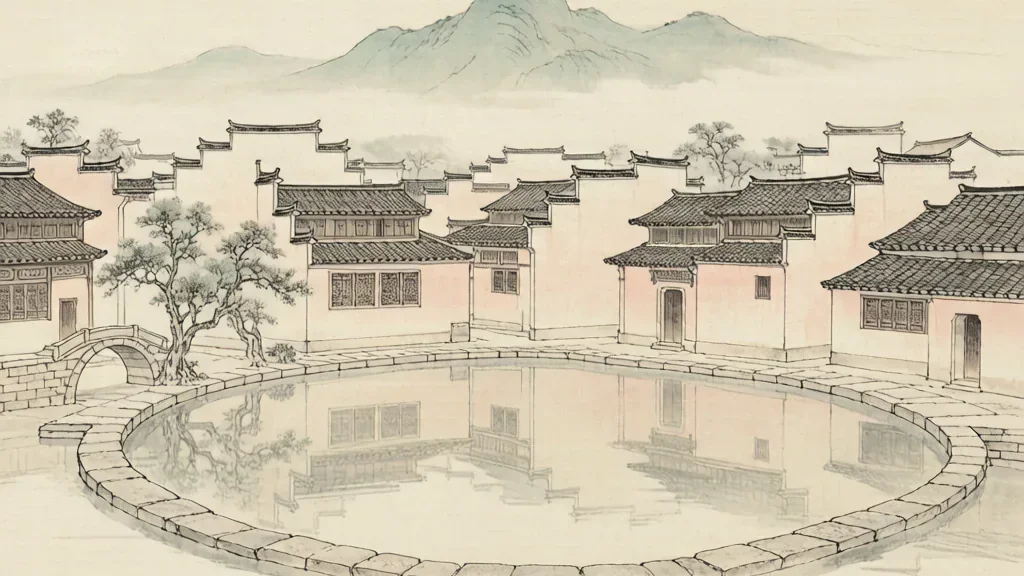
Deep in the rolling hills of Anhui province in eastern China sits a village that looks as though it floated up from a painter's scroll. This is 宏村 (), Hongcun, a settlement whose layout is said to resemble a buffalo resting beside its water. Founded more than eight hundred years ago during the Southern Song dynasty, Hongcun is one of the finest surviving examples of a traditional Chinese village built in harmony with water, family, and feng shui. Its calm ponds, arched bridges, and whitewashed houses with dark tiled roofs have made it a favorite subject for artists and, more recently, a UNESCO World Heritage site that draws visitors from around the world.
A Village Shaped Like a Buffalo
The most famous thing about Hongc2un is its plan. According to local tradition, the village was laid out to mimic the form of a buffalo, an animal prized in farming country for its strength and patience. The nearby Leigang Hill forms the head, two ancient trees stand as the horns, the twisting streams and canals of the village are the intestines, and the wide South Lake at the southern edge is the belly. The houses cluster as the body, and a system of water channels runs through the settlement like a living circulatory system. Whether or not the founders intended every detail, the metaphor captures something true: Hongcun is a village organized around water as intimately as a buffalo is bound to the fields it works.
This water system is the village's real masterpiece. In the early fifteenth century, a member of the influential Wang clan reorganized the streams so that spring water was channeled through the settlement in narrow channels, providing every household with clean water for drinking, washing, and fighting fires. At the center lies the half-moon shaped Moon Pond, around which the oldest houses gather. The engineering was practical, but its effect was also beautiful, turning daily necessity into a continuous aquatic mirror in which the architecture quietly doubles itself.
The Wang Clan and the Power of Family
Hongcun was built and sustained by the Wang family, one of the great lineages of Huizhou, the cultural region that produced some of imperial China's most successful merchants and most respected scholars. In the Ming and Qing dynasties, Huizhou merchants grew rich trading tea, salt, and timber, and they poured their wealth back into their home villages in the form of elaborate ancestral halls, fine residences, and strict schools. Hongcun preserves more than a hundred of these old dwellings, many dating from the Ming and Qing periods, with carved timber doors, lattice windows, and the famous horse-head walls whose stepped gables were meant to prevent the spread of fire and to signal the status of the household.
The ancestral hall, called Jingtang, sits at the heart of village life. Here the Wang clan gathered to honor their forebears, settle disputes, and instruct the young. In a society that placed family loyalty above almost everything else, such halls were the true centers of government, more decisive in daily life than any distant court. Walking through Hongcun, one feels that the village was designed less for individuals than for a family stretched across generations, living and dead.
Architecture in Black, White, and Gray
The visual signature of Hongcun is its restrained palette. Walls are whitewashed, roofs are capped with dark gray tiles, and the horse-head gables step upward in clean lines. Wooden brackets and window lattices are carved with scenes of scholars, immortals, and flowers, but the overall impression is calm rather than ornate. This is the Huizhou aesthetic: refined, scholarly, and quietly confident. The houses turn their finest faces inward, toward private courtyards, while the street facades remain plain. Privacy and family intimacy mattered more to the residents than outward display to passersby.
Within the houses, a central hall served as the gathering space, flanked by bedrooms and studies. A small skywell admitted light and rain, the latter being welcomed as a sign of accumulated wealth. Furniture was modest by the standards of imperial palaces, but the craftsmanship was exacting. The result is a domestic architecture that feels both humble and dignified, an everyday expression of values that valued learning, thrift, and continuity over show.
South Lake and the Painter's Eye
The South Lake was added in the early nineteenth century, when the village expanded southward. Its long rectangular surface, crossed by a slender causeway, is the single most photographed view in Hongcun, especially at dawn when mist softens the reflections. For generations of art students, the lake and its backing of old houses have been a classroom without walls, a place to learn composition by copying reality. The village's reputation as a living painting is not marketing; it is the literal experience of standing at the water's edge and watching a five-hundred-year-old streetscape dissolve and reassemble in still water.
The lake also performs a practical role, storing water and regulating the microclimate so that summer evenings in the village stay cooler than the surrounding countryside. Beauty and utility, as so often in Chinese design, were never separated. The founders would have been puzzled by the modern idea that something useful cannot also be beautiful, or that a village plan might ignore the spirits of place and water.
Hongcun Today: Heritage and Life
In 2000, UNESCO listed Hongcun together with the nearby village of Xidi as World Heritage sites, citing them as exceptional surviving examples of traditional village settlements and a remarkable integration of houses, streets, and water systems within a striking natural setting. The recognition brought tourists, and with them both income and pressure. Some residents have left for cities, while others run guesthouses and shops. The challenge now is to keep Hongcun a living community rather than a frozen stage set, to let laundry still hang and chickens still scratch even as cameras click.
What makes Hongcun worth protecting is precisely that it is not a museum but a home, one whose logic visitors can still read in the water at their feet. The buffalo metaphor endures because the village still breathes with the rhythm of its streams. To walk it slowly, away from the main pond, is to find ordinary life continuing inside an extraordinary design, which is the rarest kind of heritage there is.
How to Visit Hongcun
Hongcun lies in Yi County, Anhui, and is reached via the city of Huangshan, itself a famous destination. Many travelers combine a visit to the village with an ascent of Mount Huangshan to the north. Arriving early or staying overnight lets you see the village before tour groups arrive, when the light on the South Lake is softest and the only sounds are water and birds. Comfortable shoes are essential, as the lanes are paved with uneven stone.
Bring a sketchbook if you have one. Hongcun has inspired painters for centuries, and there is no better way to understand its proportions than to try, however clumsily, to copy them. Even a few lines will teach you what the Wang clan understood centuries ago: that a village, properly placed, can be as composed as any poem.
Hongcun in the Huizhou Cultural World
Hongcun cannot be understood in isolation, for it is a product of Huizhou, the cultural region of southern Anhui that produced some of imperial China's most successful merchants and most respected scholars. From the Ming onward, Huizhou traders grew rich moving tea, salt, timber, and pawnbroking across the empire, then poured their wealth back into ancestral halls, fine houses, and water works at home. The result was a landscape of villages, Xidi among them, built to display learning and family standing through restrained, scholarly architecture. Hongcun is the most famous of these, but it shares with its neighbors a belief that a village is first a statement of lineage and second a place to live. To see Hongcun is therefore to see the values of an entire merchant civilization carved in stone and water.
Living Traditions: Food, Rites, and the Year
Beyond its famous ponds, Hongcun remains a working community with rhythms older than tourism. At the Jingtang ancestral hall, the Wang family once gathered to honor forebears and settle disputes, and ancestor rites still mark the calendar in surrounding villages. The kitchen hearth matters as much as the courtyard: Huizhou cooking, with its salty stews and preserved vegetables, fed merchant families through long winters. At Lunar New Year the lanes fill with red lanterns and the sound of visiting kin, while daily life continues with washing at the channel edges and the slow business of maintenance. These unremarkable routines are what keep the buffalo metaphor alive; the village breathes not because it is preserved but because people still keep its water, its halls, and its festivals.
❓ Frequently Asked Questions
📝 Chinese Vocabulary
宏村 — : Hongcun, the village whose name suggests breadth or greatness.
南湖 — : South Lake, the rectangular lake at the village's southern edge.
月沼 — : Moon Pond, the half-moon pool at the village center.
马头墙 — : Horse-head wall, the stepped gable that marks Huizhou houses.
徽州 — : Huizhou, the cultural region that produced the village's merchant-scholars.
雷岗山 — : Leigang Hill, the rise north of the village that forms the head of the buffalo in local lore.
敬堂 — : Jingtang, the Wang clan's ancestral hall where forebears were honored and disputes were settled.
徽商 — : Huizhou merchants, the wealthy traders whose fortunes built and maintained the village.
🎉 Fun Facts
- The village's spring-water channels were engineered in the fifteenth century to bring clean water past nearly every household door.
- Hongcun and nearby Xidi were inscribed together by UNESCO in the year 2000.
- The horse-head gables of Huizhou houses were designed both to prevent fire from jumping between rooftops and to display family status.
- Generations of Chinese art students travel to Hongcun to paint its reflections, making it one of the most sketched villages in the country.
- Hongcun was founded more than eight hundred years ago during the Southern Song dynasty, making it one of the older surviving villages in the region.
- The South Lake at the village's southern edge was added only in the early nineteenth century, both to store water and to cool the summer air.