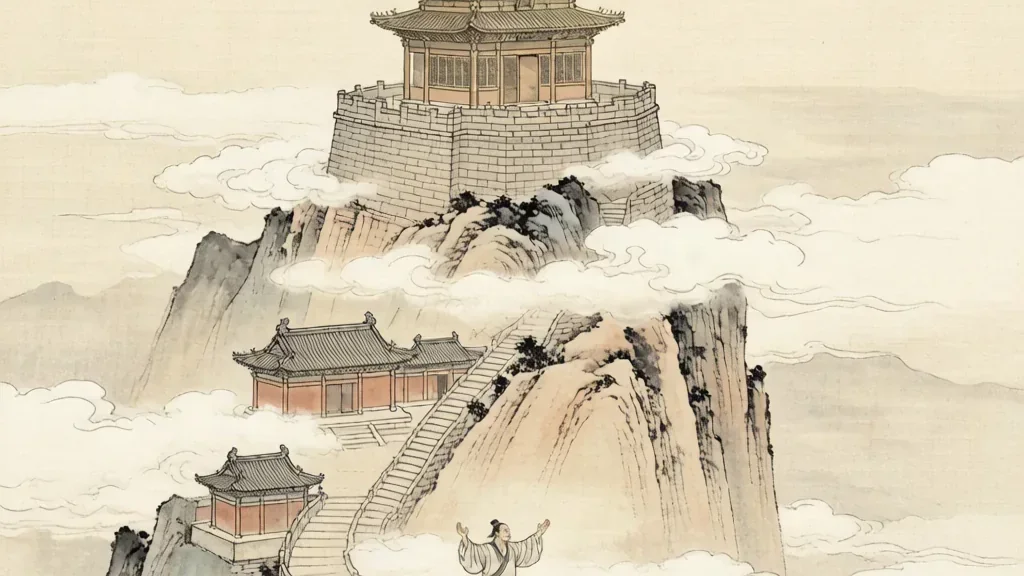
Rising in the northwest of Hubei province, the 武当山 (), Wudang Mountains, are among the most sacred landscapes in China. For centuries they have been the spiritual home of Daoism and the legendary birthplace of tai chi, the slow, flowing martial art practiced by millions today. With their mist-wrapped peaks, ancient temples, and a tradition that joins meditation, breath, and movement into one discipline, Wudang is a place where the Chinese imagination of harmony between humanity and nature took physical shape. It is a UNESCO World Heritage site and a living center of Daoist practice.
A Sacred Mountain of the Dao
Wudang's religious importance grew over many centuries, but it reached its peak in the Ming dynasty. The Yongle Emperor, who came to power in the early fifteenth century after a contested succession, became a great patron of Wudang. He rebuilt and expanded the mountain's temples on a grand scale, reportedly sending thousands of workers to construct a network of monasteries, bridges, and halls linked by mountain paths. The emperor's devotion helped fix Wudang as the leading center of Daoist worship in the empire and a symbol of heavenly approval for his rule.
The mountain's name, Wudang, is often interpreted as meaning "martial or suitable," and the whole landscape was understood as a microcosm of the cosmos. Temples were placed according to principles of feng shui so that the built environment echoed the order of heaven. For Daoist seekers, the remote, cloud-covered peaks were ideal for retreat and cultivation, a place to practice the arts of longevity and communion with the Dao, the ineffable source and pattern of all things.
The Birthplace of Tai Chi
Wudang is best known in popular culture as the cradle of tai chi, or taijiquan, the gentle martial art of flowing movements. Legend attributes its creation to a Daoist monk named Zhang Sanfeng, who is said to have lived in the late Yuan and early Ming periods. According to the story, Zhang watched a crane and a snake in combat and realized that softness could overcome hardness, that yielding could defeat force. From this insight he developed a system of movement based on circular, relaxed motion rather than muscular opposition.
Historians note that the actual evolution of tai chi was more gradual and involved many teachers over centuries, drawing on older Daoist health exercises and martial techniques. What is certain is that Wudang became closely identified with the internal martial arts, styles that emphasize breath, balance, and the cultivation of internal energy, known as 气 (), over brute strength. The Wudang tradition thus stands as a counterpoint to the external, striking styles associated with Shaolin, and the two together frame the Chinese understanding of body and spirit.
The Golden Hall and the Temples
The most famous structure on Wudang is the Golden Hall, a small but dazzling chamber cast in bronze and gilded, perched near the summit of the highest peak. Built in the early fifteenth century under Yongle's orders, it houses a statue of the Daoist deity Zhenwu, the Perfected Warrior, to whom the mountain is dedicated. The hall's metal construction has withstood centuries of mountain weather, and its gleam in sunlight gives the peak its name, the Peak that Reveals the Zhenwu. Pilgrims climb to it as the climax of the sacred journey up the mountain.
Below the summit spreads a chain of temples and nunneries, including the Purple Cloud Temple and the Nanyan Palace built into a cliff face. Each was designed to sit lightly on the slope, framed by pine and cloud, so that worship and landscape became a single experience. The architecture is notable not for size alone but for the way it threads buildings into the living rock and forest, a built expression of the Daoist wish to follow nature rather than dominate it.
Daoist Practice on the Mountain
Wudang remains a working religious community. Daoist priests and nuns keep the daily round of chanting, ritual, and meditation, and many still practice the mountain's martial and health arts. The disciplines taught there range from slow tai chi forms to more vigorous sword and staff routines, all understood as paths of self-cultivation rather than mere sport. Visitors often encounter monks performing forms at dawn on a misty terrace, a sight that captures the mountain's enduring promise that the body can be a vehicle of the spirit.
Training on Wudang is said to balance three treasures: essence, energy, and spirit. The goal is not competition but harmony, the alignment of the individual with the natural rhythm of the world. In this sense the martial art and the religion are one pursuit viewed from two sides, a unity that explains why Wudang has inspired both fighters and seekers for hundreds of years.
Wudang and the World
In 1994, UNESCO listed the Wudang Mountains as a World Heritage site, praising the group of Taoist buildings as representing "the highest standards of Chinese art and architecture" and reflecting the cultural and religious significance of the mountain. The recognition has brought preservation funds and a steady stream of visitors, from scholars to martial arts students who come to train where the art was born. As with other sacred sites, growth brings the challenge of protecting quiet against the noise of tourism.
Wudang's global influence now far exceeds its remote location. Tai chi is practiced in parks and studios on every continent as a form of exercise, therapy, and moving meditation. The mountain thus sends out a gentle but far-reaching message: that strength need not be harsh, that stillness and motion can be the same thing, and that a healthy life is one lived in step with the way of nature.
Visiting Wudang
The Wudang range lies in Danjiangkou, Hubei, reachable by train and bus from cities such as Wuhan and Xi'an. Cable cars ease the climb to the high peaks, but the mountain paths between temples are the real reward for those who can walk them. Early morning, when clouds fill the valleys, is the time the mountain reveals its famous mystery. Modest dress and quiet behavior are appropriate, since this remains a place of worship.
Whether you come to study tai chi, photograph temples, or simply breathe mountain air, Wudang repays a slow pace. Stand at the Golden Hall and look out over layered peaks fading into mist, and you may understand why generations of Daoists chose this place to seek the eternal, and why the soft art born here still moves the world.
The Architecture of Harmony with Nature
Wudang's buildings were placed to follow the mountain rather than dominate it. The Yongle Emperor's great rebuilding in the early fifteenth century set temples, bridges, and halls along the slopes according to feng shui, so that the built environment echoed the order of heaven and the contours of the land. The Golden Hall, cast in bronze and gilded, sits near the highest peak as the climax of the sacred route, while the Purple Cloud Temple and the cliff-built Nanyan Palace thread themselves into rock and forest. This is architecture as a form of respect: structures are sized to feel light against the peaks, framed by pine and cloud, so that worship and landscape become a single experience. The result is a built expression of the Daoist wish to move with nature instead of against it.
Wudang's Enduring Global Reach
Wudang's influence now reaches far beyond its remote range in Hubei. Tai chi, the slow flowing art born here, is practiced in parks and studios on every continent as exercise, therapy, and moving meditation, carrying the mountain's philosophy of softness and balance into daily life worldwide. Scholars and martial arts students still travel to Wudang to train where the tradition began, and the 1994 UNESCO listing brought both preservation funds and steady visitors. The challenge, as at other sacred sites, is to protect quiet against the noise of tourism. Yet the mountain's message travels easily: that strength need not be harsh, that stillness and motion can be one, and that a healthy life is lived in step with the way of nature rather than in struggle against it.
❓ Frequently Asked Questions
📝 Chinese Vocabulary
武当山 — : The Wudang Mountains, sacred Daoist range.
太极拳 — : Tai chi, the slow flowing internal martial art.
道教 — : Daoism, the religion centered on the Dao, the way of nature.
气 — : Qi, the vital energy cultivated in Daoist and martial practice.
张三丰 — : Zhang Sanfeng, the legendary founder of tai chi.
真武 — : Zhenwu, the Perfected Warrior, the Daoist deity to whom the Wudang Mountains are dedicated.
紫霄宫 — : The Purple Cloud Temple, one of the great monastic halls of Wudang.
内家拳 — : The internal martial arts, which emphasize breath, balance, and internal energy over brute strength.
🎉 Fun Facts
- The Golden Hall is made of gilded bronze and has withstood mountain weather for some six hundred years.
- Legend says Zhang Sanfeng conceived tai chi after watching a crane fight a snake, learning that softness defeats force.
- The Yongle Emperor sent a huge workforce to rebuild Wudang's temples in the early fifteenth century.
- Wudang is dedicated to Zhenwu, the Perfected Warrior, a Daoist deity associated with the north and with protection.
- Wudang training is said to balance the 'three treasures' of essence, energy, and spirit, rather than aiming at competition.
- The mountain range lies in Danjiangkou, Hubei, and its mist-filled valleys are famous for revealing their mystery at dawn.