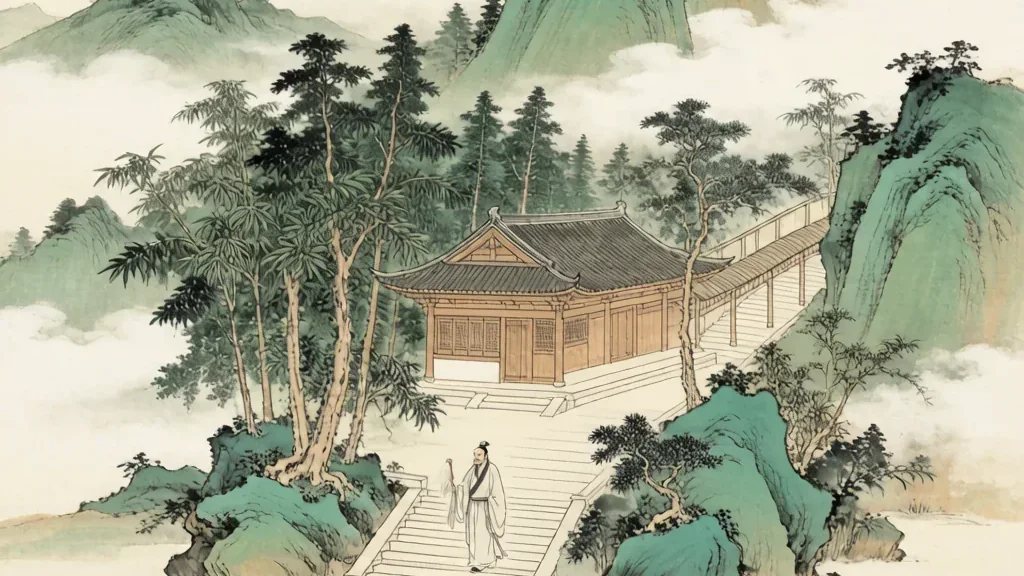
In the misty hills west of Chengdu in Sichuan province rises a mountain so closely tied to the origins of a religion that it is often called its cradle. This is 青城山 (), Mount Qingcheng, the birthplace of Daoism as an organized faith. With its shaded paths, ancient trees, and quiet temples tucked among green peaks, Qingcheng has been a place of retreat and cultivation for nearly two thousand years. Together with the nearby Dujiangyan irrigation system, it is a UNESCO World Heritage site and a living center of Daoist practice.
The Cradle of Daoism
Mount Qingcheng's central place in Chinese religious history comes from the figure of Zhang Daoling, who in the second century of the common era established the Way of the Celestial Masters here. Zhang, a former court scholar, is said to have received a revelation on the mountain and to have founded a community based on the teachings later gathered under the name Daoism. His movement, also called the Zhengyi or Celestial Master tradition, is generally regarded as the first organized Daoist church, distinct from the older philosophical Daoism of texts like the Daodejing.
From this beginning, Daoism grew into one of the great religious systems of China, with its own priesthood, rituals, scriptures, and temples. Qingcheng thus holds a status among Daoists similar to that of a founding shrine, and the mountain has been maintained and rebuilt by generations of followers. The very name Qingcheng, "Green Wall," evokes the forested ridges that enclose the valleys like a living rampart, a fitting home for a faith built on closeness to nature.
The Mountain of Two Halves
Qingcheng is traditionally divided into a front range and a back range. The front, more accessible, holds the major temples and is where most pilgrims and visitors go; the back, quieter and wilder, draws hikers who seek solitude among streams and old growth. This division reflects a Daoist sensibility that values both the formal act of worship and the unstructured communion with the wild. The paths wind through bamboo, cypress, and flowering trees, and stone bridges cross the clear mountain streams that give the place its cool, green character.
The mountain's scenery is famously serene. Poets through the ages have praised its soft peaks and drifting mist, and the temples are built low and dark so as not to disturb the natural calm. Unlike the soaring golden halls of some other sacred sites, Qingcheng's buildings favor wood, stone, and shadow, an architecture of restraint that lets the forest remain the main presence. To walk here is to understand the Daoist ideal of following the natural world rather than reshaping it.
The Founding of the Celestial Masters
Zhang Daoling's community on Qingcheng was remarkable for its organization. It required followers to contribute a small amount of rice and labor, earning the early movement the nickname the "Way of the Five Pecks of Rice." In return, the community offered healing, moral teaching, and a structured spiritual life. The movement spread through Sichuan and beyond, and although it changed greatly over the centuries, its claim to be the original Daoist church gives Qingcheng its founding status.
The Celestial Master line continued for generations, and branches of it survive today, especially in Taiwan and among overseas Chinese. The idea that a single mountain gave birth to so enduring a tradition is a source of deep pride in Sichuan. Qingcheng therefore matters not only as a pretty landscape but as the seedbed of a faith that shaped Chinese medicine, alchemy, art, and the everyday pursuit of a long and harmonious life.
Temples in the Green
The chief temple of the mountain is the Jianfu Palace at the foot of the front range, a calm cluster of halls surrounded by ancient trees. Higher up stands the Tianshi Cave, or Celestial Master Cave, where Zhang Daoling is said to have practiced and taught; it remains the spiritual heart of the mountain and a focus of pilgrimage. Smaller shrines and hermit cells dot the slopes, some reachable only by steep paths, preserving the mountain's long tradition of solitary cultivation.
Daoist priests still live and worship on Qingcheng, performing rites for the well-being of the community and keeping alive the arts of meditation, breathing, and Chinese medicine associated with the mountain. The sound of a wooden fish and the scent of incense among the pines connect today's visitors to a practice nearly two thousand years old. It is this continuity, more than any single building, that makes Qingcheng a cradle in the truest sense.
Qingcheng and Dujiangyan
Mount Qingcheng is inseparable in heritage terms from the Dujiangyan irrigation system a short distance away, built in the third century before the common era by the engineer Li Bing. Dujiangyan tamed the Min River without a dam, using channels and levees to divide and guide the water, and it still irrigates the Chengdu plain today. The pairing of a sacred mountain and a masterpiece of engineering shows the Chinese conviction that the natural and the human, the spiritual and the practical, belong together.
In 2000, UNESCO inscribed both Qingcheng and Dujiangyan as a World Heritage site, noting the mountain's role in the birth of Daoism and the irrigation system's extraordinary longevity as a human-made landscape. The dual listing reminds visitors that Sichuan's green hills and fertile fields were shaped by the same culture that sought the Dao in both of them.
Visiting Mount Qingcheng
Qingcheng lies about sixty kilometers west of Chengdu and is easily reached by train and bus, often combined with a visit to Dujiangyan. A cable car serves the front range for those who prefer it, but the wooded paths are the real pleasure and are manageable for most walkers. The back range demands more fitness and offers deeper quiet. As always at a living religious site, modest dress and a measured voice show respect.
Come in the morning, when mist hangs in the cypresses and the only sound may be water over stone. Whether you know anything of Daoism or not, the mountain speaks its central lesson plainly: that the green wall of the world is older and wiser than our noise, and that to lean against it, even for an hour, is to be restored.
The Arts of Longevity: Daoist Cultivation on Qingcheng
Qingcheng is not only a birthplace of Daoism but a working school of its arts of long life. For nearly two thousand years priests on the mountain have practiced meditation, controlled breathing, and gentle movement to cultivate health and calm, alongside the study of herbs and diet that fed into Chinese medicine. These arts were never separate from worship; they were ways of aligning the body with the natural rhythms the Daoists saw in the forests and streams. Today the mountain's clergy still perform rites for the community's well-being and teach the breathing and healing practices to initiates. For visitors, this living cultivation is the mountain's quiet lesson: that the pursuit of a harmonious, extended life was always as central to Daoism as its temples, and that Qingcheng's true product was not a building but a way of being well.
Qingcheng in Chinese Poetry and Art
Generations of Chinese poets and painters have praised Qingcheng for its soft peaks, drifting mist, and cool green stillness, making the mountain a recurring image in the literati imagination. The Tang poet Du Fu, who lived nearby in exile, wrote of its secluded beauty, and landscape painters favored its layered ridges as a subject that needed no gold or grandeur to feel sacred. The fame rested on restraint: low timber halls, shadowed paths, and the forest kept dominant, an aesthetic that matched the Daoist taste for the unforced. In this cultural afterlife the mountain became more than a religious site; it became a mood, a shorthand for retreat and renewal that artists invoked whenever they wanted to picture the world at peace. Qingcheng thus lives as much in ink and verse as in stone and pine.
❓ Frequently Asked Questions
📝 Chinese Vocabulary
青城山 — : Mount Qingcheng, the "Green Wall" mountain.
道教 — : Daoism, the religion said to have begun here.
张道陵 — : Zhang Daoling, founder of the Celestial Masters.
天师 — : Celestial Master, the title of the Daoist founder and his line.
都江堰 — : Dujiangyan, the ancient irrigation system near the mountain.
正一道 — : The Zhengyi, or Celestial Master, tradition of Daoism said to have begun on Qingcheng.
建福宫 — : Jianfu Palace, the chief temple at the foot of the front range.
李冰 — : Li Bing, the engineer who built the Dujiangyan irrigation system near the mountain in the third century BCE.
🎉 Fun Facts
- Zhang Daoling's early movement was nicknamed the "Way of the Five Pecks of Rice" after its small membership offering.
- Mount Qingcheng and Dujiangyan were inscribed together by UNESCO in the year 2000.
- The Celestial Master lineage founded here continues today, especially among Daoist communities in Taiwan and abroad.
- Qingcheng's temples are built low and dark on purpose, so the forest remains the dominant presence on the mountain.
- The name Qingcheng means Green Wall, evoking the forested ridges that enclose the valleys like a living rampart.
- Daoist priests still live and worship on the mountain, keeping alive meditation, breathing exercises, and the herbal medicine associated with the site.