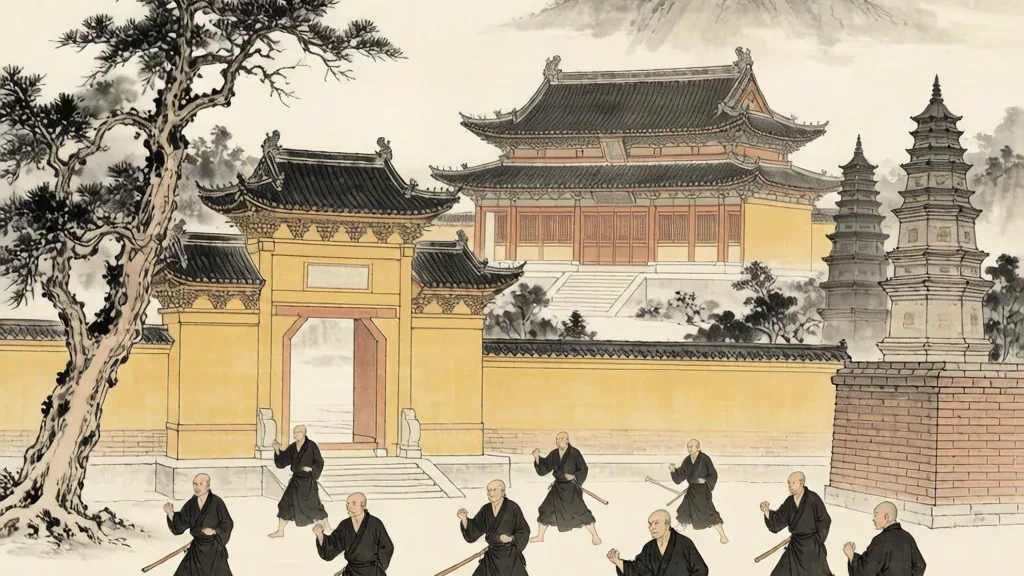
On the northern slope of Mount Song in Henan province stands a monastery that has become a byword for Chinese martial arts across the entire world. This is 少林寺 (), the Shaolin Temple, founded in the fifth century and famed as the birthplace of Chan Buddhism in China and of the fighting style known in the West as kung fu. For more than fifteen hundred years, Shaolin has been a place where meditation and movement met, where monks trained both their minds and their bodies, and where a spiritual discipline grew into a global cultural symbol. To visit is to step into a story that blends legend, religion, and physical skill into something uniquely Chinese.
The Founding of the Temple
According to tradition, the Shaolin Temple was established in the year 495 during the Northern Wei dynasty, when a monk from India named Batuo came to teach, and the emperor granted land for a monastery on the shady slopes of Mount Song. The name Shaolin means "young forest," a reference to the woods that then covered the mountain. Soon after, another Indian monk, Bodhidharma, is said to have arrived and spent years in meditation in a nearby cave. Bodhidharma, known in Chinese as Damo, is credited in legend with bringing the meditation practice that became Chan Buddhism, known in Japan as Zen, and with teaching the monks physical exercises to strengthen bodies grown weak from long sitting.
Whether Bodhidharma truly devised martial arts is debated by scholars, but the legend is inseparable from Shaolin's identity. The monastery's location on Mount Song, one of China's sacred peaks, gave it spiritual weight from the start. Over the centuries it attracted imperial patronage, pilgrim donations, and waves of monks whose discipline made it a center of both learning and defense. Its survival through dynasties of war and persecution is itself a kind of testament to the resilience it teaches.
How Kung Fu Was Born
The popular story of Shaolin boxing holds that the monks, needing to protect the temple and to keep healthy during long hours of seated meditation, developed a system of movement based on observation of animals and on breathing and stance work. They are said to have created forms named after the dragon, the tiger, the crane, the leopard, and the snake, each emphasizing a different quality of strength. The art was passed secretly from master to disciple, refined over generations, and tied always to a moral framework: force was to be used only in defense, and never apart from self-mastery.
Shaolin's martial reputation reached its height in the Tang dynasty, when legend tells of thirteen monk-warriors who helped the founding emperor suppress a rebellion and were rewarded with imperial favor. Whether the tale is exact history or later embellishment, it fixed Shaolin in the national imagination as a place where monks could also be warriors. From then on, the temple's fighting methods spread across China, seeding many of the styles that today fall under the broad term wushu, and influenced countless regional schools.
The Temple Through Tumult
Shaolin's history is also a history of destruction. The monastery was burned and rebuilt more than once, most severely in the eighteenth century when the Qing court, suspicious of the monks' independence and fighting skill, destroyed much of the complex. Many texts and techniques were lost, and the community scattered. Yet the spirit survived in dispersed masters who carried the art to other provinces, and in the oral lineage that kept the forms alive. What visitors see today is largely the result of rebuilding in the modern era, including careful restoration of the main halls and the famous pagoda forest where accomplished monks were buried.
The twentieth century brought new challenges and a surprising revival. As interest in Chinese martial arts spread internationally through film and migration, Shaolin became a global brand. The temple established cultural centers abroad, and young students from around the world began arriving to train. This commercial and diplomatic success has drawn criticism from those who feel the temple has grown too worldly, but it has also funded preservation and introduced millions to Chinese culture. The tension between sacred silence and public spectacle is now part of Shaolin's character.
The Pagoda Forest and the Halls
Among Shaolin's most remarkable features is the Pagoda Forest, a grove of several hundred stone and brick pagodas of varying sizes, each marking the tomb of a respected monk. The forest is a silent record of generations, a kind of stone biography of the monastery written in miniature towers. Nearby stand the main halls where scriptures are chanted and where the great iron wok used to feed hundreds of monks still rests as a reminder of communal life. The Mountain Gate, with its bold calligraphy, announces the threshold between ordinary life and the disciplined world within.
Just outside the temple, the cave associated with Bodhidharma draws pilgrims who wish to sit where the legendary founder supposedly faced a wall in meditation for nine years. The story says that, to stay awake, he cut off his own eyelids, and where they fell tea plants grew, a charming origin myth for the tea drunk in monasteries to this day. Fact or folklore, the cave concentrates the temple's double identity as a place of stillness and of extraordinary effort.
Shaolin in the Modern World
Today Shaolin is both a working Buddhist monastery and a martial arts institution of worldwide fame. The monks perform demonstrations of strength and agility that astonish audiences, from balancing on spears to breaking stone with bare hands, yet the temple insists that the highest skill is inner peace. Training schools in the surrounding town teach thousands of children and foreign enthusiasts the basics of the forms, the stances, and the philosophy. The result is a living tradition that adapts without, its defenders say, abandoning its root in Chan practice.
For the traveler, Shaolin offers a rare encounter with a heritage that is still breathing. The chanting at dawn, the sweat of the training yard, and the quiet of the pagoda forest exist side by side. One leaves understanding that kung fu, at its source, was never only about fighting; it was a path of cultivating the whole person, body and mind together, on a mountain where the forest is still young after fifteen centuries.
Visiting Shaolin
Shaolin lies at the foot of Mount Song near the city of Dengfeng in Henan, reachable by train and bus from major cities like Zhengzhou and Luoyang. The site is compact enough to explore in a day, though a serious student might stay longer. Try to catch a monk demonstration, walk the pagoda forest slowly, and if time allows, climb toward the Bodhidharma cave for a view back over the monastery roofs.
Approach the temple with respect for its living religious role. It is easy to treat Shaolin as a theme park of martial arts, but behind the performances is a continuous practice of meditation and devotion. The best visit balances awe at the physical feats with attention to the quieter discipline that produced them, and remembers that the young forest was always meant to shade a search for stillness.
The Ethics of the Martial Path
At the heart of Shaolin training lies a paradox: a monastery devoted to nonviolence became the wellspring of Chinese fighting. The temple's answer is that the martial arts exist to protect the weak, defend the Dharma, and master the self, never to provoke harm. Every form is taught as a moving expression of discipline, in which strength serves composure rather than pride. This ethical frame distinguishes Shaolin boxing from mere brawling and explains why generations of monks treated combat as a spiritual exercise. The ideal student learns first to still the mind through meditation and only then to move the body with precision, so that force, when it is ever needed, arises from clarity rather than anger. In this way the temple joins two paths that the outside world often separates: the quiet of the cushion and the energy of the training yard.
Shaolin in Popular Culture
Beyond its religious life, Shaolin has become one of the most recognizable names in global martial arts, carried abroad largely through film and performance. From the kung fu movies of the 1970s to modern performance troupes that tour the world, the temple's image of solemn monks performing impossible feats has shaped how millions imagine Chinese culture. This fame brought real benefits: funds for restoration, schools that train foreign students, and a role as an unofficial ambassador of Chinese heritage. It also created tension, as critics warned that commercial spectacle risked overshadowing the monastery's contemplative core. The temple now balances both identities, performing for crowds while preserving its rites. Whatever one makes of the spectacle, Shaolin's popular reach means that a small forest monastery on Mount Song has become, for better and worse, a household word on every continent.
❓ Frequently Asked Questions
📝 Chinese Vocabulary
少林寺 — : Shaolin Temple, the "young forest" monastery.
功夫 — : Kung fu, skill achieved through time and effort.
禅宗 — : Chan Buddhism, the meditation school later known as Zen.
达摩 — : Bodhidharma, the legendary founder of Shaolin meditation practice.
武术 — : Wushu, the broad Chinese term for martial arts.
嵩山 — : Mount Song, the sacred peak in Henan where the Shaolin Temple stands.
塔林 — : The Pagoda Forest, a grove of tomb pagodas of eminent Shaolin monks.
武僧 — : A warrior monk, trained in both Chan Buddhist meditation and martial arts.
🎉 Fun Facts
- The Pagoda Forest at Shaolin contains several hundred tombs, making it one of the largest groups of such pagodas in China.
- Legend says Bodhidharma faced a wall in meditation for nine years in a cave near the temple.
- Shaolin boxing tradition includes animal-inspired forms named for the dragon, tiger, crane, leopard, and snake.
- Mount Song, where Shaolin sits, is counted among the sacred peaks of China and also hosts an observatory used in early astronomy.
- The temple courtyard contains ancient trees said to date from the early centuries of the monastery, including a famous cypress associated in legend with the emperor who founded the site.
- Since the 1970s, Shaolin has been the subject of hundreds of kung fu films and television serials that carried its name around the world and turned the monastery into a global symbol of Chinese martial arts.