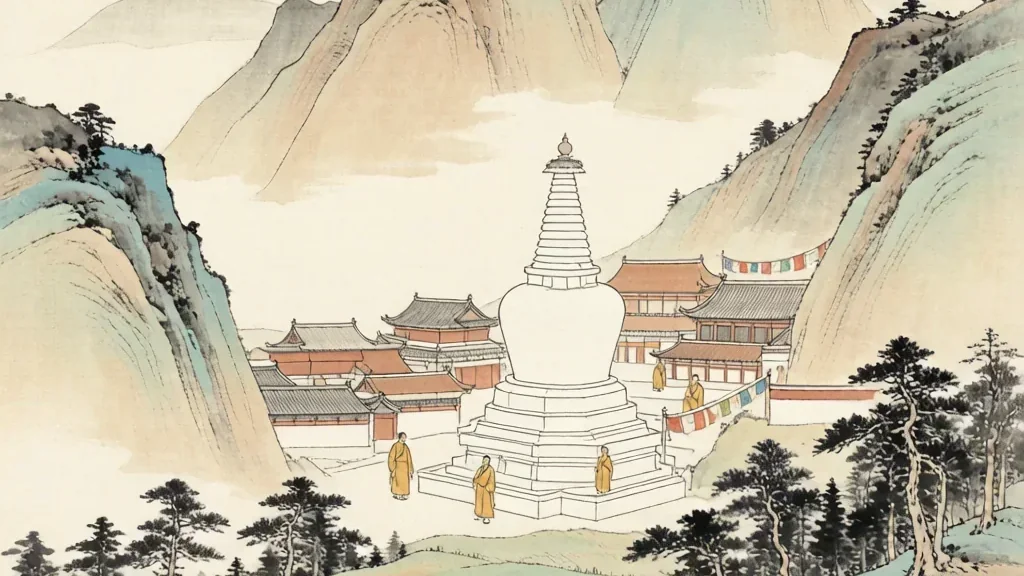
In the northeast of Shanxi province rises a mountain honored for more than fifteen hundred years as the dwelling place of wisdom itself. This is 五台山 (), Mount Wutai, the "Mountain of Five Terraces," one of the four sacred mountains of Chinese Buddhism and the earthly home of Manjushri, the bodhisattva of wisdom. With its cluster of ancient monasteries, its cool high meadows, and its layered history of imperial patronage, Mount Wutai is both a working pilgrimage center and a museum of Chinese Buddhist architecture. It is a UNESCO World Heritage site and one of the most important Buddhist places in East Asia.
The Five Flat Summits
Mount Wutai takes its name from its unusual shape: a group of five broad, flat-topped peaks surrounding a high central plateau. The rounded summits, treeless and windswept, give the mountain its gentle silhouette and its name, "five terraces." The highest of them rises above three thousand meters, and the climate is cool even in summer, which made the mountain a favored retreat from the heat of the plains and a fitting seat for contemplation. The flat tops also made the peaks themselves objects of circumambulation, as pilgrims walked the ridges to accumulate merit.
The mountain's association with Manjushri, known in Chinese as Wenshu, gives it a special intellectual and spiritual character. Manjushri is depicted wielding a sword that cuts through ignorance and holding a scripture, the very image of clear seeing. Devotees have long believed that the bodhisattva manifests on the mountain, sometimes as a glowing light in the sky, a phenomenon known as the "auspicious mist" or halo that pilgrims hope to witness at dawn or dusk on the peaks.
A Center of Pilgrimage for Centuries
Mount Wutai's rise as a Buddhist holy site began in the early centuries of the religion's spread through China and accelerated under imperial support from the Tang dynasty onward. Emperors and empresses donated to its monasteries, and the mountain became a destination not only for Chinese pilgrims but for monks and travelers from Tibet, Mongolia, and as far as India and, later, Europe. Its reputation as a place where wisdom could be sought and realized made it a magnet for scholars and ascetics alike.
The mountain also became a meeting ground of Buddhist traditions. Over the centuries it hosted monasteries of several schools, including Chan, Pure Land, and esoteric or tantric lineages, and it absorbed Tibetan Buddhist practice as well as Han Chinese forms. This blend is still visible today, with both Chinese and Tibetan style temples standing within a short walk of each other, a rare living example of the many streams of Buddhism that have flowed through China.
Temples and Timber
The architectural treasure of Mount Wutai is its collection of monasteries, more than fifty of which survive. Among the most celebrated is Nanchan Temple, whose main hall dates from the year 782 and is the oldest surviving wooden building in China. Nearby stands Foguang Temple, whose great hall, rebuilt in 857, was identified by the pioneering Chinese architect Liang Sicheng in the twentieth century as a masterpiece of Tang dynasty construction. These buildings preserve the bold, capacious wooden brackets and gentle rooflines of a style thought lost, making Wutai a key to understanding Chinese architectural history.
Beyond the famous Tang halls, the mountain is dotted with temples large and small, each with its own icon, legend, and festival. The great monastery of Tayuan holds the white stupa that has become the symbol of the mountain, while Xiantong Temple, one of the largest, displays halls ranging across dynasties. To walk from one to another is to move through a thousand years of devotion expressed in timber, tile, and bronze.
The White Stupa and the Monasteries
The most recognizable landmark of Mount Wutai is the towering white stupa of Tayuan Temple, said to contain a relic of the Buddha and to mark the spiritual heart of the mountain. Pilgrims circle it on their knees or with prostrations, and its pale form against the blue northern sky has come to stand for Wutai itself. The stupa's Tibetan-influenced shape reflects the mountain's role as a bridge between Han and Tibetan Buddhism, a role encouraged by Qing emperors who used the site to honor Mongol and Tibetan religious leaders.
Many of the monasteries remain active, with monks chanting the sutras, tending gardens, and receiving visitors. Some offer simple lodging so that pilgrims can join the rhythm of temple life. The sound of bells and the smell of incense at dusk give the mountain a living quality that pure ruins cannot, and remind the visitor that Wutai is not a monument to a dead faith but a home for a living one.
Mount Wutai as World Heritage
In 2009, UNESCO inscribed Mount Wutai as a World Heritage site, describing it as a sacred landscape with a collection of fifty-three monasteries that illustrate the way Buddhist architecture adapted to a mountainous setting and that embody the devotion of two millennia. The designation recognized both the mountain's living religious role and its unmatched concentration of early wooden architecture, including buildings from the Tang and earlier periods.
The listing also brought responsibility. As a famed pilgrimage site, Wutai faces pressure from development and the sheer number of visitors. Preserving the ancient timber halls while allowing worship and travel to continue is a delicate balance. The hope is that the mountain can remain what it has been for centuries: a high, cool place where people go to seek not comfort but clarity, not sights alone but wisdom.
Visiting Mount Wutai
Mount Wutai lies in northeastern Shanxi, reachable by road from the city of Taiyuan and by air to a nearby airport. The plateau town of Taihuai sits among the temples and serves as a base. Summer is the peak season, when the mountain lives up to its reputation for cool air, but the high meadows and ridges can be cold at any time of year, so bring warm layers. Comfortable walking shoes are essential, as the holy sites are spread across the valleys and peaks.
A good visit combines the famous Tang halls with the lesser temples where daily life continues, and, if fortune allows, a dawn watch on a summit for the fabled halo of Manjushri. Whether or not the light appears, the mountain teaches its lesson quietly: that wisdom is less a thing to be seized than a clarity to be approached, step by patient step, on a path worn smooth by countless pilgrims before you.
The Blending of Buddhist Traditions
Mount Wutai is unusual in bringing together several streams of Buddhism within a short walk. Han Chinese schools such as Chan and Pure Land stand beside esoteric and Tibetan lineages, and both Chinese- and Tibetan-style temples share the same mountain. This blend deepened under the Qing emperors, who encouraged Tibetan and Mongol practice at Wutai to honor the religious leaders of those peoples and to bind the frontier to the court. The result is a living meeting point of Buddhist cultures, where a pilgrim might hear a Tibetan chant in the morning and a Han liturgy by evening. For students of Buddhism, the mountain shows how a single sacred place can hold difference without losing its focus on Manjushri, the bodhisattva of wisdom who gives Wutai its special character.
Why the Ancient Timber Matters
The wooden halls of Mount Wutai are a key to Chinese architectural history. Nanchan Temple's main hall, built in 782, is the oldest surviving wooden building in China, and Foguang Temple preserves a great Tang dynasty hall from 857 that the architect Liang Sicheng identified as a masterpiece of early construction. Before such buildings were studied, scholars feared the bold bracket arms and gentle rooflines of the Tang style had been lost entirely. Wutai keeps them standing, along with more than fifty other monasteries, so that the evolution of Chinese carpentry can be read in timber rather than only in texts. To walk these halls is to meet a building tradition at its source, preserved by a mountain that has sheltered devotion, and builders, for more than a millennium.
❓ Frequently Asked Questions
📝 Chinese Vocabulary
五台山 — : Mount Wutai, the "Mountain of Five Terraces."
文殊 — : Manjushri, the bodhisattva of wisdom.
菩萨 — : Bodhisattva, an enlightened being who helps others.
白塔 — : The white stupa, the mountain's best-known landmark.
寺院 — : Monastery or temple complex.
显通寺 — : Xiantong Temple, one of the largest monastic complexes on Mount Wutai.
佛光寺 — : Foguang Temple, whose great Tang dynasty hall was identified by Liang Sicheng as a masterpiece of early construction.
朝台 — : The practice of circumambulating the five flat peaks to accumulate merit.
🎉 Fun Facts
- Nanchan Temple's main hall, from 782, is the oldest surviving wooden building in China.
- Mount Wutai is one of the four sacred Buddhist mountains of China, each dedicated to a different bodhisattva.
- The mountain's white stupa is believed to enshrine a relic of the Buddha.
- Pilgrims sometimes report seeing a glowing halo, linked to the bodhisattva Manjushri, on the peaks at dawn.
- More than fifty monasteries survive on the mountain, ranging from tiny hermitages to great complexes like Xiantong Temple.
- The mountain's cool high meadows made it a favored summer retreat from the heat of the plains, and a fitting seat for contemplation.