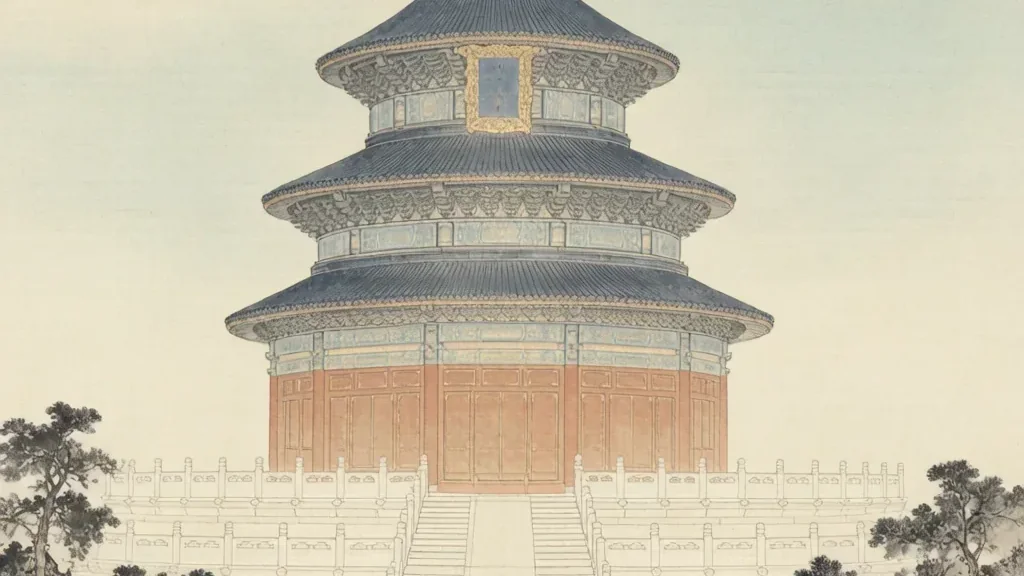
In the southern part of central Beijing stands a walled park of altars, terraces, and circular roofs that was once the most sacred ground in the empire. This is the 天坛 (), the Temple of Heaven, where for nearly five hundred years the emperors of the Ming and Qing dynasties came to pray for good harvests and to commune with the powers of heaven. More than a building, it is a diagram of the Chinese cosmos, where architecture, number, and ritual combined to express the emperor's role as the link between earth and sky. Today it is a UNESCO World Heritage site and one of the most beloved open spaces in the capital.
The Emperor as Son of Heaven
To understand the Temple of Heaven, one must understand the title held by China's rulers: the Son of Heaven. The emperor was believed to govern by the mandate of heaven, and his right to rule depended on maintaining harmony between the human and natural orders. A failed harvest, a flood, or a rebellion could be read as a sign that heaven had withdrawn its favor. The most important duty of the ruler was therefore not warfare but ritual, the performance of ceremonies that kept the cosmos in balance. The Temple of Heaven was the stage for the supreme act of that performance.
The temple was built in the early fifteenth century, shortly after the Yongle Emperor moved the capital to Beijing and began constructing the Forbidden City. While the Forbidden City was the earthly seat of power, the Temple of Heaven was its heavenly counterpart, where the emperor stepped out of his role as political master and into his role as ritual intermediary. The two complexes together expressed a single political theology: that legitimate rule was rule aligned with the rhythm of the skies.
The Hall of Prayer for Good Harvests
The most iconic structure of the Temple of Heaven is the Hall of Prayer for Good Harvests, a triple-eaved circular building mounted on a three-tiered marble terrace. Its blue-tiled roofs rise to a golden finial and are meant to evoke the color of the sky. The hall is built entirely of wood, joined without nails, and its interior columns are arranged to symbolize the seasons, the months, and the hours of the day. On the winter solstice the emperor would come here, or to the nearby Round Altar, to offer solemn prayers for the coming year's grain.
The hall we see today is a reconstruction, for the original was destroyed by lightning in the late nineteenth century and rebuilt according to the old design. Its elegance is no accident; every proportion was chosen to express order. Standing before it, one feels the Ming and Qing architects' conviction that beauty and cosmology were the same thing, that a perfect circle could itself be a prayer.
The Round Altar and the Echo Wall
South of the Hall of Prayer lies the Circular Mound Altar, an open three-tier terrace of white marble where the emperor performed the solemn rite of heaven on the winter solstice. The design is built on the number nine and its multiples, considered the most yang and heavenly of numbers; the central stone, the "heart of heaven," is said to amplify a whisper placed upon it. Nearby, the Imperial Vault of Heaven is enclosed by the famous Echo Wall, a circular wall along which a soft voice carries remarkably far, a playful demonstration of the acoustic care the builders took.
These structures show that the Temple of Heaven was as much an instrument as a monument. The altars were designed to stage sound, sight, and movement in ways that impressed on participants the majesty of heaven and the humility of the ruler. The long raised passage, the Vermilion Steps Bridge, connects the hall and the altars and was reserved for the emperor and the ritual procession, lifting them above the ordinary ground as they moved between earth and sky.
Design Rooted in Cosmos
The whole layout of the Temple of Heaven embodies Chinese cosmological ideas. The northern wall of the park is semicircular and the southern wall square, together forming a shape that echoes the ancient belief that heaven is round and earth is square. The buildings are circular to match heaven, and their colors, especially the deep blue of the roofs, point upward. Even the trees were planted to form a living wall of silence around the sacred core, shielding the rituals from the city's noise.
This was architecture as philosophy made visible. Where a European cathedral might turn the eye toward a distant heaven through height and darkness, the Temple of Heaven turns it upward through open sky and circle upon circle. The message is that heaven is not a far place but the encompassing order of which the emperor and his people are a part, an order to be honored by precise and humble rite.
The Temple After the Empire
When the last emperor was forced from power in the early twentieth century, the rituals of the Temple of Heaven ended. The site was opened to the public as a park, and ordinary Beijingers began to use its shaded walks for exercise, music, and conversation, a role it still fills today. In 1998, UNESCO inscribed the Temple of Heaven as a World Heritage site, describing it as a masterpiece of architecture and landscape design that presents a vivid picture of one of the world's great civilizations at the height of its power.
The transition from imperial altar to public park is itself a kind of quiet revolution. The ground that once admitted only the Son of Heaven now hosts grandparents practicing tai chi and children flying kites. The sacred geometry remains, but its meaning has widened from the legitimacy of one ruler to the shared heritage of a city.
Visiting the Temple of Heaven
The Temple of Heaven sits in a large park in southeastern Beijing, easily reached by subway. Arriving early lets you see both the great buildings and the local life of the surrounding grounds, where groups gather to sing, dance, and play traditional instruments. The walk from the south gate north through the park to the Hall of Prayer follows the imperial axis in reverse and gives the best sense of the original processional design.
Take time to stand at the center of the Circular Mound Altar and feel the open sky above the marble rings. However little one knows of the old rituals, the place communicates its purpose: that human order depends on something greater, and that the highest task of a ruler, or a people, is to live in right relation to the heavens that give the harvest. That is the prayer the temple was built to hold, and it still echoes in its quiet circles.
The Ritual Calendar of the Year
Although the Temple of Heaven is remembered for the winter solstice ceremony, the imperial ritual year was fuller than that single act. Throughout the year the emperor or his representatives performed lesser rites for rain, for the soil and grain, and for the changing seasons, each at its proper altar within the park. The great Hall of Prayer for Good Harvests was the focus of spring prayers, while the Circular Mound Altar belonged to the solstice. These ceremonies were not private devotion but state business: the harmony of heaven and earth was held to depend on their correct performance, and a failed rite could be read as a warning against the ruler. The temple thus functioned as the empire's spiritual clock, marking time not by hours but by the recurring duties of a son who governed under heaven.
Music, Dance, and the Sound of Heaven
The rites at the Temple of Heaven were as much about sound as about sacrifice. Teams of musicians and dancers accompanied the emperor, performing carefully scored music meant to please heaven and to express cosmic order through measured tones and steps. The famous Echo Wall around the Imperial Vault of Heaven shows how finely the builders attended to acoustics, letting a whisper travel the curve of the circular wall. Even the layout of the park was a kind of instrument, shaping the procession of the Son of Heaven from earth toward the sky along the raised Vermilion Steps Bridge. In this conception, right worship was beautiful worship, and the harmony of music mirrored the harmony the rites were meant to secure for the realm.
❓ Frequently Asked Questions
📝 Chinese Vocabulary
天坛 — : The Temple of Heaven, the imperial altar complex.
天子 — : Son of Heaven, the traditional title of the Chinese emperor.
祈年殿 — : Hall of Prayer for Good Harvests, the temple's iconic circular hall.
圜丘 — : The Circular Mound Altar used in the winter solstice rite.
天 — : Heaven, the supreme cosmic power honored at the temple.
皇穹宇 — : The Imperial Vault of Heaven, the circular hall enclosed by the famous Echo Wall.
丹陛桥 — : The Vermilion Steps Bridge, the raised passage linking the hall and the altars, reserved for the emperor.
斋宫 — : The Hall of Abstinence, where the emperor fasted and purified himself before the ceremonies.
🎉 Fun Facts
- The Hall of Prayer for Good Harvests is built entirely of wood joined without nails, a feat of traditional carpentry.
- The park's walls form a square south and a circle north, reflecting the ancient idea that heaven is round and earth is square.
- The Echo Wall around the Imperial Vault can carry a whisper from one side to the other, a clever use of acoustics.
- The original Hall of Prayer was destroyed by lightning in the late nineteenth century and rebuilt to the old design.
- The temple covers about 2.73 square kilometers, roughly twice the walled area of the Forbidden City.
- Before each ceremony the emperor fasted and bathed for three days in the Hall of Abstinence, eating a simple diet to purify himself.