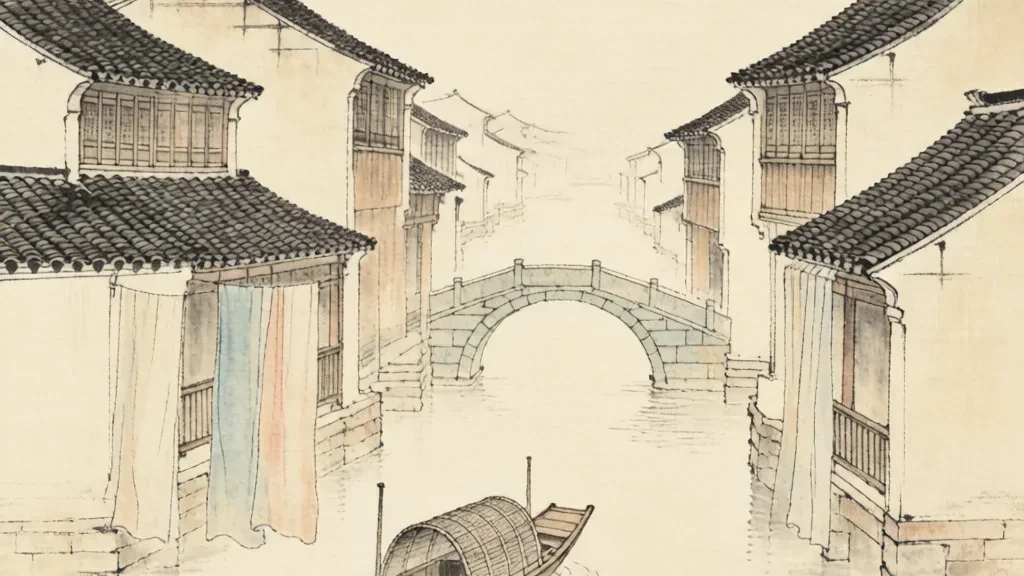
In the flat river country of northern Zhejiang, where canals replace streets and the water mirrors a thousand tiled roofs, lies a town that seems to have paused in time. Known in Chinese as 乌镇 (Wūzhèn), Wuzhen is one of the best-preserved water towns of the Jiangnan region — the "Land South of the Yangzi" that has been the economic and cultural heart of China for a thousand years. With its stone bridges, riverside pavilions, and lantern-lit alleys, Wuzhen distills the romance of the Chinese canal town into a single walkable place. It is at once a living community and a heritage site, where the rhythm of boats and washing lines still belongs to daily life even as the world comes to admire it.
The Geography of Water
Wuzhen sits in a low-lying network of rivers and lakes, part of the dense waterways that connect the Yangzi Delta to Hangzhou Bay. For most of Chinese history, water was the highway of the south, and towns like Wuzhen grew where canals met and goods could be transferred between boat and market. The town is split by a main canal into eastern and western sections, each a lattice of smaller channels lined with whitewashed houses whose foundations dip straight into the river.
This watery setting shaped everything. Streets are narrow because the boat was the cart; roofs overhang the water to shelter goods and passengers; and the famous covered corridors let residents walk dry-shod from one end of town to the other even in rain. To understand Wuzhen is to understand that it is not a town with canals but a town made of canals — a settlement whose plan is dictated by the flow of water rather than the grid of a road.
A Thousand Years of History
Wuzhen's recorded history reaches back more than thirteen hundred years, to the Tang dynasty, when it was already a market town, and it prospered through the Song, Yuan, Ming, and Qing periods as a center of trade in silk, rice, and wine. Its position on the route between Suzhou and Hangzhou made it a natural stopping point for merchants, scholars, and officials. By the Ming and Qing it was a substantial commercial town with guildhalls, temples, and the thick-walled homes of prosperous merchant families.
The town's longevity owes something to its unremarkable but steady role. It was never a capital or a battlefield of the first rank, and so it escaped the catastrophic rebuilding that leveled grander places. Generations simply maintained what their parents built, repairing beams, repaving bridges, and whitewashing walls, until a coherent old town survived almost intact into the modern era — a rarity in a country where so much was remade in the twentieth century.
Architecture: Bridges, Corridors, and Riverside Homes
The signature of Wuzhen is its architecture of water. The riverside houses are built of wood and grey brick, with broad stone steps leading down to the canal where boats tie up and laundry is rinsed. Wooden pilings, blackened by centuries of damp, support the rooms that jut over the stream. Above, the covered walkways — a kind of street-roof offered by generous households — run along the water's edge so that commerce and conversation could continue protected from sun and rain.
Stone bridges arc over every channel, and the most famous, the 逢源双桥 (Féngyuán Shuāng Qiáo), is a paired bridge said to bring good fortune to those who cross it. The town also preserves working examples of traditional industry: old dye houses where blue-and-white cloth was printed, and water-side workshops where you can still see the processes that sustained the town's economy. Together these structures form a complete vernacular vocabulary of the Jiangnan water town, intact enough to read like a textbook.
Culture, Craft, and Famous Sons
Wuzhen was not only commercial; it was literary and artistic. The town claims a place in the history of Chinese theater through the late-Ming playwright Li Yu, and it produced scholars and officials who carried its name into the wider culture. Traditional crafts flourished here — the indigo dyeing of 蓝印花布 (Lán Yìnhuā Bù), the making of wine and of fine foods — and several of these survive as living demonstrations rather than museum pieces.
In recent decades Wuzhen has also become a center of contemporary culture, hosting a well-known international theater festival that draws performers from around the world to its ancient lanes and waterside stages. This pairing of the very old and the very new is characteristic of the town's recent life: it guards its heritage while refusing to become a frozen diorama, using culture as a way to keep the place alive rather than merely preserved.
Food, Daily Life, and the Rhythm of the Canal
Life in Wuzhen still follows the canal's tempo. Early mornings bring boats laden with vegetables and fish; midday sees the kitchens of riverside restaurants steaming with the flavors of Jiangnan — fresh river shrimp, slow-cooked pork, and the sweet rice wines for which the region is known. The town's famous 三白酒 (Sānbái Jiǔ), a local liquor, has been brewed here for centuries and remains a point of local pride.
For visitors, the pleasure of Wuzhen is partly culinary and partly atmospheric. To sit by the water at dusk, with lanterns reflected in the canal and the sound of a distant oar, is to feel the continuity of a way of life that has all but vanished elsewhere. The town's survival offers a quiet argument: that heritage need not be sealed behind glass, but can continue as the setting for ordinary, everyday joy.
Preservation and the Modern Water Town
Wuzhen's present form is the result of deliberate conservation begun in the late twentieth century, when local authorities recognized the value of its intact old town and began careful restoration guided by the principle of "repairing the old as it was." Unlike some rebuilt sites, Wuzhen kept its resident population and working waterways, so that restoration reinforced a living town rather than constructing a stage set. It has since become a model for heritage-led development in the Yangzi Delta.
The town is now a major destination, yet it manages its crowds through timed entry and the sheer spread of its lanes, so that quiet corners remain findable even at peak season. Its success has made it a reference point for how Chinese water towns are presented to the world. In Wuzhen, the past is not a relic to be mourned but a living room in which the present still sits — and that, perhaps, is the truest form of preservation.
The Daily Life of a Canal Town
Wuzhen's charm is not only visual but temporal: it keeps the rhythm of a town that has always lived by the water. At dawn, boats arrive laden with vegetables and river fish, and the kitchens of riverside restaurants begin to steam with the flavors of Jiangnan — fresh shrimp, slow braised pork, and the sweet rice wines for which the region is known. Residents still rinse laundry on the stone steps that dip into the canal, and the covered corridors let them move through the town dry-shod even in rain. This is heritage as ordinary life, not a display behind glass. To sit by the water at dusk, with lanterns reflected in the current and the sound of an oar in the distance, is to feel a way of living that has all but vanished elsewhere in China.
Wuzhen Between Old and New
Wuzhen refuses to be only a relic. In recent decades it has become a stage for contemporary culture, hosting a well-known international theater festival that brings performers from around the world to its ancient lanes and waterside platforms. This pairing of the very old and the very new is the town's distinctive recent character: it guards its heritage while using culture to keep the place alive rather than frozen. The restoration that began in the late twentieth century followed the principle of repairing the old as it was, yet kept residents and working waterways in place, so the town functions as a community and not a diorama. In Wuzhen the past is not mourned but inhabited, and the present still pulls up a chair at the same canal-side table.
❓ Frequently Asked Questions
📝 Chinese Vocabulary
乌镇 — : Wuzhen, a preserved water town of the Jiangnan region in Zhejiang.
江南 — : Jiangnan, the "Land South of the Yangzi," the cultural and economic heart of southern China.
蓝印花布 — : Blue printed cloth, the traditional indigo-dyed fabric of Wuzhen.
逢源双桥 — : The "Twin Bridges of Good Fortune," a famed Wuzhen crossing.
三白酒 — : Sanbai liquor, the local rice wine brewed at Wuzhen for centuries.
水乡 — : A water town or riverine region, built around canals rather than roads.
枕水 — : Literally 'pillowed on water,' describing riverside dwellings whose foundations dip into the canal.
乌篷船 — : The black-awning boat traditional to the canals of the Jiangnan region.
🎉 Fun Facts
- Wuzhen's recorded history spans more than thirteen hundred years, back to the Tang dynasty.
- The town is divided by a main canal into eastern and western sections linked by many stone bridges.
- Wuzhen now hosts a major international theater festival that stages performances along its canals and alleys.
- The town's covered corridors let residents walk dry-shod from one end to the other even in rain, since roofs overhang the water.
- Traditional indigo dyeing of blue printed cloth is still demonstrated in old dye houses as a living craft.
- Wuzhen kept its resident population during restoration, so it remains a working town rather than a stage set.