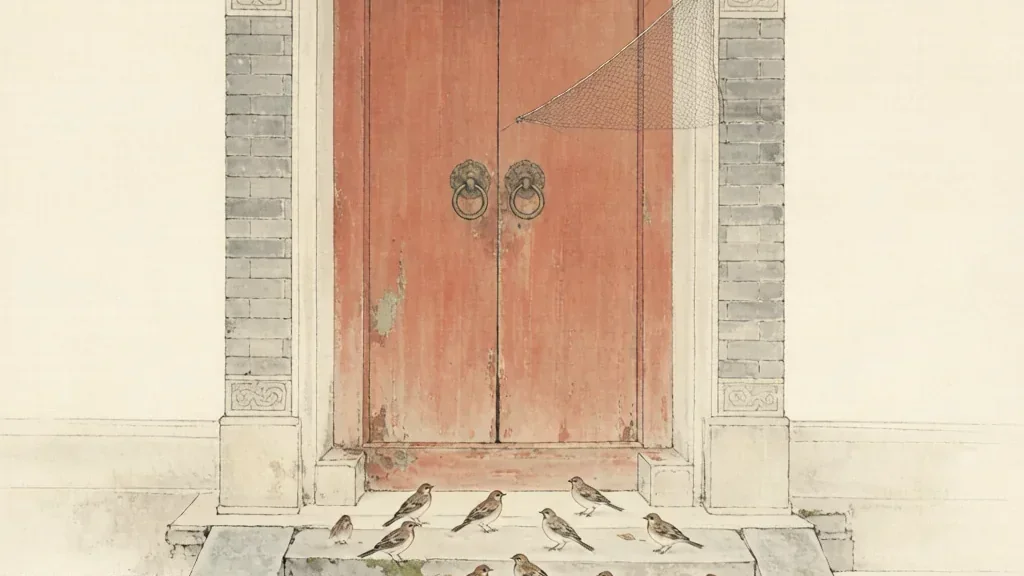
Popularity is a weathervane, and the wind of fortune turns it. The Chinese idiom 门可罗雀 (mén kě luó què) — "at the gate one could net sparrows" — paints a deserted household so empty of visitors that birds settle and can be caught in a net at the threshold. It is the image of a fallen fortune, a forgotten name, a friendless hour. Drawn from the great historian Sima Qian, it captures the fickleness of human acquaintance and the cruel silence that follows lost status. To say a gate "can net sparrows" is to say, with melancholy precision, that no one comes anymore.
The Story in the Records of the Grand Historian
The idiom is rooted in the 史记 (Shǐ Jì, the Records of the Grand Historian) by 司马迁 (Sīmǎ Qiān). In the combined biography of the officials Ji An (汲黯) and Zheng Dangshi (郑当时), Sima Qian observes that when these men held power, their gates were thronged from dawn to dusk with visitors seeking favor; but once they lost office or fell from grace, the same gates stood empty, and sparrows could be netted there.
A closely related anecdote concerns 翟公 (Zhái Gōng), who served as Commandant of Justice. While in office his gateway was never clear of carriages and guests; when dismissed, it was so deserted that sparrows nested in it. When he was later reinstated and the old crowd came rushing back, Zhai Gong had a bitter inscription carved on his gate: "A life and a death show who are true friends; poverty and wealth reveal the ways of the world; high and low expose the real bond."
Sima Qian's point was moral and political. He used the contrast between the crowded gate and the sparrow-net gate to comment on the transactional nature of court society, where visitors flock to power and flee its loss. The image became a permanent emblem of how friendship follows fortune rather than character.
The Characters and the Quiet Gate
The four characters decode as: 门 (mén) "gate" or "household," 可 (kě) "can" or "may," 罗 (luó) "to net" or "to catch with a net," and 雀 (què) "sparrow" (a small, skittish bird). So the phrase literally says the gate is so quiet that one could set a net for sparrows there — meaning no human footfall disturbs them.
The choice of the sparrow is telling. Sparrows are wary, easily startled birds; they will not linger where people come and go. For them to nest or be netted at a gate, the place must be profoundly still. The small, ordinary bird becomes the measure of human absence — a quietly poignant touch.
The verb 罗 (to net) adds a faint absurdity. A gate is for receiving guests, not catching birds; the image of spreading a net there underscores how far the household has fallen from its social purpose. The idiom turns an entrance into a snare, and silence into the only catch.
The Meaning: The Fickleness of Fortune and Friends
At its core, 门可罗雀 mourns the conditional nature of worldly connection. It observes that many "friends" are really followers of status, and that when status departs, they do too. The empty gate is the visible proof of invisible abandonment. The idiom is thus a critique of sycophancy as much as a description of isolation.
It also reflects a deeper Chinese pessimism about the stability of fortune (a theme echoed in sayings about the wheel of fate). To hold power is to be besieged by warmth; to lose it is to be met by cold. The idiom trains the observer to distinguish genuine affection from instrumental friendliness — a skill the wise cultivate early.
Yet there is consolation in the flip side. A quiet gate can also mean peace, integrity, and freedom from the false crowd. Some who "net sparrows" do so by choice, withdrawing from hollow society. The idiom's tone is usually sorrowful, but it can be reclaimed as a badge of honest solitude.
The Opposite: A Gate Thronged With Carriages
The natural antonym of 门可罗雀 is 门庭若市 (mén tíng ruò shì) — "the gate and courtyard are like a market," describing a household so busy with visitors it resembles a bazaar. The pair lets Chinese speakers mark the swing of social fortune in a single contrast: from market to sparrow-net.
This pairing is often used to reflect on life's changes. A retired official, a disgraced celebrity, a closed business — all may watch their gate turn from market to snare. The contrast is not merely descriptive; it carries the moral that the crowd was never really theirs. The market was for the office, the title, the moment — not the person.
Zhai Gong's inscription captures the lesson exactly: only the extremes of life and death, poverty and wealth, reveal who truly stands by you. The sparrow-net gate, painful as it is, performs that revelation. In this light the idiom is less a complaint than a test, harsh but clarifying.
How the Idiom Is Used Today
In modern Chinese, 门可罗雀 describes any place or person fallen into neglect. A once-popular shop now empty, a retired leader no longer visited, a fading trend — all may be called "sparrow-net gates." The phrase is common in nostalgic or critical writing about changing fortunes.
It also appears in personal reflection, especially among the elderly or the retired, who feel the thinning of formerly busy social lives. Used this way it is gently tragic, a way of naming loneliness without melodrama. The birds do the speaking.
In business journalism, the idiom can mark a brand's decline — stores where customers once queued, now quiet enough to net sparrows. Its literary weight lends a sigh of inevitability to market shifts, reminding readers that popularity is seasonal.
A Reflection on the Empty Gate
门可罗雀 is a sobering mirror. We all, at some point, keep company with the crowd because the crowd is there; and we all, at some point, hear the sparrows where the carriages used to be. The idiom asks whether our bonds were ever real, and whether we mistook the noise for the friendship.
Perhaps the healthiest response is Zhai Gong's: inscribe the lesson on the gate. Let the empty threshold teach you who remains, and value those few above the departed many. A quiet gate is not the end of worth; often it is the beginning of truth. The sparrows, after all, ask nothing of you — and in that, they may be the sincerest company of all.
Sima Qian and the Biographer's Eye
The anecdote comes from the Records of the Grand Historian, the great work in which Sima Qian invented the biographical chapter as a literary form. He often opens a life, follows its rise, and then lingers on its fall, and the sparrow-net gate is one of his sharpest devices for that descent. By contrasting the thronged gate of power with its deserted later state, he turns architecture into moral commentary. Sima Qian was himself a man who lost favor and suffered, which may explain his sympathy for the fallen and his keen eye for how friendship follows fortune. Knowing the author's own wounded career helps a reader hear in the idiom not abstract satire but the lived observation of someone who had watched the carriages leave his own gate.
Friendship and Status in Imperial Society
The idiom captures a structural truth about hierarchical societies, where access to a powerful person was itself a kind of wealth. Visitors crowded a gate not for affection but for advantage, and their departure on a fall was rational, not merely heartless. The phrase therefore documents a social economy in which bonds were instrumental, and it asks the reader to distinguish genuine regard from useful proximity. Zhai Gong's inscription hardens this into a maxim: only extremes of life and death, poverty and wealth, reveal true friends. Such candor was unusual and somewhat bitter, which is part of the idiom's power. It names, without flinching, the transactional core of much worldly friendship, and invites a more honest accounting of who really stands by us.
❓ Frequently Asked Questions
📝 Chinese Vocabulary
门可罗雀 — : "At the gate one could net sparrows"; a deserted, friendless household.
门 — : Gate / household; the social entrance that has fallen silent.
罗 — : To net / catch; the absurd image of trapping birds at a doorway.
雀 — : Sparrow; the wary bird whose presence proves human absence.
史记 — : Records of the Grand Historian, the source of the anecdote.
门庭若市 — : The gate and courtyard like a market — the antonym of the empty, sparrow-netted gate.
翟公 — : Zhai Gong — the Han official who inscribed his gate with a bitter lesson on fickle friends.
汲黯 — : Ji An — the official whose fall from favor turned his crowded gate into a quiet one, per Sima Qian.
🎉 Fun Facts
- Sparrows are so wary that their presence at a gate proves no human footfall disturbs it — a poignant measure of absence.
- Zhai Gong's bitter gate-inscription said only life-and-death and poverty-and-wealth reveal true friends.
- The idiom's antonym is 门庭若市 ("gate and courtyard like a market"), the thronged opposite.
- Sima Qian used the image to critique court society, where visitors follow power and flee its loss.
- The sparrow was chosen because it is among the wariest of birds, fleeing at the slightest human sound, so its presence proves a gate has fallen truly silent.
- In traditional painting the empty gate with a single net and a few birds became a recognized motif for lost status and the loneliness that follows it.