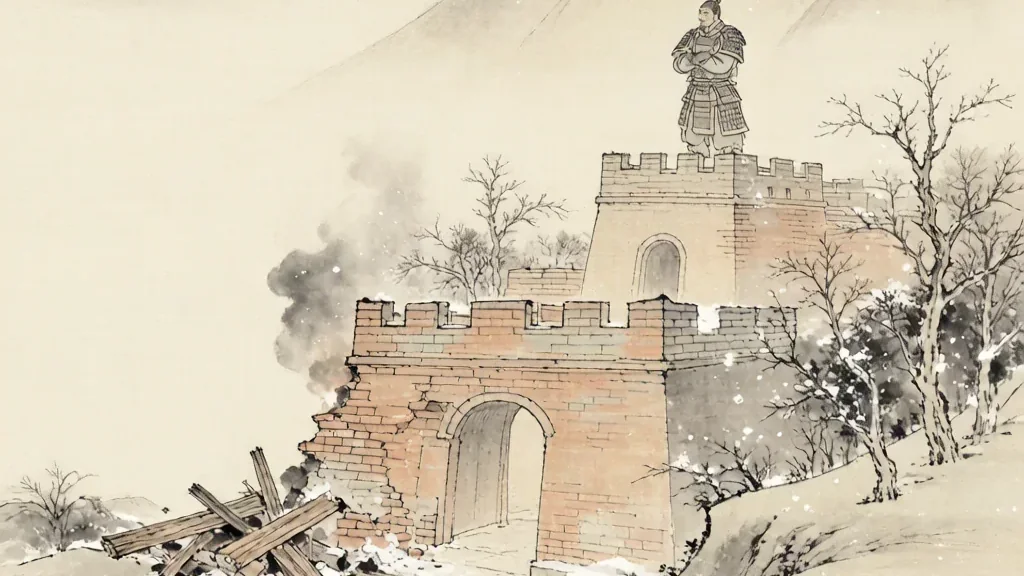
Neighbours who ignore each other's danger rarely survive alone, and the Chinese idiom chún wáng chǐ hán says exactly that with a single shiver. Written as 唇亡齿寒 and pronounced , it means "when the lips are gone, the teeth are cold" — a plain image for a deep truth about interdependence. The teeth cannot feel the wind until the lips that sheltered them are gone; by then it is too late to mourn the lips. For readers new to Chinese culture, this phrase opens a door onto a whole way of thinking in which nothing stands fully alone and the fall of one small state, friend, or ally signals the cold that will soon reach you. In this article we follow the idiom back to a famous warning delivered in the court of a doomed duke, examine its political wisdom, and ask what it means for loyalty, alliances, and everyday life.
The Historical Story
The idiom comes from the Zuo Zhuan (左传), the great commentary on the Spring and Autumn Annals compiled in the fourth century BCE. During the Spring and Autumn period, the state of Jin (晋) wanted to conquer the smaller state of Guo (虢). The only road to Guo ran through a third state, Yu (虞). Duke Xian of Jin (晋献公) asked his adviser Xun Xi (荀息) how to win passage. Xun Xi proposed a bribe: send Yu's ruler precious jade and a team of fine horses, and the greedy duke would surely open the road.
The duke of Yu was tempted, but his minister Gong Zhiqi (宫之奇) objected with desperate clarity. He told the ruler that Yu and Guo were bound together like lips and teeth. "If the lips are gone, the teeth will be cold," he warned. Destroy Guo and Yu would stand exposed, the next morsel for Jin's appetite. The duke, dazzled by the gifts, waved the warning away. Jin's army marched through Yu, crushed Guo, and on its return journey simply absorbed Yu as well. The jade and the horses came home to Jin, and the duke of Yu lost his state. Gong Zhiqi's image entered the language forever.
Literal Meaning and Characters
Each character carries the picture. (唇) is the lip; (亡) means to perish or be gone; (齿) is a tooth; and (寒) is cold. Read in order: lip-perish-tooth-cold. A learner of Chinese quickly notices how the idiom stacks two small clauses — one event, one consequence — to make a single argument about cause and effect. The body supplies the metaphor: lips shield teeth from the air, so their loss is felt at once as chill.
This is classic construction, where a physical fact becomes a moral one. The cold is not only literal; it is the exposure, the vulnerability, the loneliness of the survivor. Chinese political thought loved such bodily metaphors — the realm as a family, the ruler as the head, the people as the limbs — and "lips and teeth" is among the most durable of them. It turns an abstraction ("we are interdependent") into something a child could feel on a winter morning.
The Lesson About Alliance
Gong Zhiqi's warning is, above all, a lesson in strategic honesty. The duke of Yu made a familiar error: he valued a visible gift more than an invisible bond. He could see the jade and the horses; he could not see the protection that Guo silently provided by standing between Yu and Jin. The idiom warns against this kind of shortsightedness in every alliance, whether between states, departments, friends, or nations. To cheer the fall of a neighbour you dislike is to invite the wind onto your own teeth.
History offers the idiom as a quiet rebuke to those who profit from a rival's ruin without reckoning the cost to themselves. In the Zuo Zhuan, the lesson lands because the duke's mistake is so human: he was not stupid, only tempted and unwise. The story implies that wisdom is precisely the ability to feel the cold before the lips are gone — to protect the ally you may not love because your own warmth depends on theirs.
How the Idiom Lives On
Today is used whenever two parties share a fate they fail to see. A small business next to a failing anchor store, a minor power beside a collapsing neighbour, an ecosystem whose loss drags down its companions — all are described with this phrase. Diplomats and commentators reach for it when one country abandons another and soon faces the same threat alone. The tone is solemn, even mournful, because the idiom always describes a loss that was foreseeable and is now irreversible.
In personal life, people use it to describe friendships and families. A sibling who ignores another's trouble may later discover that the whole family's shelter is gone. The phrase carries a moral weight: interdependence is not weakness but survival, and denying it is a form of self-betrayal. Unlike more boastful idioms, this one teaches through regret rather than triumph.
Contrasts and Companions
The idiom belongs to a family of phrases about relationship and consequence. (相依为命, "depending on each other for life") celebrates the bond positively. (为渊驱鱼, "driving fish into deeper water") warns against pushing allies toward the enemy. Together they map a Chinese understanding of politics as a web, not a ladder — a view that prizes the health of the whole net over the gain of a single knot.
Studying alongside these companions helps a learner grasp how classical China imagined society. The individual was rarely the hero of the story; the relationship was. To know your place in the web, and to defend the threads that shelter you, was a primary form of wisdom. The cold teeth are a permanent reminder of what happens when that wisdom fails.
A Closing Reflection
There is comfort as well as warning in . If our welfare is bound to others', then protecting them protects us, and kindness is not only moral but pragmatic. The duke of Yu lost everything because he could not feel that bond; we can choose otherwise. To live by the idiom is to notice the lips before they vanish, to stand with the neighbour whose fall would chill us too. In a divided world, a phrase from a twenty-six-hundred-year-old court dispute still whispers the same counsel: no one is warm alone for long.
The Three States of the Tale
The idiom gains force from a concrete triangular drama among three Spring and Autumn states. Jin was the great power, ambitious and armed. Guo stood between Jin and the smaller state of Yu, whose territory offered the only convenient road to Guo. Duke Xian of Jin won passage through Yu with gifts of jade and fine horses, conquered Guo, and then absorbed Yu on the way home. The geography is the point: Yu's safety depended entirely on Guo's survival, a fact the duke ignored for the sake of a bribe. Knowing these three players turns an abstract warning about interdependence into a crisp political chess game that Chinese readers have remembered for more than two thousand years. The triangle of Jin, Guo, and Yu is a compact lesson in how neighbors rise and fall together.
Bodies as Metaphors for Society
Chun wang chi han belongs to a long classical habit of describing the state through the human body. The ruler was the head, the people the limbs, and here the states are lips and teeth, parts whose welfare is literally shared. This bodily language made abstract politics feel intimate and physical, the kind of thing a child could understand from a winter morning. Other phrases in the same family speak of heart and belly, or of one part aching when another is struck. Together they show a society that imagined itself as an organism, where no part can be harmed without the whole feeling the cold. The idiom is thus a small example of how Chinese political thought turned metaphysics into flesh and blood. To speak of lips and teeth was to make the abstract fate of states felt in the body.
❓ Frequently Asked Questions
📝 Chinese Vocabulary
唇亡齿寒 — : when the lips are gone, the teeth are cold; interdependence.
唇 — : lip.
齿 — : tooth.
宫之奇 — : the Yu minister who uttered the warning.
左传 — : the Zuo Zhuan, the classic commentary that records the tale.
虞 — : The state of Yu, whose ruler accepted bribes and was swallowed by Jin after Guo fell.
虢 — : The state of Guo, the neighbor whose destruction left Yu exposed to Jin.
晋 — : The state of Jin, the dominant power that used Yu's road to conquer Guo and then Yu itself.
🎉 Fun Facts
- The story is set in the Spring and Autumn period, more than 2,600 years ago, in the struggle among the states of Jin, Yu, and Guo.
- The bribe of jade and horses was so famous that the very objects are said to have "returned home" to Jin after both small states fell.
- The idiom is still taught to Chinese diplomats and students as a caution about abandoning allies.
- "Lips and teeth" is one of several body-part metaphors (heart, limbs, head) used in classical Chinese political writing.
- The jade-and-horses bribe behind the story is echoed in another idiom, using the road to destroy Guo, about exploiting a neighbor's passage for betrayal.
- Farmers in northern China still use the saying in daily speech to warn a neighbor that harming the other party only hurts both in the end.