There is a kind of strength that is mostly appearance. A loud voice, an imposing presence, a single dramatic move repeated whenever challenged. As long as no one tests the strength, it functions as strength. The voice intimidates. The presence overawes. The single move — the kick, the threat, the dramatic gesture — drives off anyone who does not stay to examine it closely. But the moment someone does stay, the moment someone watches carefully and refuses to be frightened by the first show, the strength is revealed for what it is: a small repertoire, performed loudly, covering a core of helplessness. The Chinese idiom 黔驴技穷 (Qián lǘ jì qióng), "the Guizhou donkey exhausts its tricks," describes the moment of that revelation, and the fable behind it is one of the most psychologically sharp in the classical tradition.
The tale comes from the writings of Liu Zongyuan (柳宗元), one of the great prose stylists of the Tang Dynasty. Liu lived from 773 to 819 CE, and he was a master of the fable — short, allegorical stories in which animals stood in for human types and political situations. His "Three Fables" (三戒) are considered minor masterpieces of classical Chinese literature, and the story of the Guizhou donkey is the most famous of the three. It is a story about appearance and reality, about the cost of bluffing, and about the patient intelligence of those who watch before they act.
The Donkey That Should Not Have Been There
Guizhou (贵州) is a mountainous region in southwest China, in Liu Zongyuan's time a frontier province of forests, gorges, and wild things. There were no donkeys in Guizhou. The terrain was wrong for them, the work did not call for them, and the people of the province had no tradition of using them. So when, the story tells us, a certain "busybody" — a man with more money than sense — decided to ship a donkey to Guizhou by boat, the animal was a genuine novelty. It arrived in the province with no purpose, no role, and no natural predators who knew what to make of it.
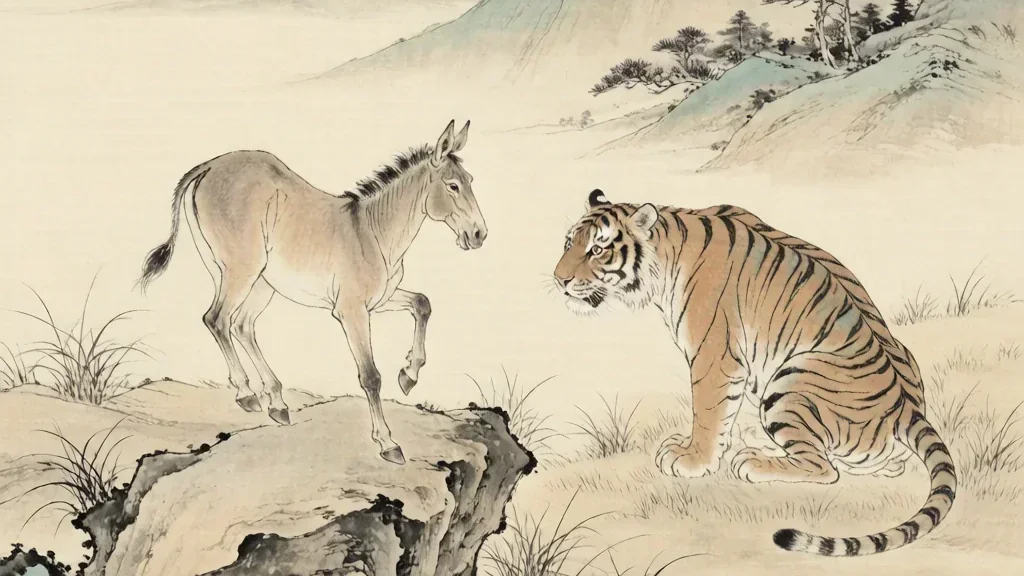
The donkey was set down in the foothills at the edge of the forest. The busybody, having no real use for it, left it there to graze. And there, in the foothills, the donkey was discovered by a tiger.
The tiger had never seen a donkey. He had never seen anything like it — the long ears, the gray coat, the strange, braying voice, the heavy hooves. From the tiger's point of view, the donkey was an unknown quantity, and unknown quantities, in the wild, are dangerous. The tiger, who was the apex predator of those foothills and feared nothing he understood, found himself afraid of this strange creature. He hid in the trees and watched.
The Tiger Who Watched
This is where the story becomes interesting, because Liu Zongyuan's tiger is not a foolish animal. He is a careful, intelligent predator who understands that the unknown must be investigated before it is engaged. He does not attack. He does not flee. He watches. He circles at a distance. He observes.
What he sees, at first, is alarming. The donkey is large. The donkey is loud — its bray, when it lets one out, echoes through the trees with a horrifying resonance. The donkey's hooves, when it stamps, strike the earth with a heavy thud. To a tiger who has never encountered such a creature, these signs suggest power. The tiger retreats further into the forest, genuinely uncertain whether this strange beast might be dangerous.
But the tiger keeps watching. Days pass. The donkey grazes. It brays. It stamps. And slowly, the tiger begins to notice something. The donkey's behavior is always the same. It grazes. It brays. It stamps. When birds startle it, it brays. When insects bother it, it stamps. When the tiger shows himself at the edge of the trees, the donkey brays and stamps. There is no other move. There is no hidden capacity. The donkey, the tiger begins to suspect, is a creature of one or two tricks, repeated endlessly.
The Testing of the Donkey
Now the tiger grows bolder. He comes closer. He circles the donkey at a shorter distance. He approaches, retreats, approaches again — testing, probing, looking for any response beyond the bray and the stamp. The donkey, alarmed by this closer attention, does the only thing it knows how to do. It brays louder. It stamps harder. And finally, when the tiger comes close enough to touch, the donkey unleashes its ultimate weapon: it kicks.
The kick is powerful. A donkey's kick can break a man's ribs. It can shatter the jaw of a wolf. The donkey, in delivering this kick, is using the strongest move in its limited repertoire — the move that, in its old life, drove off dogs and wolves and small threats. It is the donkey's equivalent of going all in.
And the tiger, watching the kick land on empty air a few inches from his shoulder, understands everything. The kick was the donkey's best. The kick was the donkey's last. The donkey has nothing else. The bray was a bluff. The stamp was a bluff. The kick was the truth behind the bluff — and now that the truth has been shown, the donkey is, in the tiger's calm assessment, simply meat.
The story ends as it must. The tiger leaps. The donkey, which has exhausted its tricks, cannot defend itself. The tiger eats well that night, and the strange beast shipped from far away is never seen in the foothills of Guizhou again.
The Politics of the Empty Repertoire
Liu Zongyuan's fable was political. He was writing during the Tang Dynasty, a period when provincial officials were often sent from the capital to govern regions they did not understand, armed with credentials they had not earned and bluffs they could not back up. These officials, in Liu's eyes, were the donkeys of Guizhou — strangers in unfamiliar territory, surviving on the strength of their unfamiliarity, terrifying the locals with their braying and stamping until someone patient enough to watch them closely realized that they had, in fact, no real ability at all.
The tiger, in this reading, is the careful observer — the local official, the wise counselor, the patient rival who refuses to be intimidated by appearances and who, through steady observation, comes to understand the true measure of the person in front of him. The fable's warning is dual: to the donkey, it says that a limited repertoire will eventually be exposed. To the tiger, it says that patience and observation are more powerful than aggression. The donkey does not lose because it is weak. It loses because it relies on a few tricks that, once seen, can be evaded. The tiger does not win because it is strong. It wins because it watches long enough to learn.
Why the Idiom Endures
黔驴技穷 has lasted because the situation it describes is eternal. Every workplace has its donkey — the colleague whose impressive title and loud voice disguise a narrow set of skills that, once examined, cannot sustain the position. Every negotiation has its donkey moment, when one side reveals that its threats were empty and its position was weaker than it appeared. Every political career has its donkey moment, when a candidate who seemed formidable on the stump is exposed in debate as a person with one speech and no policy. In each case, the exposure is not the result of malice. It is the result of someone, somewhere, finally watching long enough to see the whole repertoire.
The idiom's quiet wisdom is that real strength does not need to be advertised. A creature with genuine ability does not bray or stamp or kick at every provocation. It waits. It watches. It acts when action is necessary and not before. The donkey's mistake was not that it lacked the tiger's strength — most creatures lack the tiger's strength. Its mistake was that it relied on the appearance of strength rather than developing any genuine capacity. The kick was real. But the kick was not enough. And the moment the tiger saw the kick, the donkey's entire performance collapsed into what it had always been: a small ability, loudly presented, waiting to be discovered.
In modern Chinese, the idiom is used most often to describe a person, organization, or nation that has revealed the limits of its capability — usually after a period of confident posturing. It is spoken with a mixture of sympathy and finality, as if to say: the show was good while it lasted, but the show is over now. The donkey grazed, and brayed, and stamped, and kicked. And then it had nothing left. The tiger, who had been watching all along, understood this before the donkey did. That, in the end, was the only difference that mattered.
Liu Zongyuan and His Exile
The fable's author, Liu Zongyuan, was one of the finest prose writers of the Tang, but his career was cut short by politics. A supporter of the reformist Wang Shuwen clique, he was purged and banished to Yongzhou in the far south, far from the capital he had served. It was during this long exile, with little to do but observe and write, that he composed the Three Fables. Read in that light, the donkey shipped to a place it did not belong becomes a disguised portrait of the court official posted to a province he could not understand. Liu's wit turns personal grievance into universal satire, and the fable's sharpness comes partly from a man writing far from the power he once advised.
The Tiger's Patience as Method
The tiger is the quiet hero of the fable. Rather than attack from fear or pride, he hides, circles, and watches for days, collecting evidence about the strange newcomer. Only when he has seen the whole repertoire, graze, bray, stamp, kick, does he act. Liu Zongyuan thereby models a form of intelligence that modern strategy calls competitive scouting: do not be impressed by noise, study the pattern until the bluff is exposed. The tiger wins not by being stronger in the moment but by refusing to be rushed. The lesson for observers is as clear as it is for the donkey: most reputations are thinner than they look, and patience is the tool that reveals the truth behind them.
Why the Donkey Amuses Us
Part of the idiom's durability is comic. The donkey is not evil, only out of its depth, and its desperate kick at the end is almost pathetic. We laugh because we recognize the performance of strength, the loud voice, the big gesture, that hides an empty toolkit, and we suspect we have done the same. The fable is kinder than a pure insult because the donkey is also a victim of circumstance, a creature placed where it never belonged. That mix of mockery and recognition is why the phrase survives in daily speech: it names a small, universal vanity, the wish to seem formidable, and the quiet relief of those who finally see through it. The tiger, watching, simply waits for the show to end.
❓ Frequently Asked Questions
📝 Chinese Vocabulary
黔驴技穷 — : "The Guizhou donkey exhausts its tricks" — to be exposed as having limited ability after one's repertoire of bluffs has been exhausted.
柳宗元 — : The Tang Dynasty prose master (773–819 CE) who wrote this fable as part of his "Three Fables."
贵州 — : The mountainous southwestern region where the fable is set — a place with no native donkeys.
老虎 — : "Tiger" — the patient, observant predator of the fable whose careful watching ultimately exposes the donkey.
三戒 — : "Three Warnings" — the title of Liu Zongyuan's fable collection, of which the donkey story is the most famous piece.
黔 — : The ancient name for Guizhou, the southwestern region where the fable is set and which had no native donkeys.
技 — : Skill or trick; the limited repertoire the donkey exhausts when the tiger has seen it all.
穷 — : Exhausted or at an end; the donkey's tricks run out, revealing it has nothing left.
🎉 Fun Facts
- Liu Zongyuan wrote the "Three Fables" while in political exile in Yongzhou, far from the Tang capital — a circumstance that gives the story of the displaced donkey an additional layer of personal meaning.
- The phrase "黔驴之技" (Qián lǘ zhī jì, "the tricks of the Guizhou donkey") is a related idiom that refers specifically to a limited skill set, often used in literary criticism to describe a writer whose range is narrow.
- Guizhou, the setting of the fable, remains a mountainous and biologically diverse region of southwest China — though it now has plenty of donkeys, the cultural association with "the place that had no donkeys" persists.
- The story is sometimes read in Chinese business schools as a parable about competitive intelligence: the tiger's strategy of patient observation before engagement is treated as a model for evaluating an unfamiliar competitor.
- Liu Zongyuan fell from favor at court and was exiled to Yongzhou, and scholars often read his fables, including the Guizhou donkey, as coded commentary on incompetent officials sent from the capital to regions they did not understand.
- A donkey's kick can actually break bones, so the tiger's caution was practical; only after confirming the kick was the animal's final move did he dare to close in.