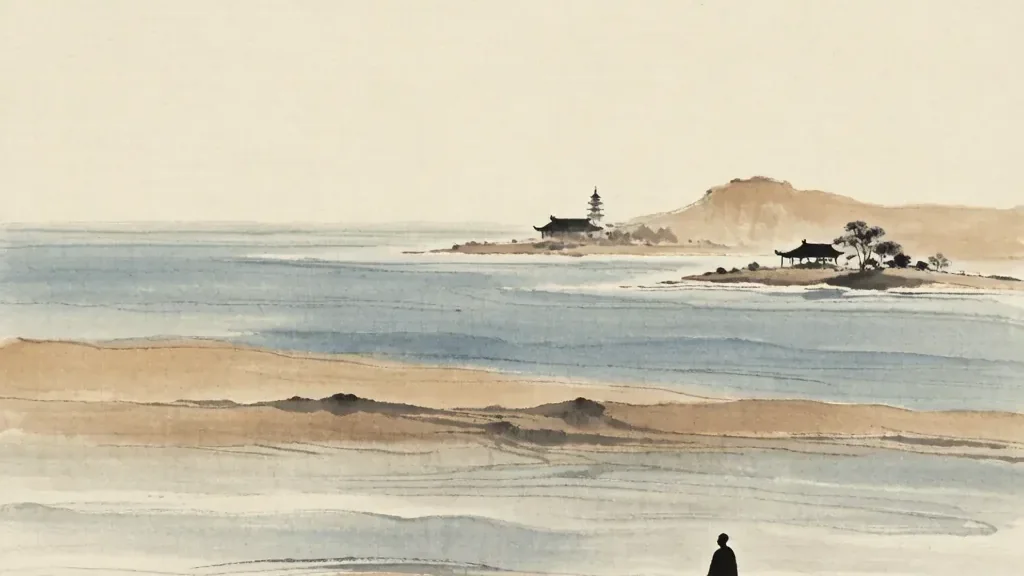
Humility begins at the shore of something vaster than you. The Chinese idiom 望洋兴叹 (wàng yáng xīng tàn) — often rendered "gazing at the ocean and sighing" — comes from the Zhuangzi and tells of the river god who, proud of his own full waters, travels to the sea and there realizes how small he is. The phrase has become the Chinese way to express awe before immensity and a sober recognition of one's own limits. It is not despair but a clearsighted sigh: the task, or the other person's greatness, is simply larger than I am.
The River God and the Sea
The story appears in the "Autumn Floods" (秋水, Qiū Shuǐ) chapter of the 庄子 (Zhuāngzǐ). In autumn, the Yellow River (黄河, Huáng Hé) swells with rain, and its god, 河伯 (Hé Bó), is delighted, believing his was the greatest water under heaven. Following the current east, he reaches the 北海 (Běi Hǎi, the northern sea) and sees vast waters with no end in any direction. There the ocean's keeper, Ruo (若), receives him, and Hebo,对比之下, realizes his former pride was laughable.
Hebo then "gazes" (望洋) and "sighs" (兴叹), acknowledging that having heard the saying "the petty learn of the Way only after seeing the world" he now understands it in his bones. The encounter humbles him not through shame but through scale: he has met a water larger than his river, and his self-importance dissolves.
The tale is a set piece of Zhuangzi's relativism. Hebo's error was not that he was small but that he thought himself complete. The sea corrects the thought, not the size. The idiom thus marks the moment a confident smallness meets a larger truth.
The Characters and a Possible Misreading
The four characters: 望 (wàng) "to gaze toward," 洋 (yáng) "ocean" (or, in some readings, part of the binome 望洋 meaning a look of astonished抬头), 兴 (xīng) "to rise up" (here, to emit a sigh), and 叹 (tàn) "to sigh." The common reading is "gaze at the ocean and sigh."
Scholars note a wrinkle: 望洋 may be a fixed binome describing a wide-eyed, upward look of wonder, not literally "gaze at the ocean." But the popular understanding — reinforced by the story's setting at the sea — treats 洋 as the ocean. Either way, the image is of a small being looking up at immensity and breathing out a sigh.
The verb 兴 (to rise/arise) gives the sigh an active quality; it is not a defeated gasp but an arising response to grandeur. The idiom thus balances awe and acceptance. One does not flee the ocean; one sighs before it, and in the sigh, grows.
The Meaning: Knowing One's Limits
Primarily, 望洋兴叹 expresses the recognition of one's own limitation in the face of something greater — a vast task, a deeper wisdom, a more talented person. It is the opposite of 夜郎自大 (the proverbial boaster who thinks his small state is the world's greatest), which is exactly Hebo's earlier attitude.
The idiom values this recognition. In a culture that also prizes confidence and ambition (the peng's flight), the ocean-sigh supplies the necessary counterweight: know the sea. Zhuangzi suggests that true freedom requires first seeing how small one's river is, so that one stops mistaking the local for the absolute.
It also carries a gentle melancholy. To sigh before the ocean is to admit one cannot cross it, at least not yet. The idiom therefore names a productive helplessness — the kind that precedes learning. Hebo's sigh is the beginning of wisdom, not its end.
Comparison With the Peng and the Frog
The idiom sits in a Zhuangzi constellation. The 鹏 (peng) soars vast and free; the 井底之蛙 (frog in the well) knows only its small world; Hebo the river god learns the sea exists. Together they map three postures: the liberated vast, the confined ignorant, and the humbled learner who has just glimpsed beyond himself.
Hebo is the bridge between frog and peng. The frog cannot sigh because it cannot see; the peng has no need to, having already risen. Hebo does both — he sees the greater and sighs, and in sighing becomes capable of more. The idiom thus captures the transitional, educational moment that the other two images bracket.
This is why the phrase is so useful in learning and growth. Every student, confronting a master or a discipline vaster than their beginners' river, feels the ocean-sigh. Zhuangzi frames that feeling not as failure but as the correct, even necessary, first response to greatness.
How the Idiom Is Used Today
In modern Chinese, 望洋兴叹 is used when facing a task or a person's ability that dwarfs one's own. A small firm before a tech giant's resources, a novice before a master's skill, a reader before a profound book — all may "gaze at the ocean and sigh." The tone is admiring more than defeated.
It also appears in self-deprecation. Confronted with someone's talent, one might say lightly, "I can only gaze at the ocean and sigh," conceding the gap with grace. The idiom lets a person acknowledge inferiority without humiliation — the sigh is respectful, not resentful.
In writing about limits and ambition, the phrase is a counter to hubris. It reminds overconfident "river gods" that a sea exists. Used well, it checks pride without crushing drive: sigh, then learn, then perhaps one day sail.
A Reflection on the Sigh
望洋兴叹 is a gift disguised as a defeat. Hebo's pride was harmless until it met the sea; the sea did not shrink him, it right-sized him. The sigh is the sound of a mind making room for more than it knew. We should welcome such sighs.
The danger is twofold: to be the frog, never seeing the sea, or to be the sigh-er who stops at the shore. The idiom invites the first step — honest awe — but Zhuangzi would push further, toward the peng's flight. Sigh at the ocean, by all means; then learn to sail it. The sea that humbled the river can also become the water that carries you.
Hebo and the Sea God's Dialogue
After Hebo gazes and sighs, the story does not end. The sea god Ruo answers him, and the two discuss why the river god once thought himself greatest and why the sea, though vaster, is still not the whole of things. Ruo points out that the sea is immense compared with the river yet tiny compared with the heaven and earth, teaching Hebo that every measure is relative to where you stand. This exchange turns a private embarrassment into a conversation about the limits of knowledge itself. Hebo's progress, from pride to sigh to dialogue, is the arc Zhuangzi wants readers to feel in their own bones. The ocean is not the finish line but the first true teacher, and the river god's willingness to keep listening is what finally saves him from his earlier folly.
Zhuangzi's Lesson on Perspective
The idiom sits inside Zhuangzi's larger argument about perspective. Hebo's error was not that the Yellow River was small but that he took his local flood for the absolute measure of waters. The sea corrects the scale, and even the sea is corrected by the wider world. The point is relativist: every creature, every opinion, every standard is finite, shaped by where it happens to stand. To 望洋兴叹 is therefore to take the first honest step out of that local trap, acknowledging a greater frame exists. Zhuangzi uses the river god to show that wisdom begins when we stop crowning our own small pond as the universe. The sigh is not weakness but clarity, the moment a limited view meets a larger one and chooses to learn rather than to boast.
❓ Frequently Asked Questions
📝 Chinese Vocabulary
望洋兴叹 — : "Gaze at the ocean and sigh"; awed recognition of one's limits.
河伯 — : The river god whose pride is humbled by the sea.
秋水 — : "Autumn Floods," the Zhuangzi chapter containing the tale.
北海 — : The northern sea; the immensity that humbles the river.
叹 — : To sigh; the respectful response to grandeur.
若 — : The sea god Ruo who receives the river god Hebo at the northern sea and embodies its boundless view.
夜郎自大 — : The boast of the small state of Yelang that thought itself greatest; the exact pride Hebo begins with.
鹏 — : The giant roc whose vast flight Zhuangzi sets against smaller, confined creatures like Hebo.
🎉 Fun Facts
- The tale sits in the "Autumn Floods" chapter of the Zhuangzi, a set piece of philosophical relativism.
- Hebo's earlier pride mirrors the "frog in the well" — both mistake a small world for the whole.
- 望洋 may be a binome for an astonished look, but the sea setting fixes the "ocean" reading.
- The idiom captures the educational moment between ignorance and liberation — the sigh that precedes growth.
- The Autumn Floods chapter opens with Hebo's river-and-sea trip, then widens into a long philosophical debate on perspective and relativity.
- 河伯, Hebo, is a real figure in early Chinese religion, a local lord of the Yellow River worshipped long before Zhuangzi retold his story.