Among the many forms survival that depends on never being examined too closely. The colleague who speaks confidently in meetings but produces nothing. The board member whose advice is sought in good times and ignored the moment a real decision must be made. The expert whose expertise has never been tested by an actual question. As long as the context is large enough and the scrutiny light enough, such a person can thrive. But let the context shrink — let the meeting become a one-on-one, let the board demand a real recommendation, let the expert be asked to demonstrate — and the survival collapses. The Chinese idiom 滥竽充数 (làn yú chōng shù), "filling a number with bad yu-playing," describes exactly this collapse, and the story behind it remains one of the funniest and most uncomfortable in the classical tradition.
The tale comes from the "Han Feizi" (韩非子), the foundational Legalist text written by the philosopher Han Fei in the third century BCE. Han Fei was a brilliant political theorist whose work argued, with relentless clarity, that rulers must build systems that do not depend on the virtue of their ministers — because ministers, like all human beings, will inevitably fake their qualifications when faking is possible. The story of Nan Guo, the fake musician, is one of his most vivid illustrations of why systems must test individuals rather than trust the appearance of competence.
The Orchestra of Three Hundred
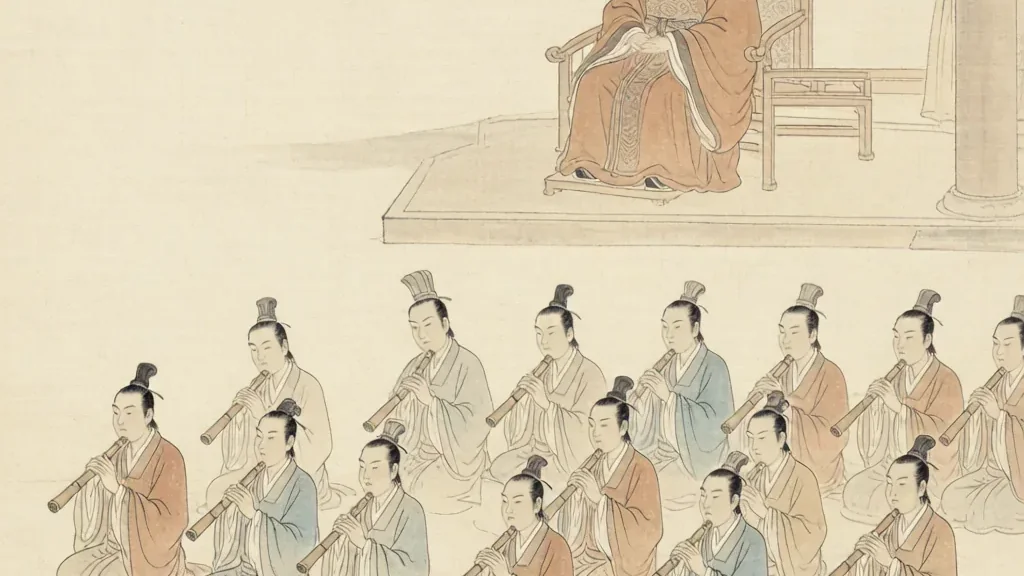
In the state of Qi (齐国), during the Warring States period, there lived a king named King Xuan (齐宣王). King Xuan loved music, and in particular he loved the yu (竽) — a large, complex wind instrument made of bamboo pipes arranged in a frame, something between a panpipe and a small organ. The yu was played at court ceremonies, and its sound was rich and imposing, suited to the grandeur of a royal household. King Xuan did not merely love the yu. He loved hearing it played in vast numbers. His court orchestra, the story tells us, had three hundred yu players — three hundred musicians, all playing together, filling the great hall with a wall of sound.
Into this enormous ensemble walked a man named Nan Guo (南郭). Nan Guo could not play the yu. He had no training, no talent, no ear for music. But he had something more useful than any of those things: he had a sense of opportunity. He understood, with the instinct of a born survivor, that in an orchestra of three hundred, no single player would ever be heard. The sound of the yu, played by three hundred musicians at once, was a great rolling tide in which individual notes disappeared. If a man held the instrument to his lips, moved his fingers on the pipes, and swayed with the rhythm, he would be indistinguishable from the genuine players beside him.
So Nan Guo presented himself at the court, claimed to be a master of the yu, and was duly added to the orchestra. He took his place among the three hundred, lifted his instrument, blew without sound, and moved his fingers over the stops with the practiced earnestness of a real performer. The king, watching from his throne, saw only a sea of musicians playing in unison. The music rose, grand and impressive. Nan Guo swayed with the rest. He received the same pay as the rest. He ate at the same table, wore the same robes, and lived the life of a court musician — all without producing a single note.
The King Who Wanted Solos
And so things might have continued indefinitely. Nan Guo might have lived out his days in comfortable deception, retiring from the orchestra as a respected elder, his secret dying with him. The system that allowed his fraud was stable. The king was happy. The music sounded fine. No one was harmed — or at least, no one who could be identified.
But kings, like all people, eventually die. King Xuan passed away, and his son, King Min of Qi (齐湣王), took the throne. King Min shared his father's love of the yu. But he had one small, fatal difference of preference. King Xuan had loved hearing the yu played in vast ensembles. King Min preferred to hear it played one player at a time. Solo performances, he felt, revealed the true skill of the musician — and the true beauty of the instrument. So shortly after taking the throne, King Min issued an order: the three hundred musicians of the orchestra would, one by one, come before him and play alone.
The order spread through the orchestra. The genuine musicians prepared, perhaps a little nervously, but confident in their training. They had practiced for years. They could play. The command was an opportunity, not a threat — a chance to demonstrate the skill they had honed in the shadow of the ensemble. One by one, they began to step forward.
The Departure of Nan Guo
Nan Guo, hearing the order, understood immediately that his time was up. There was no way to fake a solo. There was no ensemble to hide in, no wall of sound to absorb his silence, no crowd of swaying bodies to mask his still fingers. He would have to stand alone before the king, lift the yu to his lips, and play — and the moment he did, his fraud would be audible to everyone in the hall. There would be no escape, no excuse, no second chance. The system that had protected him for so long had changed, and his survival depended on a skill he had never bothered to acquire.
So Nan Guo fled. The "Han Feizi" tells us, with a dryness that has delighted readers for two thousand years, that he "slipped away and ran." No confrontation, no dramatic unmasking, no punishment — just a quiet, urgent departure in the night, before his turn came. The king never knew his name. The orchestra played on, slightly smaller than before, and the music was, if anything, better for the absence of one silent pipe.
The System That Hides the Incompetent
Han Fei's purpose in telling this story was political and structural, not personal. He was not interested in condemning Nan Guo, who after all was only doing what the system allowed. He was interested in condemning King Xuan, whose love of large ensembles had created an environment in which fraud was not just possible but easy. The fault, in Han Fei's analysis, lay not with the fake musician but with the king who never tested him. A ruler who rewards ministers based on their appearance, their titles, their presence at court — without ever examining their actual work — is King Xuan. And the kingdom he builds will be full of Nan Guos, men who look the part without playing the part, drawing salaries and accumulating influence while contributing nothing.
The cure, Han Fei argued, was King Min's method. Examine each person individually. Test the work, not the worker's costume. Demand solos. The genuine musicians will welcome the test, because the test is their chance to shine. The frauds will flee, because the test is their ruin. A system that never tests its members is a system that subsidizes fraud. A system that tests them regularly is a system that, over time, purifies itself.
Why the Idiom Endures
滥竽充数 has lasted because the situation it describes is universal. Every large organization has its Nan Guos — employees whose work is invisible because the organization is large enough to absorb their non-contribution. Every committee has a member who speaks only when the minutes are being taken. Every academic department has a scholar who has not published in years but whose name still appears on the masthead. Every orchestra, in the broadest sense, has players who hold their instruments but do not play.
The idiom is used in modern Chinese with a characteristic mixture of mockery and self-deprecation. It is spoken of others to describe obvious frauds — the cousin who claims expertise in a field they have never studied, the consultant whose reports could have been written by anyone, the official whose department produces nothing. But it is also spoken of oneself, in moments of honest humility: "I'm just filling a number here," a person might say, acknowledging that they are not yet — or not anymore — earning their place. The phrase carries both the sharp edge of Han Fei's original critique and the softer edge of human self-awareness.
The deepest wisdom of the story may be its quiet observation that fraud is not always a moral failing. Sometimes it is a structural opportunity. Nan Guo did not conquer the orchestra. He was admitted to it. The system that admitted him was the system that allowed him to fake. The lesson, for any leader, is that the size of an ensemble is not a measure of its quality. Three hundred yu players may contain one silent fraud, or ten, or fifty — and the only way to know is to listen to them one at a time. The solos will reveal what the ensemble conceals. And the moment the solos begin, the Nan Guos of the world will, as they have always done, quietly gather their things and slip away before anyone can hear the silence they have been hiding in.
Han Fei and Legalist Theory
The tale is a product of Legalism, the school that distrusted appeals to virtue and trusted instead in clear law and verified results. Han Fei, its great systematizer, used Nan Guo to show why rulers must design institutions that expose the unqualified rather than hope the qualified act from goodness. His argument is almost modern in its mechanics: assume people will free-ride, then build a system where free-riding is impossible to hide. The preference for solo performance over ensemble is, in this light, a method of audit. Readers who know Legalist thought hear in the story a blueprint for bureaucracy done right, where the silent pipe is found not by moral outrage but by a simple change in how music is heard. The idiom is thus political theory wearing the clothes of comedy.
The Yu and Ancient Music
The instrument at the center is no prop but a real and ancient sound. The yu was a large free-reed mouth organ of bundled bamboo pipes, ancestor to the sheng still played in some regions, and archaeology has recovered Warring-States examples with many pipes. Its full, blended tone made a grand court sound, which is exactly why a single silent player could vanish inside it. The choice of the yu matters: an instrument whose richness hides individuals becomes the perfect stage for fraud. Knowing the instrument's actual acoustic and social role deepens the fable, because the joke depends on a real feature of real music. The idiom is, among other things, a wry comment on how collective sound can mask the absent note.
From Court Orchestra to Workplace
The story's move into modern life was inevitable, because every large organization resembles King Xuan's ensemble. A committee member who says nothing of substance, a department whose output no one measures, a hire kept because the team is too big to notice the gap — all are Nan Guo in new robes. Business writers invoke 'King Xuan's orchestra problem' to argue for regular individual review, and employees themselves use the phrase to admit they are still learning a role. The idiom's genius is that it fits both directions: it mocks the pretender and warns the leader who never listens closely. Few classical tales map so cleanly onto the modern office, which is why 滥竽充数 remains a live, slightly uncomfortable word in boardrooms and break rooms alike.
❓ Frequently Asked Questions
📝 Chinese Vocabulary
滥竽充数 — : "To fill a number with bad yu-playing" — to pass oneself off as qualified in a context where individual contribution cannot be easily distinguished.
南郭 — : The fake musician of the parable, whose name has become a byword for incompetence disguised by context.
齐宣王 — : King Xuan of Qi, who loved ensemble yu music and inadvertently created the system that allowed Nan Guo to fake.
齐湣王 — : King Min of Qi, whose preference for solo performances exposed the fraud his father's system had hidden.
竽 — : A large ancient wind instrument made of bamboo pipes, central to the parable's imagery and the source of the idiom's musical metaphor.
滥 — : Excessive or inferior — the 'bad' in 'bad yu-playing,' marking the musician's lack of real skill.
充 — : To fill — as in filling a roster or a number without earning the place.
数 — : Number — the headcount the fake musician pads, the quota that hides individual emptiness.
🎉 Fun Facts
- The yu (竽) that gives the idiom its name was a real instrument of ancient China, similar to the later sheng (笙); examples have been recovered from archaeological sites dating to the Warring States period, some with over thirty bamboo pipes.
- Han Fei, who recorded this story, was himself a victim of the kind of system he critiqued — he was imprisoned and forced to commit suicide by rivals at the court of Qin, despite (or because of) his brilliance.
- The phrase 滥竽充数 is sometimes used self-deprecatingly in modern Chinese workplaces, where an employee might use it to politely deflect praise or to acknowledge that they are still learning their role.
- The story is a favorite in Chinese business commentary, where it is invoked to criticize large companies that fail to evaluate individual employee contributions — described as "King Xuan's orchestra problem."
- The yu described in the tale resembles the later sheng, a mouth organ whose bundled bamboo pipes survive in folk ensembles today.
- Han Fei, who recorded the story, argued that good law makes vice unprofitable, so a ruler who tests individuals needs no faith in ministers' honesty.